



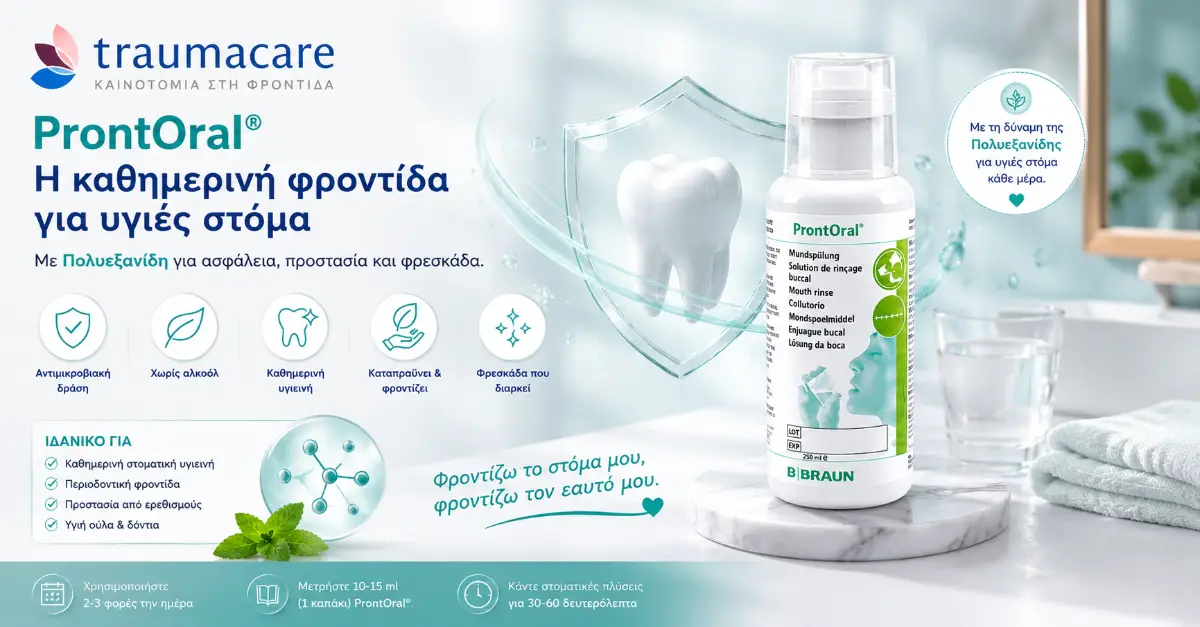
Per decenni, la clorexidina è stata il leader indiscusso nell'igiene orale antimicrobica. Oggi, tuttavia, un'alternativa più potente e ben tollerata, il polihexametilene biguanide (PHMB), sta gradualmente cambiando i protocolli clinici, in particolare laddove l'obiettivo è decolonizzare gli organismi multiresistenti ai farmaci (MDRO) senza i noti effetti collaterali della clorexidina.
ProntOral® dell'azienda tedesca B|Braun è la soluzione di PHMB più completa disponibile in commercio per uso orale. In questo articolo approfondito esaminiamo:
- Come funziona il polihexanide a livello molecolare e cellulare
- Perché l'assenza di clorexidina è un vantaggio clinico, non una concessione
- Quali pazienti ne traggono maggior beneficio
- Come ProntOral® si inserisce in un programma completo di igiene orale, dalla terapia intensiva a casa
Nota di Traumacare: La nostra azienda è il distributore esclusivo dei prodotti B|Braun in Grecia e negli ultimi anni ha monitorato la transizione di molte unità ospedaliere dai protocolli a base di clorexidina a quelli a base di PHMB.
1. Cos'è il polihexanide (PHMB) e come funziona
Il polihexanide è un polimero biguanide cationico con un'affinità chimica con la clorexidina, ma con un profilo tossicologico significativamente più mite. È stato utilizzato in medicina fin dagli anni '80, inizialmente nella cura delle ferite croniche (Prontosan®), e negli ultimi anni ha esteso la sua presenza all'igiene orale attraverso ProntOral®.
Meccanismo d'azione
A differenza dei collutori a base di alcol che agiscono mediante citolisi non specifica, il polihexanide segue un meccanismo mirato in due fasi:
- Adesione elettrostatica : Le molecole di PHMB caricate positivamente sono attratte dalla membrana cellulare batterica caricata negativamente (fosfolipidi, lipopolisaccaridi).
- Destabilizzazione della membrana : Penetrano nel doppio strato, aumentano la permeabilità e causano il rilascio di componenti intracellulari, portando ad attività battericida senza sviluppo di resistenza.
Poiché la membrana delle cellule della mucosa orale umana contiene colesterolo e ha una carica diversa, il PHMB non ha quasi alcun effetto su di esse alle concentrazioni cliniche (0,04–0,1%). Questa selettività è alla base della sicurezza di ProntOral®.
Spettro di attività
Il polihexanide ha documentato attività in vitro e in vivo contro:
- Batteri Gram-positivi: Staphylococcus aureus , MRSA , Streptococcus mutans , Streptococcus salivarius , enterococchi (inclusi VRE )
- Batteri Gram-negativi: Pseudomonas aeruginosa , Klebsiella pneumoniae , produttori di ESBL E. coli , Acinetobacter baumannii
- Funghi : Candida albicans e specie non albicans
- Virus con involucro (con involucro)
È importante notare che ProntOral® mantiene la sua attività in presenza di proteine (sangue, saliva), a differenza di alcuni antisettici più blandi.
2. Perché l'assenza di clorexidina è un vantaggio
La clorexidina rimane efficace, ma presenta svantaggi concomitanti che diventano sempre più evidenti con l'uso a lungo termine:
| Svantaggio della clorexidina | Impatto |
|---|---|
| Macchie di denti e lingua | Macchie giallo-brunastre, soprattutto dopo >7 giorni di utilizzo |
| Disgeusia/alterazione del gusto | Diminuisce la compliance, soprattutto in anziani e pazienti oncologici |
| Interazione con il fluoro | Diminuisce l'efficacia del dentifricio |
| Reazioni allergiche | Aumento dell'incidenza di anafilassi (specialmente con l'uso preoperatorio) |
| Potenziale citotossicità | Ritarda la guarigione delle ferite della mucosa |
| Indicazione di resistenza | Studi recenti mostrano una crescente resistenza antimicrobica |
ProntOral®, con solo polihexanide come principio attivo, elimina quasi completamente questi effetti collaterali pur mantenendo una potente attività antimicrobica. Questo equilibrio è il motivo per cui molti protocolli internazionali di terapia intensiva e pacchetti preoperatori lo hanno incluso nell'uso di routine.
3. Indicazioni ufficiali per l'uso di ProntOral®
Secondo il catalogo ufficiale B|Braun, ProntOral® è indicato per:
- Decolonizzazione della cavità orale e della faringe, compresi i microrganismi multiresistenti (MRSA, VRE, ESBL)
- Prevenzione della formazione della placca dentale
- Prevenzione della carie nei pazienti con ridotta capacità di pulizia meccanica
- Prevenzione e trattamento di supporto di gengivite e parodontite
- Inibizione della crescita, diffusione e trasmissione di MDRO
- Supporto per la pulizia meccanica della cavità orale
Oltre a queste indicazioni, la pratica clinica ha dimostrato ulteriori benefici:
- Trattamento delle ulcere aftose : il polihexanide riduce il carico batterico intorno alla lesione, accelerando la guarigione
- Trattamento dell'alitosi : riduce i composti solforati volatili (VSC) prodotti dai batteri anaerobici sulla superficie dorsale della lingua
- Terapia di supporto nella mucosite chemio-/radioterapia
- Igiene orale nei pazienti intubati in terapia intensiva (prevenzione della VAP)
4. Dove viene utilizzato clinicamente — immagine da il campo
In ospedale
- Terapia intensiva : Cura orale dei pazienti intubati per la prevenzione della polmonite associata alla ventilazione meccanica (VAP). Combinata con pulizia meccanica 4 volte al giorno.
- Chirurgia/preoperatoria : Parte del set Prontoderm® per la decolonizzazione di tutto il corpo prima di procedure elettive (ortopediche, cardiache, oncologiche).
- Cliniche oncologiche : Cura orale aggiuntiva durante la chemioterapia e la radioterapia della testa e del collo, per ridurre gli episodi di stomatite grave.
- Cliniche di patologia : Nei pazienti anziani con disfagia, ridotta produzione di saliva o scarsa igiene orale.
Nelle case di cura
- Uso quotidiano in pazienti con disturbi dell'alimentazione, demenza o semplicemente difficoltà a lavarsi i denti
- Prevenzione della trasmissione di MDRO in spazi condivisi
- Prevenzione delle infezioni respiratorie, poiché la flora orale è la principale fonte di polmonite nosocomiale negli anziani
A casa
- Pazienti dimessi da un intervento chirurgico e che necessitano di 5-7 giorni di protezione
- Anziani con mobilità ridotta
- Persone con afte frequenti
- Pazienti con alitosi cronica che non risponde ad altre soluzioni
5. Protocollo d'uso
Dosaggio
Il tipico il dosaggio è 10 ml di soluzione 2-3 volte al giorno , per un risciacquo di 30 secondi.
- Importante : Non risciacquare con acqua dopo l'uso (senza risciacquo)
- Non è necessaria alcuna diluizione: pronto all'uso
- Consigliato dopo lo spazzolamento e almeno 30 minuti prima o dopo l'uso del dentifricio al fluoro (non a causa di un'interazione come con la clorexidina, ma per consentire che la sua azione si svolga senza ostacoli)
Durata d'uso
- Preparazione preoperatoria : 5 giorni prima dell'intervento chirurgico + giorno dell'intervento chirurgico
- Protocollo di decolonizzazione MDRO : 5-7 giorni, secondo il protocollo ospedaliero
- Igiene orale in terapia intensiva : 4 volte al giorno per tutta la durata dell' intubazione
- Prevenzione dell'alito cattivo/ulcere aftose : 2×/giorno fino alla risoluzione dei sintomi
- Igiene orale quotidiana negli anziani : 1–2×/giorno
Chi necessita di attenzione
ProntOral® ha un eccellente profilo di sicurezza, tuttavia dovrebbe essere evitato in:
- Bambini di età inferiore a 4 anni (rischio di ingestione)
- Persone con nota ipersensibilità alle biguanidi
- Non raccomandato durante la gravidanza e l'allattamento senza consiglio medico
6. Evidenza: cosa dice la letteratura
La commercializzazione del polihexanide nella cura orale è supportato da un corpus significativo di studi:
- Pitten FA et al. (2003) “Efficacia del cloruro di cetilpiridinio e del PHMB nella decolonizzazione della cavità orale”, Journal of Hospital Infection — hanno mostrato un’efficacia comparabile del PHMB e della clorexidina nel ridurre il carico batterico, con una tollerabilità nettamente migliore.
- Welk A et al. (2016) “L’effetto antimicrobico del collutorio a base di polihexanide” — hanno confermato l’attività contro S. mutans e Porphyromonas gingivalis .
- Müller G, Kramer A. (2008) “Indice di biocompatibilità degli agenti antisettici” — il polihexanide presenta il più alto indice di biocompatibilità tra tutti gli antisettici comuni (inclusi clorexidina, octenidina, iodio).
- Studi interni B|Braun (disponibili su richiesta da Traumacare) — valutazione clinica in portatori di MRSA negli ospedali tedeschi.
Le recenti linee guida di organizzazioni come l' OMS per l'igiene orale in terapia intensiva, così come le dichiarazioni internazionali WUWHS sulle ferite croniche, riconoscono il polihexanide come un antisettico di prima linea nei pazienti suscettibili.
7. Quando raccomandiamo ProntOral® rispetto ad un'altra soluzione
ProntOral® è superiore quando:
- Il paziente è in uso a lungo termine di antisettico (>7 giorni)
- C'è una storia di allergia o intolleranza alla clorexidina
- L'obiettivo è mantenere il gusto normale (pazienti oncologici, anziani, bambini >4 anni)
- L'obiettivo è prevenire la colorazione dei denti (estetica dentale)
- È necessario usare il dentifricio al fluoro in parallelo
- il paziente ha gengive orali sensibili mucosa (mucosite, stomatite, afte)
- La decolonizzazione MDRO è ricercata nella preparazione preoperatoria
8. Conclusione
Il polihexanide non è una “clorexidina più blanda”. È una classe distinta di antisettici con un meccanismo d'azione progettato per la neutralizzazione microbica mirata senza episodi citotossici concomitanti. In questo contesto, ProntOral® è una delle opzioni più moderne per qualsiasi protocollo di igiene orale, dalla terapia intensiva alla cura domiciliare quotidiana.
Offre un'azione affidabile contro i microrganismi multiresistenti, previene la placca, la carie, la gengivite e la parodontite, tratta efficacemente l'alito cattivo e le afte, e tutto questo senza mostrare i classici effetti collaterali della clorexidina.
Articoli correlati nella serie
- Pacchetto di decolonizzazione MDRO pre-chirurgica: il ruolo di ProntOral® accanto a Prontoderm®
- Prevenzione della VAP in terapia intensiva: igiene orale di un paziente intubato con ProntOral®
- ProntOral® vs clorexidina: somiglianze, differenze, quando preferiamo l'uno all'altro
Ordina ProntOral® da Traumacare
Traumacare è il distributore esclusivo di B|Braun in Grecia. La soluzione ProntOral® 250 ml è disponibile con consegna gratuita in tutto il paese.
➤ Ordina qui: ProntOral® 250 ml — Traumacare
Bibliografia
- B|Braun Melsungen AG. Pagina del prodotto ProntOral®. catalogs.bbraun.com (prova 2026-05).
- Pitten FA, Kramer A. Efficacia del cloruro di cetilpiridinio usato come antisettico orofaringeo. Arzneimittelforschung. 2001;51(7):588-95.
- Welk A, et al. L'effetto antimicrobico di un collutorio contenente polihexametilene biguanide. Quintessence Int. 2016;47(5):421-431.
- Müller G, Kramer A. Indice di biocompatibilità degli agenti antisettici mediante valutazione parallela dell'attività antimicrobica e della citotossicità cellulare. J Antimicrob Chemother. 2008;61(6):1281-7.
- Kramer A, et al. Consenso sull'antisepsi delle ferite: aggiornamento 2018. Skin Pharmacol Physiol. 2018;31(1):28-58.
- OMS. Linee guida sui componenti principali dei programmi di prevenzione e controllo delle infezioni. Ginevra: OMS; 2016.
- WUWHS. Congresso di Firenze, Documento di posizione: Gestione locale delle ulcere del piede diabetico. Wounds International; 2016.
${{products:190}}
Συντάκτης & Επιμέλεια
Συντάκτης: Ιατρική Ομάδα Traumacare — αποκλειστικός διανομέας B|Braun στην Ελλάδα.
Τελευταία ενημέρωση: Μάιος 2026 · Disclaimer: Ενημερωτικό άρθρο, δεν αντικαθιστά τη συμβουλή ιατρού.
με την Ιατρική Ομάδα Traumacare
Έχετε ερωτήσεις για το ProntOral®;
Δωρεάν συμβουλή για χρήση σε ασθενή, ΜΕΘ, οίκο ευγηρίας ή χειρουργική προετοιμασία.
| ✉️ Φόρμα επικοινωνίας | 💬 Viber Traumacare ✓ |
📞 Τηλέφωνο: 2311 286262