



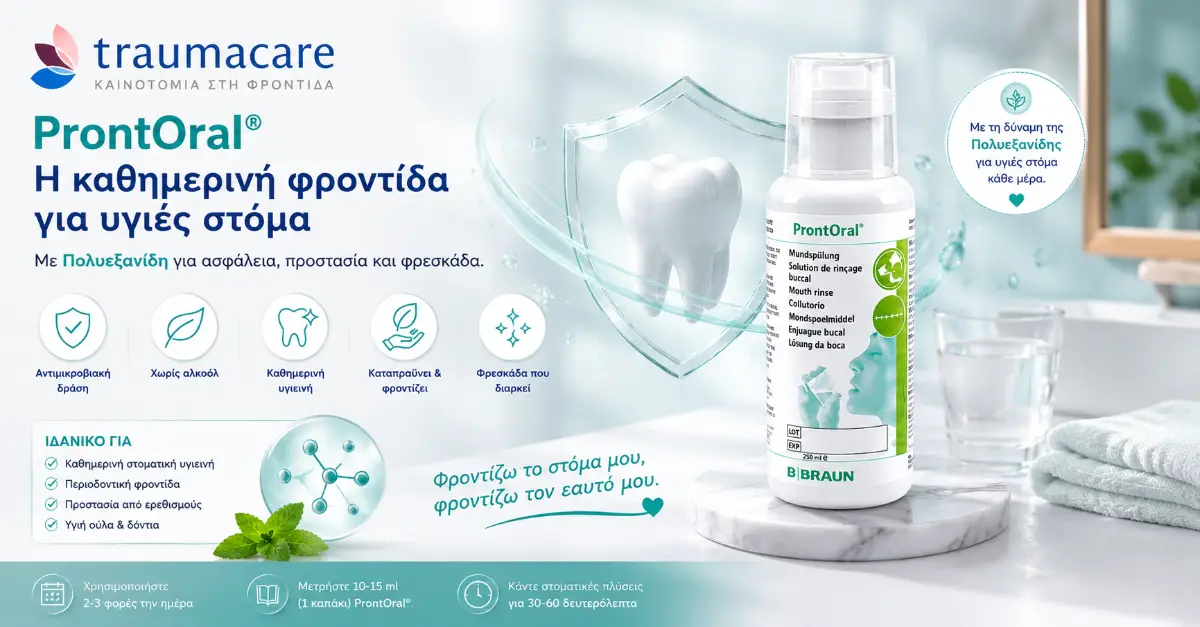
Durante décadas, la clorhexidina ha sido el líder indiscutible en higiene bucal antimicrobiana. Sin embargo, hoy en día, una alternativa más potente y bien tolerada — la polihexametileno biguanida (PHMB)— está cambiando gradualmente los protocolos clínicos, particularmente cuando el objetivo es descolonizar organismos multirresistentes (OMR) sin los efectos secundarios conocidos de la clorhexidina.
ProntOral® de la empresa alemana B|Braun es la solución de PHMB más completa disponible comercialmente para uso oral. En este artículo de análisis en profundidad examinamos:
- Cómo funciona la polihexanida a nivel molecular y celular
- Por qué la ausencia de clorhexidina es una ventaja clínica, no una concesión
- Qué pacientes se benefician más
- Cómo ProntOral® se integra en un programa integral de higiene bucal, desde la UCI hasta el hogar
Nota de Traumacare: Nuestra empresa es el distribuidor exclusivo de productos B|Braun en Grecia y en los últimos años ha estado supervisando la transición de muchas unidades hospitalarias de los protocolos de clorhexidina a PHMB.
1. ¿Qué es la polihexanida (PHMB) y cómo funciona?
La polihexanida es un polímero biguanida catiónico con afinidad química por la clorhexidina, pero con un perfil toxicológico significativamente más suave. Se ha utilizado en medicina desde la década de 1980, inicialmente en el cuidado de heridas crónicas (Prontosan®), y en los últimos años ha ampliado su presencia al cuidado bucal a través de ProntOral®.
Mecanismo de acción
A diferencia de los enjuagues bucales a base de alcohol que funcionan mediante citólisis no específica, la polihexanida sigue un mecanismo dirigido de dos pasos:
- Adhesión electrostática: Las moléculas de PHMB con carga positiva son atraídas por la membrana celular bacteriana con carga negativa (fosfolípidos, lipopolisacáridos).
- Desestabilización de la membrana: Penetran la bicapa, aumentan la permeabilidad y provocan la liberación de componentes intracelulares, lo que conduce a una actividad bactericida sin el desarrollo de resistencia.
Debido a que la membrana de las células de la mucosa oral humana contiene colesterol y tiene una carga diferente, el PHMB casi no tiene efecto sobre ellas en concentraciones clínicas (0,04–0,1%). Esta selectividad es la base de la seguridad de ProntOral®.
Espectro de actividad
La polihexanida tiene actividad documentada in vitro e in vivo contra:
- Bacterias Gram positivas: Staphylococcus aureus , MRSA , Streptococcus mutans , Streptococcus salivarius , enterococos (incluidos VRE )
- Bacterias Gram negativas: Pseudomonas aeruginosa , Klebsiella pneumoniae , E. productora de ESBL coli , Acinetobacter baumannii
- Hongos : Candida albicans y especies no albicans
- Virus envueltos (envueltos)
Es importante destacar que ProntOral® mantiene su actividad en presencia de proteínas (sangre, saliva), a diferencia de algunos antisépticos más suaves.
2. Por qué la ausencia de clorhexidina es una ventaja
La clorhexidina sigue siendo eficaz, pero tiene desventajas que se hacen cada vez más evidentes con el uso a largo plazo:
| Desventaja de la clorhexidina | Impacto |
|---|---|
| Manchas en los dientes y la lengua | Manchas de color marrón amarillento, especialmente después de >7 días de uso |
| Disgeusia/alteración del gusto | Disminuye el cumplimiento, especialmente en el pacientes ancianos y oncológicos |
| Interacción con fluoruro | Disminuye la eficacia de la pasta dental |
| Reacciones alérgicas | Mayor incidencia de anafilaxia (especialmente con uso preoperatorio) |
| Potencial citotoxicidad | Retrasa la cicatrización de heridas mucosas |
| Indicación de resistencia | Estudios recientes muestran una creciente resistencia antimicrobiana |
ProntOral®, con solo polihexanida como ingrediente activo, elimina casi por completo estos efectos secundarios a la vez que mantiene una potente actividad antimicrobiana. Este equilibrio es la razón por la que muchos protocolos internacionales de UCI y paquetes preoperatorios lo han incluido en su uso rutinario.
3. Indicaciones oficiales de uso de ProntOral®
Según el catálogo oficial de B|Braun, ProntOral® está indicado para:
- Descolonización de la cavidad oral y la faringe, incluyendo microorganismos multirresistentes (MRSA, VRE, ESBL)
- Prevención de la formación de placa dental
- Prevención de caries en pacientes con capacidad reducida de limpieza mecánica
- Prevención y cuidados de apoyo de la gingivitis y la periodontitis
- Inhibición del crecimiento, propagación y transmisión de MDRO
- Apoyo para la limpieza mecánica de la cavidad oral
Además de estas indicaciones, la práctica clínica ha demostrado beneficios adicionales:
- Tratamiento de úlceras aftosas: la polihexanida reduce la carga bacteriana alrededor de la lesión, acelerando la cicatrización
- Tratamiento de la halitosis: reduce los compuestos volátiles de azufre (CVA) producidos por bacterias anaerobias en la superficie dorsal de la lengua
- Cuidados de apoyo en la mucositis quimio/radioterapia
- Higiene bucal en pacientes intubados en la UCI (prevención de la VAP)
4. Donde se usa clínicamente: imagen del campo
En el hospital
- UCI: Cuidado bucal de pacientes intubados para la prevención de la neumonía asociada a la ventilación mecánica (NAV). Combinado con limpieza mecánica 4 veces al día.
- Cirugía/preoperatorio: Parte del Set Prontoderm® para la descolonización de todo el cuerpo antes de procedimientos electivos (ortopédicos, cardíacos, oncológicos).
- Clínicas de oncología: Cuidado bucal complementario durante la quimioterapia y la radioterapia de cabeza y cuello, para reducir los episodios de estomatitis grave.
- Clínicas de patología: En pacientes ancianos con disfagia, producción reducida de saliva o mala higiene bucal.
En residencias de ancianos
- Uso diario en pacientes con trastornos de la alimentación, demencia o simplemente dificultad para cepillarse los dientes
- Prevención de la transmisión de MDRO en espacios compartidos
- Prevención de infecciones respiratorias, ya que la flora oral es la principal fuente de neumonía nosocomial en ancianos
En el hogar
- Pacientes dados de alta de cirugía y que requieren de 5 a 7 días de protección
- Ancianos con movilidad reducida
- Personas con aftas frecuentes
- Pacientes con halitosis crónica que no responde a otras soluciones
5. Protocolo de uso
Dosis
La dosis típica es 10 ml de solución 2-3 veces al día , para un enjuague de 30 segundos.
- Importante: No enjuagar con agua después de usar (sin enjuague)
- No requiere dilución: listo para usar
- Recomendado después del cepillado y al menos 30 minutos antes o después de usar pasta dental con flúor (no debido a la interacción como con la clorhexidina, sino para permitir que su acción se lleve a cabo sin obstáculos)
Duración del uso
- Preparación preoperatoria: 5 días antes de la cirugía + día de la cirugía
- Protocolo de descolonización de MDRO: 5-7 días, según el protocolo del hospital
- Cuidado bucal en la UCI: 4 veces al día durante la duración de intubación
- Prevención del mal aliento/úlceras aftosas : 2 veces al día hasta que los síntomas desaparezcan
- Higiene bucal diaria en ancianos : 1–2 veces al día
Quién necesita atención
ProntOral® tiene un excelente perfil de seguridad, sin embargo, debe evitarse en:
- Niños menores de 4 años (riesgo de ingestión)
- Personas con hipersensibilidad conocida a las biguanidas
- No se recomienda durante el embarazo y la lactancia sin consejo médico
6. Evidencia: lo que dice la literatura
La comercialización de polihexanida en el cuidado bucal es respaldado por un conjunto significativo de estudios:
- Pitten FA et al. (2003) “Eficacia del cloruro de cetilpiridinio y PHMB en la descolonización de la cavidad oral”, Journal of Hospital Infection — mostró una eficacia comparable de PHMB y clorhexidina en la reducción de la carga bacteriana, con una tolerabilidad claramente mejor.
- Welk A et al. (2016) “El efecto antimicrobiano del enjuague bucal a base de polihexanida” — confirmó la actividad contra S. mutans y Porphyromonas gingivalis .
- Müller G, Kramer A. (2008) “Índice de biocompatibilidad de agentes antisépticos”: la polihexanida presenta el índice de biocompatibilidad más alto entre todos los antisépticos comunes (incluidas la clorhexidina, la octenidina y el yodo).
- Estudios internos de B|Braun (disponibles a solicitud de Traumacare): evaluación clínica en portadores de SARM en hospitales alemanes.
Las directrices recientes de organizaciones como la OMS para la higiene bucal en la UCI, así como las declaraciones internacionales WUWHS sobre heridas crónicas, reconocen la polihexanida como un antiséptico de primera línea en pacientes susceptibles.
7. ¿Cuándo recomendamos ProntOral® sobre otra solución?
ProntOral® es superior cuando:
- El paciente está en uso prolongado de antiséptico (>7 días)
- Hay antecedentes de alergia o intolerancia a la clorhexidina
- El objetivo es mantener el gusto normal (pacientes oncológicos, ancianos, niños >4 años)
- El objetivo es prevenir la tinción dental (estética dental)
- Es necesario usar pasta dental con flúor en paralelo
- el paciente tiene sensibilidad oral mucosa (mucositis, estomatitis, aftas)
- La descolonización de MDRO se busca en la preparación preoperatoria
8. Conclusión
La polihexanida no es una “clorhexidina más suave”. Es una clase distinta de antiséptico con un mecanismo de acción diseñado para la neutralización microbiana dirigida sin episodios citotóxicos concomitantes. En este contexto, ProntOral® es una de las opciones más modernas para cualquier protocolo de higiene bucal, desde la UCI hasta el cuidado diario en el hogar.
Proporciona una acción confiable contra microorganismos multirresistentes, previene la placa, caries, gingivitis y periodontitis, trata eficazmente el mal aliento y las aftas bucales, y todo esto sin mostrar los efectos secundarios clásicos de la clorhexidina .
Artículos relacionados en la serie
- Paquete de descolonización prequirúrgica de MDRO: el papel de ProntOral® junto a Prontoderm®
- Prevención de VAP en la UCI: higiene bucal de un paciente intubado con ProntOral®
- ProntOral® vs clorhexidina: similitudes, diferencias, ¿cuándo preferimos uno sobre el otro?
Orden ProntOral® de Traumacare
Traumacare es el distribuidor exclusivo de B|Braun en Grecia. La solución ProntOral® de 250 ml está disponible con envío gratuito a todo el país.
➤ Haga su pedido aquí: ProntOral® 250 ml — Traumacare
Bibliografía
- B|Braun Melsungen AG. Página del producto ProntOral®. catalogs.bbraun.com (p.º 2026-05).
- Pitten FA, Kramer A. Eficacia del cloruro de cetilpiridinio utilizado como antiséptico orofaríngeo. Arzneimittelforschung. 2001;51(7):588-95.
- Welk A, et al. El efecto antimicrobiano de un enjuague bucal que contiene polihexametileno biguanida. Quintessence Int. 2016;47(5):421-431.
- Müller G, Kramer A. Índice de biocompatibilidad de agentes antisépticos mediante evaluación paralela de la actividad antimicrobiana y la citotoxicidad celular. J Antimicrob Chemother. 2008;61(6):1281-7.
- Kramer A, et al. Consenso sobre antisepsia de heridas: Actualización 2018. Skin Pharmacol Physiol. 2018;31(1):28-58.
- OMS. Directrices sobre los componentes básicos de los programas de prevención y control de infecciones. Ginebra: OMS; 2016.
- WUWHS. Congreso de Florencia, Documento de posición: Manejo local de las úlceras del pie diabético. Wounds International; 2016.
${{products:190}}
Συντάκτης & Επιμέλεια
Συντάκτης: Ιατρική Ομάδα Traumacare — αποκλειστικός διανομέας B|Braun στην Ελλάδα.
Τελευταία ενημέρωση: Μάιος 2026 · Descargo de responsabilidad: Ενημερωτικό άρθρο, δεν αντικαθιστά τη συμβουλή ιατρού.
Επικοινωνία με την Ιατρική Ομάδα Traumacare
Έχετε ερωτήσεις για το ProntOral®;
Δωρεάν συμβουλή για χρήση σε
| ✉️ Φόρμα επικοινωνίας | 💬 Viber Traumacare ✓ |
📞 Τηλέφωνο: 2311 286262
Formulario de contacto
Όλο το Cluster ProntOral®
- #1 — Πολυεξανίδη (PHMB) στη στοματική αποαποικιοποίηση
- #2 — Paquete de descolonización MDRO prequirúrgico
- #3 — Prevención de VAP στη ΜΕΘ
- #4 — Mucositis σε ογκολογικούς ασθενείς
- #5 — ProntOral® στη φροντίδα κατ' οίκον
- #6 — ProntOral® vs χλωρεξιδίνη
- #7 — Από την οδοντιατρική προφύλαξη στη νοσοκομειακή λοίμωξη