



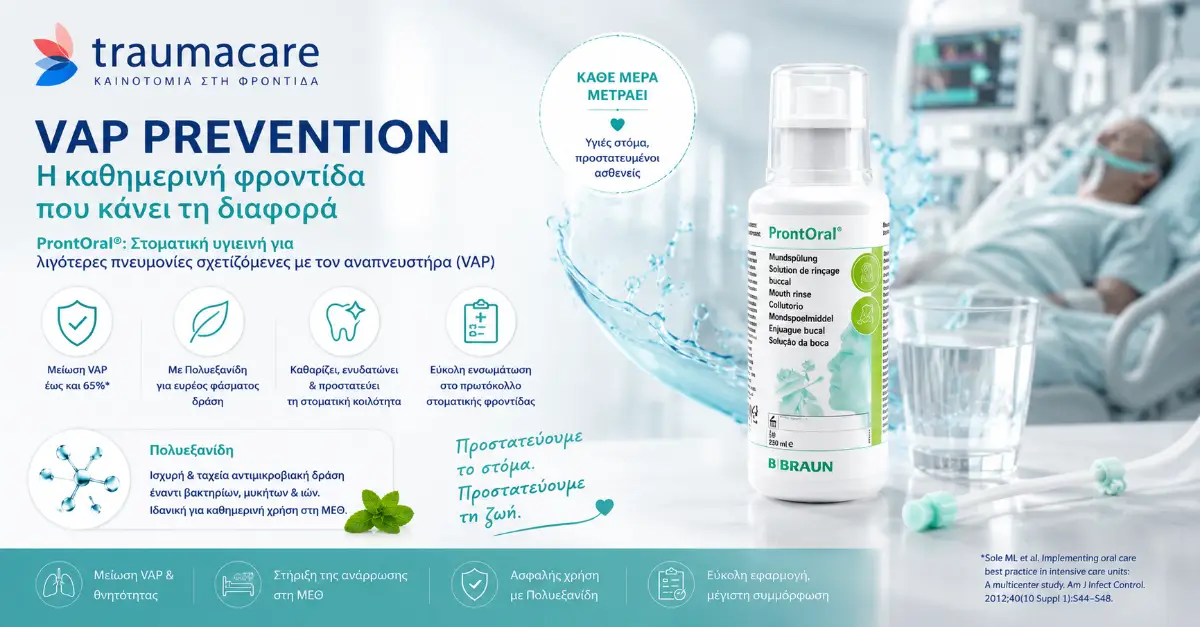
Ventilator-associated pneumonia (VAP) remains the most common nosocomial infection in ICU patients. The incidence ranges from 5% to 20% per patient on mechanical ventilation, with mortality attributable to VAP reaching 13%. Despite investment in ventilator bundles, VAP often remains underreported—and the most neglected link is routine oral care.
In this article, we present an evidence-based oral hygiene protocol for the intubated patient with ProntOral® , with clear steps, timelines, and quality indicators for the clinical team.
Traumacare Note: We collaborate with ICU nursing teams of Greek hospitals to implement oral hygiene programs based on international SHEA/IDSA, CDC and ESICM guidelines.
1. Why the oral cavity is the epicenter of VAP
In healthy people, the oral flora is relatively harmless. In the ICU patient, however, three dramatic events occur within 48 hours:
- Change in flora composition: common aerobic streptococci are replaced by Gram-negative bacilli ( Pseudomonas , Klebsiella , Acinetobacter ).
- Biofilm formation on the endotracheal tube and teeth, where the bacteria are protected from systemic antibiotics.
- Microaspiration of secretions above the cuff lumen, which carries the bacterial load to the lower airways.
In other words: the oral cavity is typically the source of VAP — not the environment, nor the hands of staff (these are already controlled by other measures).
2. What the guidelines say
All modern guidelines include oral hygiene as a essential component of the VAP bundle :
- CDC/HICPAC (2024 update): recommends oral care with antiseptic every 4 hours
- SHEA/IDSA Compendium (2022): specific recommendation for non-chlorhexidine antiseptic in selected patients (increasing reports of chlorhexidine-related mortality)
- ESICM/ESCMID (2017): mechanical cleaning + antiseptic 4×/day
- CHEST/SCCM (2019): mouth cleaning and dental hygiene as part of the VAP bundle
The recent debate surrounding chlorhexidine — with studies such as Klompas et al. 2014 and Price et al. 2014 associating prolonged use of 0.12–2% with increased mortality in selected subgroups — has focused attention on polyhexanide as a safer alternative.
3. How ProntOral® works in the ICU
ProntOral® combines three targeted actions needed in the ICU:
- Targeted antimicrobial action : polyhexanide (PHMB) acts against Gram-positive (including MRSA), Gram-negative (including ESBL, Pseudomonas ) and fungi ( Candida ).
- Biofilm destabilization : the surfactants in the solution penetrate the first layers of the biofilm and facilitate mechanical removal.
- Good mucosal tolerance: unlike chlorhexidine which can cause mucositis and taste changes after extubation, polyhexanide maintains mucosal integrity even after prolonged use.
In addition, the product offers supportive benefits that are also found in general oral hygiene:
- Prevention of plaque, caries, gingivitis and periodontitis — important in patients hospitalized for >7 days
- Treatment of halitosis often attributed to ICU patients
- Support for aphthae and mucositis that occur with prolonged dry mouth and host medications
4. ICU application protocol — step-by-step
Frequency and escalation
| Frequency | Intervention |
|---|---|
| Every 4 hours | Mouthwash with ProntOral® (via suction) |
| Every 8 hours | Mechanical cleaning with brush/sponge + ProntOral® |
| Every 12 hours | Check cuff pressure and subglottic suction |
| Daily | Assessment dental/mucosal condition |
Procedure (8-hour deep cleaning)
Materials: - ProntOral® 250 ml - Soft toothbrush or sponge (Sage / Kerr) - Gloves - Suction system - Luminospheres
Steps:
- Preparation : Elevate head 30–45°, check that cuff pressure is >20 cmH₂O (prevention of microaspiration).
- Subglottic suction (if available) and oral suction.
- Mechanical cleaning : brushing of all surfaces of teeth (2 minutes), tongue and mucosa with gauze.
- Rinsing : 10 ml ProntOral® applied with a brush or luminosphere to the entire oral cavity — no rinsing with water afterwards.
- Aspirate the solution (do not allow it to be transferred to the lower airways).
- Moisturize the lips with a greasy cream.
- Record on VAP bundle sheet.
Procedure (4-hour light cleaning)
- Subglottic + oral suction.
- 10 ml ProntOral® with sponge or luminosphere.
- Suction.
- Record.
5. Quality indicators (KPIs)
To assess whether the program is working, monitor:
- VAP bundle compliance : percentage of shifts with full protocol (target >90%)
- VAP episodes/1000 ventilator days : target <5
- Microaspiration episodes (subglottic culture +)
- Oral status : scoring system such as Beck Oral Assessment Scale (BOAS) or OAG before and after the first 72 hours
⚕️ Indications, contraindications and safety profile in the ICU
Indications in the ICU
- All intubated patients as part of the VAP prevention bundle
- Trauma patients at high risk of VAP
- Prolonged mechanical ventilation (>48 hours)
- Oral care in non-intubated ICU patients at high risk of aspiration
- Post-extubation period for 5 days (prevention of biofilm rebound)
- MDRO carriers in ICU (contact isolation + targeted decolonization)
Contraindications
- Known hypersensitivity to polyhexanide/biguanides
- Severe oropharyngeal trauma without possibility of controlled suction
- Pediatric patients <4 years: special protocol with reduced dose and suction
Side effects in ICU setting
In the ICU, where application is always by suction without swallowing, the safety profile is excellent:
| Side effect | Frequency |
|---|---|
| Systemic absorption | None documented |
| Transient mucosal redness | Very rare |
| Worsening of existing mucositis | Rare — significantly less than chlorhexidine |
| Interaction with inotropes/anesthetics/antibiotics | Not reported |
| Association with increased ICU mortality | None |
Important comparison: Recent studies (Klompas 2014, Price 2014) have raised doubts about the prolonged use of chlorhexidine in the ICU due to a possible association with increased mortality in selected subgroups. No such association has been reported for polyhexanide.
Special populations
- Neonates/preterm : special forms with reduced concentration, according to neonatal IC guidelines
- Pregnant women in ICU : safe with medical supervision
- Severe thrombocytopenia : does not affect coagulation or hemostasis
- Hypersensitivity to chlorhexidine : ProntOral® is the only safe alternative for oral antiseptics
When to stop / report event
- Rash or urticaria
- New or worsening mucositis
- Suspected anaphylaxis (recorded in IC committee)
- Paradoxical CRP elevation without other focus
7. When is ProntOral® superior to chlorhexidine in the ICU
- In patients with cardiovascular or pulmonary dysfunction where chlorhexidine has been associated with increased mortality
- In prolonged stay (>14 days on ventilator), where tooth staining and dysgeusia become clinically significant
- In patients with mucositis or transmucosal injury from chemotherapy
- In pediatric ICU where the safety profile of PHMB is more favorable
- When there is known hypersensitivity or history of anaphylaxis to chlorhexidine
8. Practical examples from the field
Example 1: Young multi-trauma patient, intubated for 9 days
The VAP bundle protocol with ProntOral® was implemented from the day of admission. BOAS improved from 5 to 2 by the 3rd day. No growth of pathogens in tracheal secretions after Day 4. Successful extubation Day 9.
Example 2: Elderly woman with COPD and pneumonia, intubated for 14 days
Initially 0.12% chlorhexidine was applied. Dysgeusia (responsive to closing movements) was observed from Day 4. Changed to ProntOral®. No further side effects, stable oral health, no VAP.
Example 3: 6-year-old child with ARDS, hospitalization 21 days
Due to pediatric age and need for prolonged use, ProntOral® was chosen from the beginning at a dosage of 5 ml × 4. No mucosal damage, no lower respiratory tract infection.
9. Logistics and Cost
Traumacare supplies ProntOral® in units:
- 250 ml bottle : ideal for 5-7 days in one patient with 4×/day irrigation
- Multipacks for high volume ICUs
Compared to classic chlorhexidine 0.12%, ProntOral® has a comparable or slightly higher cost per application, but is compensated by faster extubation and reduced antibiotic use for VAP.
10. Conclusion
VAP is not inevitable. Systematic, graded, and evidence-based oral care—with mechanical cleaning plus an antiseptic such as ProntOral®—is the most underrated intervention in the VAP bundle. Polyhexanide offers the combination of potent activity against MDROs and excellent mucosal tolerance, making it ideal for long-term use in susceptible patients.
Related articles in the series
- Polyhexanide (PHMB) in oral decolonization
- Pre-surgical MDRO decolonization bundle
- ProntOral® vs chlorhexidine
Order ProntOral® for your ICU
➤ ProntOral® 250 ml
For group orders of hospital units and training materials (poster, checklist, micro-training video), contact the Traumacare team.
Bibliography
- B|Braun Melsungen AG. ProntOral® product page. catalogs.bbraun.com (accessed 2026-05).
- Klompas M, et al. Reappraisal of routine oral care with chlorhexidine gluconate. JAMA Intern Med. 2014;174(5):751-61.
- Price R, et al. Selective digestive or oropharyngeal decontamination and topical oropharyngeal chlorhexidine for prevention of death in general intensive care. BMJ. 2014;348:g2197.
- Klompas M, et al. Strategies to prevent ventilator-associated pneumonia, ventilator-associated events, and nonventilator hospital-acquired pneumonia in acute-care hospitals: 2022 update. Infect Control Hosp Epidemiol. 2022;43(6):687-713.
- CDC. Ventilator-Associated Event (VAE) protocol. 2024.
- ESICM. Recommendations for the prevention of nosocomial pneumonia in ICU. Intensive Care Med. 2017.
- Berry AM, et al. Beyond comfort: oral hygiene as a critical nursing activity in ICU. Intensive Crit Care Nurs. 2011;27(6):318-29.
${{products:190}}
Editor & Editor
Editor: Traumacare Medical Group — exclusive distributor of B|Braun in Greece.
Last updated: May 2026 · Disclaimer: Informative article, does not replace medical advice.
Contact the Traumacare Medical Team
Do you have questions about ProntOral®?
Free consultation for use in an inpatient, ICU, nursing home or surgical preparation.
| ✉️ Contact form | 💬 Viber Traumacare ✓ |
📞 Phone: 2311 286262