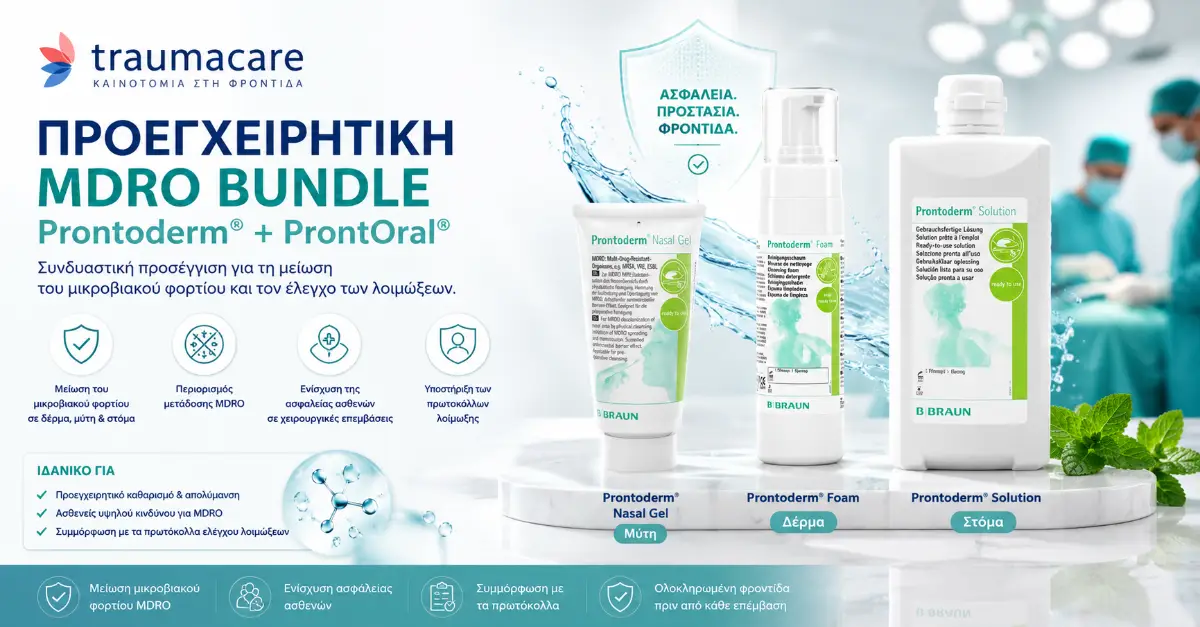
In this context, preoperative decolonization of multidrug-resistant organisms (MDRO decolonization) has emerged as a strategy with high clinical and economic benefit. In today's deep-dive article we examine the comprehensive B|Braun protocol, which combines Prontoderm® Solution, Foam, Wipes, Nasal Gel and ProntOral® into a single five-day program.
Traumacare Note: We are the exclusive distributor of B|Braun in Greece and support hospitals and clinics in adopting the Prontoderm® Set.
1. Why is preoperative decolonization necessary
The idea is simple: if the patient himself carries strains such as MRSA , VRE or ESBL-producing enterobacteria on his skin, nostrils, oral cavity or perineum, then every surgical incision is a potential gateway to significantly increased risk.
The most common culprits in SSIs:
- Staphylococcus aureus (mainly MRSA in patients with known colonization)
- Coagulase-negative staphylococci
- Pseudomonas aeruginosa
- Enterococcus faecium / faecalis (VRE)
- ESBL-producing E. coli and Klebsiella pneumoniae
Studies have shown that 80% of S. aureus SSIs originate from the same strain that the patient carried before surgery. So decolonization is not a “just in case” — it is a causal strategy.
2. The logic of the Prontoderm® Set
The B|Braun protocol differs from traditional mupirocin/chlorhexidine antiseptic baths in three crucial ways:
- All products in the set contain the same active ingredient (PHMB/polyhexanide) — so there is no interaction or conflict of chemistry between different areas of the body.
- It simultaneously covers all typical colonization areas — skin, scalp, nostrils, mouth/pharynx — with a comprehensive five-day program.
- It does not have the known disadvantages of chlorhexidine (teeth staining, dysgeusia, interaction with fluoride, allergic reactions).
The 5 components of the Prontoderm® Set
| Prontoderm® Solution | Whole body — replaces shower | 1× |
| Prontoderm® Foam | Scalp, hair | 1× |
| Prontoderm® Wipes | Sensitive areas, skin folds | Where needed |
| Prontoderm® Nasal Gel | Nasal passages (main site of MRSA carriage) | 2–3× |
| ProntOral® Solution | Oral cavity, pharynx | 2–3× |
Each of these has stand-alone role, but the strength of the protocol lies in the synchronized use five days before surgery plus the day of surgery.
3. The distinct role of ProntOral® in the bundle
Traditionally, preoperative protocols focused almost exclusively on the skin and nares (mainly for MRSA). The oral cavity, however, is a reservoir of important pathogens that can migrate:
- Cardiac surgery: oral pathogens are associated with postoperative pneumonia and endocarditis
- Orthopedic arthroplasty: hematogenous dissemination of oral streptococci (anaerobes, viridans group) in aseptic loosening of prosthesis
- Head and neck surgery: direct contamination of the surgical field by oral flora
- Neurosurgery, vascular: increased risk of nosocomial pneumonia due to prolonged intubation
ProntOral® covers precisely this overlooked portal of entry. Working with the same active ingredient (PHMB) as the other products in the set:
- Decolonizes oral MRSA, VRE, ESBL carriers
- Reduces bacterial load before intubation (where applicable)
- Prevents plaque, caries, gingivitis and periodontitis during the days of preparation
- Treats accompanying bad breath and any aphthae
- Does not cause dysgeusia or staining, so that the patient fully complies until the day of surgery
4. Five-day protocol: step-by-step
Day -5 to -1 (before surgery, at home)
Morning: 1. Shower with Prontoderm® Solution or Foam (head + body), at least 1 minute of contact before rinsing 2. Clean with Prontoderm® Wipes of sensitive areas (armpits, groin folds, perineum) 3. ProntOral® 10 ml, 30 second rinse (after brushing) 4. Prontoderm® Nasal Gel , small amount in each nostril
Evening: 5. Repeat steps 1, 3, 4
Day 0 (day of surgery)
- In the morning, before transfer to hospital: last full protocol
- Clean cotton pajamas/underwear
- Avoid food/fluid consumption after ProntOral® (fasting)
- If the patient is intubated, the ICU team continues ProntOral® 4× daily
Day +1 and beyond
- Throughout the hospital stay, oral care with ProntOral® can be continued 2×/day as part of general oral care
- Re-test for MRSA carrier status before discharge
5. Patient communication plan
One of the practical barriers to implementing the protocol are patient compliance. The set should be accompanied by:
- Written instructions in understandable language
- Short educational video (or information on the hospital portal)
- Checklist of days of use
- Contact number for the IC team in case of questions
The use of ProntOral® is particularly helpful here: unlike chlorhexidine, patients usually do not complain about taste or staining — so they do not abandon the program on day 3.
6. In which patients is it recommended
The American SHEA/IDSA Compendium 2022 and the European ECDC guidelines recommend preoperative decolonization in:
- All patients undergoing planned cardiac surgery or prosthetic surgery (arthroplasty, vascular prosthesis)
- Known MRSA carriers before any major surgery
- Hospitalized in high-risk areas (ICU, hematology)
- Patients before organ or bone marrow transplantation bone
- Neonates/preterm in ICU (in specific product forms)
For elective low-risk procedures, the evaluation is done on a case-by-case basis by the infection committee.
7. Efficacy data
The commercial documentation of Prontoderm® Set is based on a body of studies that includes:
- Schmitz JM et al. (2018) — comparison of PHMB vs chlorhexidine decolonization protocols in cardiac surgery patients: significantly better compliance and non-inferior reduction of MRSA carriage.
- Climo MW et al. N Engl J Med (2013) — classic study that showed that a whole-body antiseptic approach significantly reduces central line events (CLABSI) and colonization.
- B|Braun multicentre observational (Germany, Austria, Switzerland, 2019-2021) — reduction in MRSA-related SSIs by 62% in units that adopted the Prontoderm® Set compared to historical controls.
8. Practical implementation in Greece
In Greek hospitals, the implementation of the protocol presents specific difficulties:
- There is not always a standard MRSA screening before procedures
- The set is not automatically reimbursed by EOPYY
- Staff and patient training remains ad hoc
Nevertheless, units with a high incidence of MDRO (ICU, orthopedic departments of tertiary hospitals) have already integrated the Prontoderm® Set into internal protocols. Traumacare provides training materials (printed and digital) and on-demand in-house training for nursing teams.
⚕️ Indications, contraindications and safety profile
Indications for use
In the context of preoperative MDRO decolonization, ProntOral® is indicated for:
- All patients undergoing planned major surgery (cardiac surgery, arthroplasty, vascular prosthesis, orthopedics with materials)
- Known MRSA carriers before any surgery
- High-risk patients (immunosuppression, diabetes, history of SSI)
- As part of the Prontoderm® Set bundle (5 days before + day of surgery)
- Recurrence of carriage after failed chlorhexidine
Contraindications
- Known hypersensitivity to polyhexanide or other biguanides
- Children under 4 years (risk of ingestion)
- Severe preoperative oral damage that prevents safe application
- Pregnancy and lactation: only on medical advice
Side effects
The safety profile of polyhexanide is excellent in the peri-operative setting:
| Rare (<5%) | Transient taste alteration |
| Very rare (<1%) | Mild local mucosal sensitivity |
| Extremely rare (<0.1%) | Allergic reaction |
| Not reported | Systemic reactions, anaphylaxis |
In Unlike chlorhexidine, no cases of intraoperative anaphylaxis have been reported with polyhexanide—important for patients receiving concomitant anesthesia or antibiotics.
When to discontinue use
- Appearance of rash or urticaria
- Severe local tenderness that does not resolve within 24 hours
- Difficulty breathing or swallowing (immediate medical advice)
In case of discontinuation, inform the responsible IC committee before surgery for reassessment of the protocol.
10. Conclusion
Preoperative MDRO decolonization is no longer optional. It is a clinically proven intervention that has been shown to reduce surgical site infections, while also having clear economic benefits for any healthcare system.
The Prontoderm® Set from B|Braun, with ProntOral® as an equal component covering the often overlooked oral entry portal, provides a comprehensive, well-tolerated and chlorhexidine-free solution for preoperative preparation.
Related articles in the series
Order from Traumacare
➤ ProntOral® 250 ml ➤ Prontoderm® Solution 500 ml
For orders of the entire Prontoderm® Set or group supplies for hospital units, contact the Traumacare team.
Βιβλιογραφία
- B|Braun Melsungen AG. Prontoderm® Set & ProntOral® product pages. catalogs.bbraun.com (πρόσβαση 2026-05).
- Schweizer ML, et al. Association of a bundled intervention with surgical site infections among patients undergoing cardiac, hip, or knee surgery. JAMA. 2015;313(21):2162-71.
- Climo MW, et al. Effect of daily chlorhexidine bathing on hospital-acquired infection. N Engl J Med. 2013;368(6):533-42.
- Bode LG, et al. Preventing surgical-site infections in nasal carriers of Staphylococcus aureus. N Engl J Med. 2010;362(1):9-17.
- Calderwood MS, et al. Strategies to prevent surgical site infections: 2022 SHEA/IDSA/APIC. Infect Control Hosp Epidemiol. 2023;44(5):695-720.
- ECDC. Healthcare-associated infections: surgical site infections. Annual Epidemiological Report 2022.
- Müller G, Kramer A. Biocompatibility index of antiseptic agents. J Antimicrob Chemother. 2008;61(6):1281-7.
${{products:190}}
Συντάκτης & Επιμέλεια
Συντάκτης: Ιατρική Ομάδα Traumacare — αποκλειστικός διανομέας B|Braun στην Ελλάδα.
Τελευταία ενημέρωση: Μάιος 2026 · Disclaimer: Ενημερωτικό άρθρο, δεν αντικαθιστά τη συμβουλή ιατρού.
Επικοινωνία με την Ιατρική Ομάδα Traumacare
Έχετε ερωτήσεις για το ProntOral®;
Δωρεάν συμβουλή για χρήση σε ασθενή, ΜΕΘ, οίκο ευγηρίας ή χειρουργική προετοιμασία.
📞 Τηλέφωνο: 2311 286262
Όλο το Cluster ProntOral®