



“I’ve been told I need a colostomy — what exactly is it?”
Colostomy may be a new word for you. It’s normal to feel confused and anxious. In this short introductory guide you will understand:
- What exactly is a colostomy
- The 3 main types and how they differ
- Permanent or temporary — what does it mean for you
- How will it change your daily life
- Next steps
Definition: What is a Colostomy
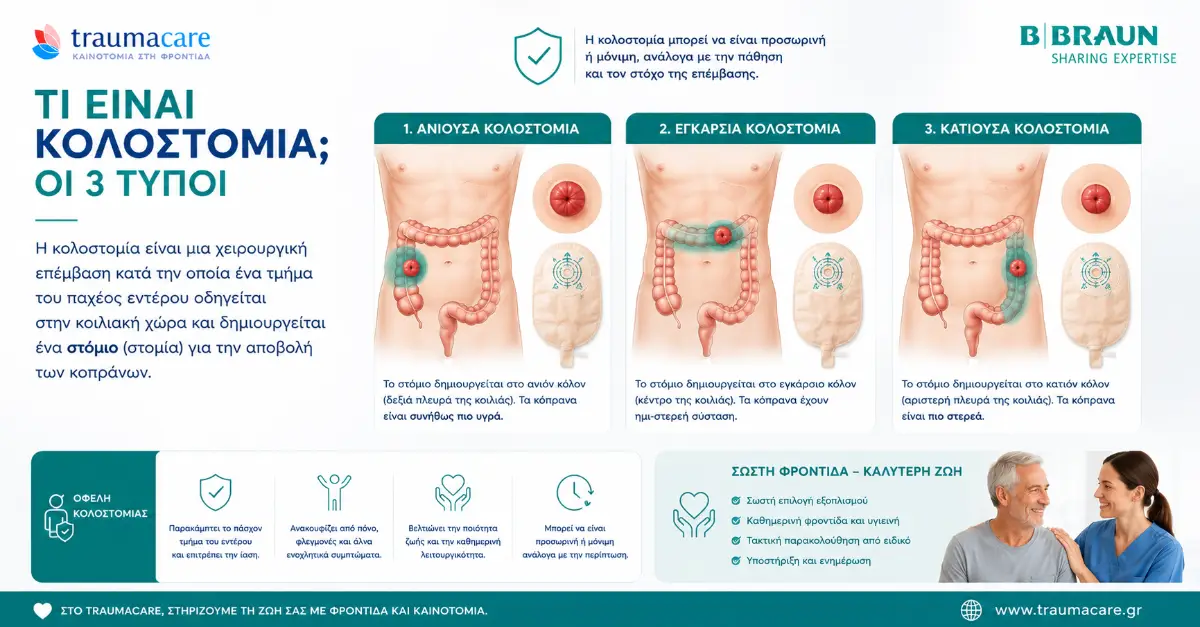
A colostomy is a surgical procedure in which a portion of the large intestine (colon) is removed through the abdominal wall and creates a stoma — from which stool is collected in a special bag [2] .
Simply put: instead of stool coming out of the anus, it comes out of a small opening in the abdomen and is collected in a bag.
Colostomy is part of a broader category of digestive/urinary stomas :
- Colostomy — from the large intestine (colon)
- Ileostomy — from the small intestine (ileum)
- Ureterostomy — from the urinary system
According to data from the Hellenic Anti-Cancer Society , in Greece approximately 3,500-4,000 new colostomies are performed annually — the vast majority due to cancer colorectal cancer, the 2nd most common cancer in the country.
The 3 Types of Colostomy
Depending on the site of the colon used, we distinguish 3 basic types [3] :
| Type | Stoma location | Stool consistency | Pouch |
|---|---|---|---|
| 1. Ascending | Right side of the abdomen | Liquid/watery | Drainable |
| 2. Transverse | Upper-middle abdomen | Semi-formed | Closed or drainable |
| 3. Sigmoid/Descending | Left lower abdomen | Formed (almost normal) | Closed |
1. Ascending Colostomy
It is created in the ascending part of the colon (right side of the abdomen). It is the rarest type because it is mainly used when the entire lower colon is affected.
- Stool: liquid because it does not pass through the entire colon to dehydrate
- Bowel frequency: Continuous (not controlled)
- Pouch: Drainable with a tap — empty when 1/3 full
- Flexima recommendations: Flexima Flat Drainable
2. Transverse Colostomy (Transverse)
It is created in the transverse section of the colon (upper-middle abdomen). It is often temporary and is used to rest the lower part of the intestine so that it can heal.
- Stool: semi-formed
- Frequency: 3-5 times a day
- Pouch: Closed or drainable depending on output
- Flexima Recommendations: Flexima Active or Flat (closed) or Flat Drainable for high output
3. Sigmoid/Descending Colostomy
The most common type — created in the sigmoid colon or descending colon (left lower abdomen). It is the most "friendly" type because the stools are almost normal (formed).
- Stools: Formed (as normal)
- Frequency: 1-2 times a day — almost predictable
- Pouch: Closed — change every 24 hours in total
- Flexima Recommendations: Flexima Active (premium soft adhesive) or Flexima Flat (standard)
➡️ See the complete pouch selection guide to find the right one for your type.
Permanent or Temporary Colostomy?
According to the ASCRS Clinical Practice Guidelines [3] :
Permanent Colostomy
It is created when [4] :
- The diseased part of the intestine has been removed without the possibility of reconnection
- The anus has been removed or is not functioning (usually in anal cancer)
- There is a chronic serious disease (Crohn's, radical incontinence, radial enteritis)
It represents ~70% of colostomies in Greece.
Temporary Colostomy
Created when the bowel needs to rest for healing:
- After colorectal anastomosis (to heal the suture)
- After perforation (peritonitis, leakage)
- After injury
- In complicated diverticulitis
Reversible in 3-12 months (median 6 months) with a second operation. Represents ~30% of colostomies.
➡️ Read in detail the indications for colostomy .
Anatomy: How It Works
In normal digestion, food passes through: mouth → stomach → small intestine → large intestine → rectum → anus . In the large intestine, water absorption and stool formation occur.
In a colostomy, the surgeon interrupts the large intestine at a point and extracts the adduct (the part that comes “up”) through the abdominal wall. The opening is sutured to the skin — thus creating the stoma.
Characteristics of the stoma:
- Color: pink to red (like the mucous membranes of the mouth) — healthy stoma
- Surface: moist and bloody slightly
- Sensitivity: Does not hurt because it has no pain nerves internally. May bleed slightly when cleaned — normal.
- Function: No control (like the anus). Stool comes out when the bowel sends it, automatically.
According to the UOAA study [5] , the stoma gradually decreases in the first 6-8 weeks — from swollen to permanent size.
How Will Your Daily Life Change
It’s the question everyone asks. The truth [6] :
| Activity | How does it change? |
|---|---|
| Work | Return in 6-8 weeks (office). 85%+ of patients continue normally. |
| Diet | Almost free. Some foods increase gas/odor. |
| Exercise | Walking from week 1, cardio from month 2, weights after 3 months (always with Ally Belt). |
| Swimming | From week 4 — Flexima are waterproof. |
| Travel | Everywhere — with preparation (double disposables + travel certificate). |
| Sexual life | Returns in 75%+ of patients after 3 months. |
| Social life | Almost invisible with modern Flexima with midi cover. Few realize. |
See the detailed 6-month recovery guide .
Next Steps
If you have just been told you will have a colostomy:
- Discuss with your surgeon — type (permanent/temporary), timing, technique (laparoscopic/open)
- Request stoma siting from a specialized stoma nurse — critical to reduce complications
- Book a free consultation with Traumacare for B Braun Flexima material selection and EOPYY preparation
- Read our cluster articles for procedure, recovery, everyday life
- Meet other patients — patient organizations (Ostomy Hellas) offer peer support
Free Pre-Surgical Consultation
| ✉️ Contact form | 💬 Viber Traumacare ✓ |
Related articles
- Pillar C: Complete colostomy guide 2026
- When is a colostomy performed (indications)
- Colostomy procedure: the step-by-step process
- Colostomy bag: which one to choose choose?
Author: Traumacare Medical Group — exclusive representatives of B Braun Avitum in Greece
Scientific documentation: ASCRS Clinical Practice Guidelines, ACPGBI Position Statement, UOAA Patient Education, BAUS Information, Vonk-Klaassen SM et al. QoL Research 2016, Government Gazette B' 5395/09-10-2025
Last updated: May 2026
Note: The content is informative and does not replace medical advice. The specific type of colostomy you choose is decided by your surgeon based on your specific case.
📚 Bibliography / Scientific sources
- Vonk-Klaassen SM et al. Ostomy-related problems and their impact on quality of life . Quality of Life Research , 2016. pubmed.ncbi.nlm.nih.gov
- BAUS — Information about Colostomy . British Association of Urological Surgeons. baus.org.uk
- ASCRS Clinical Practice Guidelines for the Surgical Care of Patients with Colostomy . American Society of Colon and Rectal Surgeons. fascrs.org
- ACPGBI Position Statement on Stoma Care . Association of Coloproctology of Great Britain and Ireland. acpgbi.org.uk
- UOAA — United Ostomy Associations of America: Colostomy Guide . ostomy.org/colostomy
- Cancer Research UK — Living with a colostomy . cancerresearchuk.org
- ΦΕΚ Β' 5395/09-10-2025 — Table 11, No. 2 (Colostomy Materials) . National Printing House. eopyy.gov.gr