



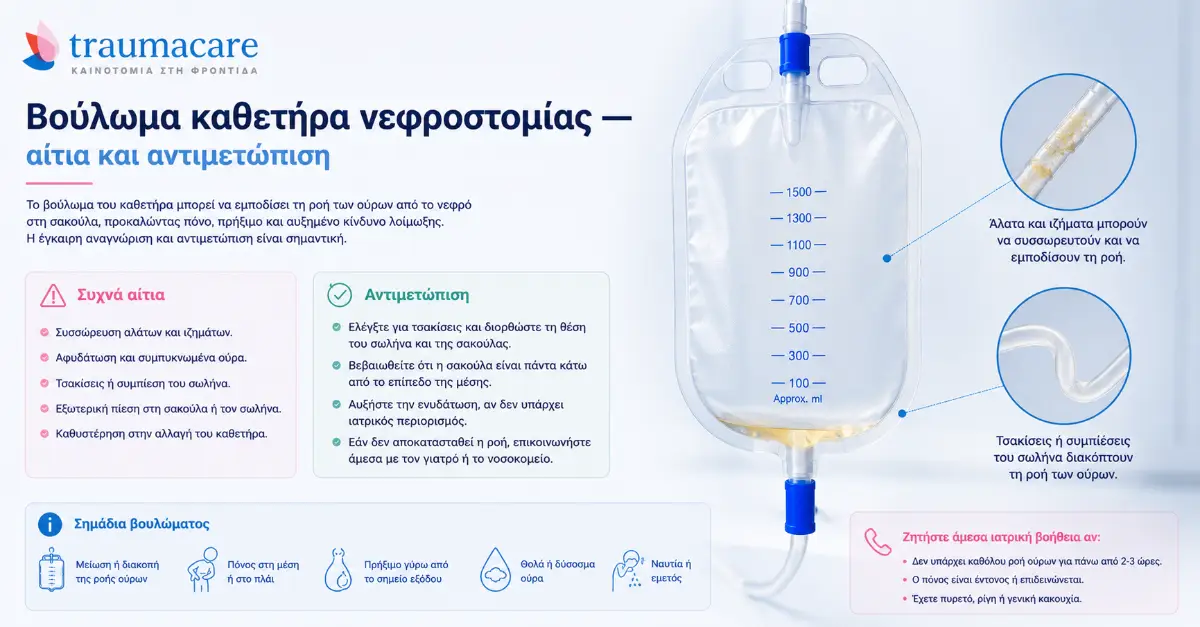
Blockage is, along with infection, the most common complication of nephrostomy. It occurs when salts, blood clots, or crystal particles build up inside the catheter, reducing or completely stopping the flow of urine. Let's look at why it happens, how to recognize it, and — most importantly — how to prevent it.
If you don't know what nephrostomy is or the overall care , start there.
How to recognize a blockage
- The bag remains almost empty for more than 4 hours.
- Urine leakage around the exit site (urine leaks out).
- Pain or pressure in the lower back on the side of the catheter.
- Swelling of the area above the kidney.
- In advanced cases: fever (if infection is present).
The 4 causes
1. Encrustation
The most common cause . Calcium and magnesium salts form crystals that stick to the walls of the catheter. Patients with alkaline urine or a history of stones are more susceptible.
2. Blood clots
More common in the first few days after insertion or after mucosal injury. They are more persistent in patients taking anticoagulants.
3. Bacterial biofilm
When infection is present, bacteria form a layer (biofilm) on the inside of the catheter that both clogs and resists antibiotics.
4. Mechanical kinking
Rarer cause. When the tube is kinked by poor fixation or sudden movement, flow is stopped mechanically. Usually corrected by alignment.
Prevention — the right routine
- Adequate hydration: 1.5-2 liters of water/day. Proper flow is the best “self-cleaning”.
- Diet low in sodium and processed foods.
- Treat urinary tract infections promptly — alkalinization of urine increases crystals.
- Meticulous catheter fixation without kinks.
- Scheduled change every 8-12 weeks — do not postpone it.
- In high-risk patients, weekly lavage by a nurse.
What to do if this happens
First instruction: Do not try to dislodge the blockage by force. You may damage the catheter or cause a pelvic rupture.
- Check that the bag is below the level of the kidney (gravity helps flow).
- Check that the tube is not kinked or folded.
- If not corrected mechanically: contact a doctor.
- At a scheduled time, flushing or changing the catheter is done — this is common and not urgent if there is no fever.
- If there is fever or severe pain: go to the emergency room immediately.
Flushing — trained only
In trained patients or caregivers, flushing with 5-10 ml of saline can unblock an incipient blockage. See our guide “ Flushing the nephrostomy catheter” for details (link will be updated with the actual URL). If you are not trained, do not attempt it .
When to change in an emergency
For persistent blockage that does not resolve with irrigation, visible crusts, or a recurring problem, the doctor will arrange for a new catheter placement — a procedure that is done quickly over a guidewire through the existing tract. No new puncture is needed.
Comparison of materials — which catheter is more durable
Not all products are created equal:
- 100% silicone catheters are more resistant to encrustation than polyurethane ones.
- Some newer models have a hydrogel coating that reduces microbial adhesion.
- B Braun Avitum catheters come in specific sizes (8-14 Fr) with good durability.
Ask your doctor which type he or she recommends and whether it would be worth upgrading to a more durable material.
Relationship between blockage and infection
It is a cyclical problem: infection → alkaline urine → more salts → blockage. And vice versa: blockage → urinary retention → infection. Early recognition of symptoms of infection (link will be updated when article #10 is published) is critical to breaking this cycle.
| ✉️ Contact form | 💬 Viber channel Traumacare ✓ |
| See all nephrostomy products → |
Do you have any questions? Send a message
Our team will respond within 24 hours. As exclusive B Braun Avitum representatives, we supply you with durable silicone and hydrogel catheters with EOPYY coverage.
Contact form
Sources: Percutaneous Nephrostomy Nursing Care (Patras General Hospital), B Braun Avitum, Government Gazette B' 5395/2025. Informative article, does not replace medical advice.