



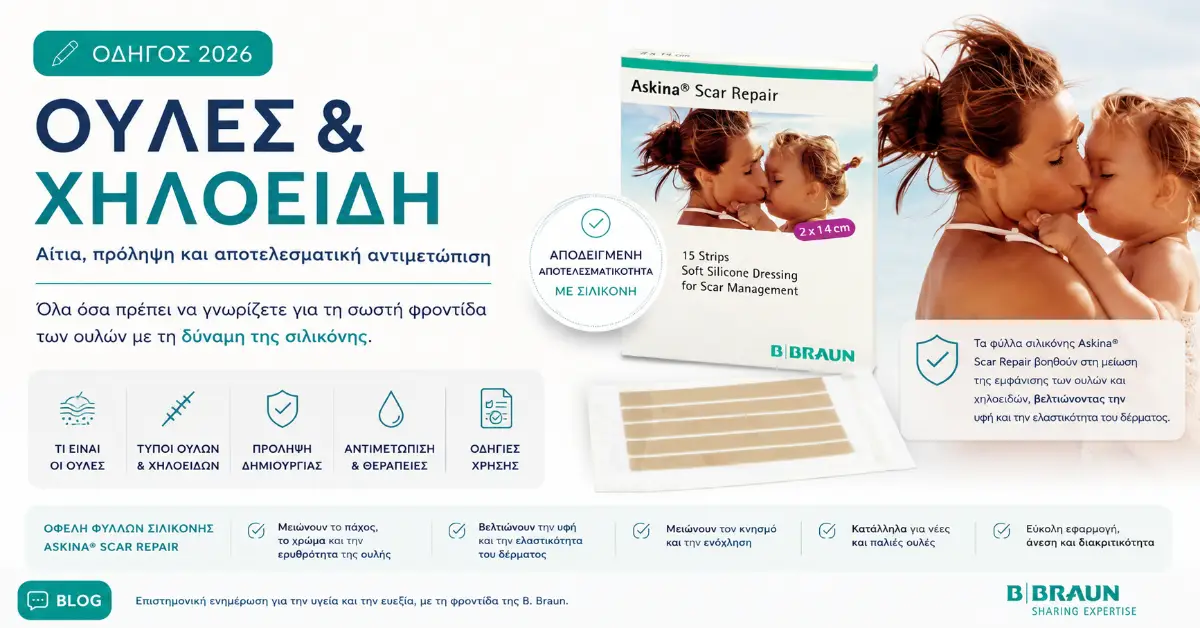
Varför ärr bildas – och vad vi kan göra åt det
Närhelst vår hud skadas – genom operation, kejsarsnitt, olycka, akne eller brännskada – påbörjar kroppen en komplex läkningsprocess som ofta resulterar i ett ärr. I de flesta fall är ärret normalt och bleknar gradvis bort. I 30–50 % av kirurgiska ingrepp blir ärret dock hypertrofiskt eller keloidt [1] – det vill säga upphöjt, rött och ofta estetiskt eller funktionellt störande.
I denna kompletta guide från Traumacare Medical Group lär du dig:
- De 4 typerna av ärr och hur man känner igen dem
- De 3 faserna av läkning och när man ska ingripa
- De moderna behandlingarna (silikon, kortison, laser, kryoterapi, kirurgi, tryck)
- Varför Askina Scar Repair (B Braun) silikonplattor är den främsta behandlingslinjen
- Hur man förebygger ett dåligt ärr från dag 1 en
- När man ska träffa en hudläkare eller plastikkirurg
De fyra typerna av ärr — Hur man känner igen dem
1. Moget ärr
Kännetecken: Platt eller lätt upphöjt, blekt eller rosa (inte rött), inom den ursprungliga skadans gränser, asymptomatisk.
Tidslinje: Bildas 6–12 månader efter skadan.
Prognos: Bra. Ingen specifik behandling behövs — endast solskydd för att förhindra mörkfärgning.
2. Hypertrofiskt ärr
Kännetecken: Upphöjt (upp till 4 mm), rött eller rosa, inom det ursprungliga sårets gränser. Kan vara kliande eller smärtsamt.
Incidens: Vid ~50 % av kejsarsnitten och många buk-/thoraxoperationer.
Prognos: Kan förbättras eller till och med försvinna med 6–12 månaders silikonbehandling.
➡️ Läs mer om hypertrofiska ärr
3. Keloidärr
Kännetecken: Mycket upphöjt, mörkrött/lila/brunt, sträcker sig bortom gränserna för det ursprungliga såret. Klåda, smärta, estetiska problem.
Riskfaktorer: Genetisk predisposition, mörk hud (Fitzpatrick III-VI), ung ålder, bröstben/axel/öronområden.
Prognos: Svårare. Kombination av silikon + kortisoninjektioner + laser. I svåra fall kirurgiskt avlägsnande + strålning.
➡️ Hela artikeln: Hypertrofisk vs Keloid
4. Atrofisk ärr
Kännetecken: Djup (under hudnivån). Vanligtvis från akne eller vattkoppor.
Subtyper: Ispinne (smal djup), Boxcar (bred med tydliga gränser), Rolling (vågig).
Prognos: Behandlas inte med silikon. Mikronålning, laserablativ, fillers eller subcision behövs.
Hur ett ärr bildas — Läkningens tre faser
Fas 1 — Inflammation | Dag 0-3
När en skada inträffar skickar kroppen ut blodplättar och vita blodkroppar. Området är rött, svullet, varmt. Normalt.
Fas 2 — Proliferation | Dag 3-21
Fibroblaster producerar snabbt typ III-kollagen. granulationsvävnad bildas. Huden sluter sig.
🎯 Kritisk fas för intervention: Det är här silikonskiktet börjar (efter läkning och borttagning av suturerna). Förebyggande > behandling.
Fas 3 — Ombyggnad | Månader 1-18
Typ III-kollagen omvandlas till typ I (samma som normal hud). Ärret mognar — blir plattare, mindre rött.
När denna balans störs (kollagenöverproduktion) bildas ett hypertrofiskt eller keloidt ärr [3] .
➡️ Detaljerad artikel om de 3 faserna av läkning
Moderna ärrbehandlingar (2026)
1. Silikonplattor — FÖRSTA VALET (Evidensnivå I)
Som nämnts är silikon förstahandsvalet för att förebygga och behandla hypertrofiska/keloida ärr. 65–90 % förbättring i kliniska studier [4] .
Hur fungerar det? Skapar en ogenomtränglig film över ärret. Bibehåller stabil hydrering, reglerar kollagenproduktionen och minskar inflammation.
Behandlingstid: 12–24 timmar/dag · 2–6 månader (färska ärr) eller 6–12 månader (gamla ärr).
B Brauns Askina Scar Repair-serie
Askina Scar Repair är självhäftande silikonark av medicinsk kvalitet med CE-klass IIa-certifiering enligt MDR 2017/745. Finns i 4 olika storlekar för att passa alla typer av ärr:
- 2x14cm (15 st) — perfekt för ärr efter kejsarsnitt (Pfannenstiel)
- 5x7,5cm (5 st) — små kirurgiska ärr, axlar, akne
- 4x30cm (5 st) — förlängda ärr (kolostomi, skolios, post-kolostomi)
- 10x18cm (5 st) — stora områden (brännskador, mastektomi)
➡️ Komplett användarhandbok för Askina-ärrreparation
➡️ Hur man väljer rätt Askina-storlek för ditt ärr
2. Kortisoninjektioner (triamcinolon)
Intralesionella kortikosteroidinjektioner. En hudläkare eller plastikkirurg gör det. Var 4-6:e vecka i 3-5 sessioner. Rekommenderas för keloider eller hypertrofiska ärr som inte svarar tillräckligt på silikon.
Kombinerad terapi: Silikon + Kortison = bättre resultat än endera behandlingen var för sig [5] .
3. Laserterapi
Pulserad färglaser (PDL) — för röda/vaskulära ärr. Fraktionerad CO2 — för atrofiska ärr. Vanligtvis 3-6 sessioner, kostar €100-300/session, täcks inte av EOPYY.
4. Kryoterapi
Kryoterapi med flytande kväve. Effektiv för små keloider. 2–3 sessioner var 4–6:e vecka.
5. Kirurgisk borttagning + strålbehandling
För stora, resistenta keloider. Kirurgisk borttagning ensam har en hög risk för återfall (50–100 %) utan samtidig behandling. Vanligtvis kombinerat med strålbehandling eller silikon postoperativt.
6. Tryckbehandling (kompressionsplagg)
Idealisk för brännskador och stora ärr. 23 timmar/dag i 6–12 månader. Kombineras med silikon.
Varför välja Askina Scar Repair
Askina Scar Repair utmärker sig av 7 huvudskäl:
- ✅ B Braun Tysk ingenjörskonst — ett av de ledande medicintekniska företagen sedan 1839
- ✅ CE klass IIa-certifiering — strikta kliniska standarder enligt MDR 2017/745
- ✅ 4 olika storlekar — passar alla ärr
- ✅ Självhäftande — ingen extra tejp behövs
- ✅ Återanvändbar (3–7 dagar per ark) — ekonomisk
- ✅ Tunn, diskret, vattentät — kan bäras under kläder, duschsäker
- ✅ 5–15 st/förpackning — täcker 2–3 månaders kontinuerlig behandling
Bruksanvisning
- Rengör och torka ärrområdet
- Skär arket till en form som sträcker sig 1–2 cm bortom ärret
- Ta bort skyddsfilmen och stift
- Använd 12–24 timmar/dag i 2–6 månader (kontinuerligt, inte intermittent)
- Rengör lakanet med vatten och mild tvål 1 gång/dag
- Byt ut när det förlorar sin klibbighet (vanligtvis 5–7 dagar)
➡️ Komplett steg-för-steg-användarguide med foton
Ärrförebyggande — Vad man ska göra från dag ett
Att förebygga är lättare än att bota. Om du ska opereras (kejsarsnitt, kolostomi, cystektomi, plastikkirurgi), börja med:
- Läkningsfas (vecka 0-2): Rengöring med Prontosan eller koksaltlösning. Ingen alkohol.
- Efter stygn (vecka 2-4): Börja med silikon (Askina Scar Repair). 12-24 timmar/dag.
- Solskydd (månader 0-12): SPF 50+ dagligen. Solen mörkar ärret permanent.
- Massage (efter månad 1): Lätt cirkulär massage 2 gånger/dag för ett tillplattat ärr.
- Undvik spänningar (månad 0-6): Ingen ansträngande träning, vikter eller stretching i området.
- Vätskebalans och näring: Protein, C-vitamin, zink för kollagen.
➡️ Komplett guide till ärrförebyggande åtgärder
Specialfall — var vi fokuserar
Kejsarsnitt
50 % av kvinnor upplever hypertrofiska ärr efter kejsarsnitt [6] . Askina Scar Repair 2x14cm (15 st) är speciellt utformad för den specifika storleken på Pfannenstiel-snittet.
${{products:182}}
➡️ Komplett guide till kejsarsnittsärr
Akneärr
Atrofiska ärr (ispikar, godsvagnar, rolling). Silikon behandlar dem INTE — microneedling, fillers eller laser behövs. För inflammatoriska akneärr på axlar och rygg kan Askina 5x7,5cm hjälpa.
➡️ Komplett guide till akneärr
Brännärr
Mer aggressiv. Kombination av silikon (Askina 10x18cm för stora områden) + tryckskydd + regelbunden övervakning.
${{products:174}}
➡️ Komplett guide till brännärr
Ärr efter bukoperation (stomi/kolostomi)
Patienter som har genomgått kolostomi, ileostomi eller cystektomi har ofta ett avlångt bukärr. Askina 4x30cm täcker idealiskt denna längd.
${{products:173}}
➡️ Ärr efter operation · Kolostomikluster
Ansiktsärr
Diskretion är avgörande. Den tunna Askina 5x7,5cm kan bäras på natten under smink under dagen. Solskydd obligatoriskt.
${{products:172}}
➡️ Ansiktsärr
När man ska uppsöka läkare
En dermatologisk eller plastikkirurgisk utvärdering rekommenderas om:
- Ärret växer snabbt eller sträcker sig bortom skadans gränser (möjlig keloid)
- Det är intensivt smärtsamt eller ständigt kliande
- Det är infekterat (rött, svullet, (varfylld)
- Förbättras inte efter 3 månader med korrekt applicerat silikon
- Du har en historia av keloider (genetisk predisposition)
- Är i ett funktionellt kritiskt område (leder, läppar, ögonlock)
Stomipatienter — Cross-Cluster Connection
Om du är en patient med kolostomi, ileostomi eller ureterostomi är ditt bukkirurgiska snitt ett idealiskt fall för Askina-silikon. Hypertrofisk ärrbildning förekommer i 30–50 % av dessa ingrepp och kan bidra till utvecklingen av parastomalt bråck om det lämnas obehandlat.
➡️ Se även: Parastomalt bråck: Förebyggande med Ally Belt
Referenser
- Gauglitz GG, Korting HC, Pavicic T, Ruzicka T, Jeschke MG. Hypertrofisk ärrbildning och keloider: patomekanismer och nuvarande och framväxande behandlingsstrategier. Mol Med. 2011;17(1-2):113-25. PubMed: 20927486
- Monstrey S, Middelkoop E, Vranckx JJ, et al. Uppdaterade praktiska riktlinjer för ärrbehandling: icke-invasiva och invasiva åtgärder. J Plast Reconstr Aesthet Surg. 2014;67(8):1017-25. PubMed: 24888226
- Berman B, Maderal A, Raphael B. Keloider och hypertrofiska ärr: Patofysiologi, klassificering och behandling. Dermatol Surg. 2017;43 Suppl 1:S3-S18. PubMed: 27347634
- Mustoe TA, Cooter RD, Gold MH, et al. Internationella kliniska rekommendationer för ärrbehandling. Plast Reconstr Surg. 2002;110(2):560-71. PubMed: 12142678
- Sproat JE, Dalcin A, Weitauer N, Roberts RS. Hypertrofiska sternala ärr: silikongelskikt kontra Kenalog-injektionsbehandling. Plast Reconstr Surg. 1992;90(6):988-92. PubMed: 1448532
- Wagner W, Alfrink M, Micke O, et al. Resultat av profylaktisk bestrålning hos patienter med resekerade keloider. Strahlenther Onkol. 2000;176(7):315-9. PubMed: 10930941
- Mustoe TA. Utvecklingen av silikonbehandling och verkningsmekanism vid ärrbehandling. Aesthetic Plast Surg. 2008;32(1):82-92. PubMed: 17968615
- Bleasdale B, Finnegan S, Murray K, et al. Användning av silikonlim för ärrreducering. Adv Wound Care. 2015;4(7):422-430. PubMed: 26155385
- O'Brien L, Jones DJ. Silikongelskikt för att förebygga och behandla hypertrofiska och keloida ärr. Cochrane Database Syst Rev. 2013;(9):CD003826. PubMed: 24030657
- British Association of Plastic Surgeons. Riktlinjer för ärrhantering. 2023.
- B. Braun Medical. Teknisk dokumentation och kliniska studier för Askina Scar Repair. 2024.
Redaktör & Redaktör
Författare: Traumacare Medical Group — exklusiva representanter för B Braun Avitum Grekland sedan 2003. Specialiserat på sårvård och ärrbehandling.
Senast uppdaterad: Maj 2026 · Friskrivning: Artikeln är informativ och ersätter inte råd från en hudläkare eller plastikkirurg. Rådfråga alltid din behandlande läkare.
Kontakta Traumacare Medical Team
Har du ett ärr och vill ha personlig rådgivning?
Gratis rådgivning om lämplig storlek på Askina Scar Repair för ditt fall.
| ✉️ Kontaktformulär | 💬 Viber Traumacare ✓ |
📞 Telefon: 2311 286262
Kontaktformulär
Hela ärr- och keloidklustret
- #1S — Vad är ett ärr? (4 typer)
- #2S — Hur ett ärr bildas (3 faser)
- #3S — Hypertrofisk vs. keloidärr
- #4S — Ärrförebyggande från dag ett
- #5S — Silikon: Hur det fungerar
- #6S — Askina ärrreparation: Komplett guide
- #7S — Hur man väljer rätt Askina-storlek
- #8S — Kejsarsnitt Ärr
- #9S — Akneärr
- #10S — Brännärr
- #11S — Ärr efter operation
- #12S — Barnärr
- #13S — Gamla ärr
- #14S — Ansiktsärr