



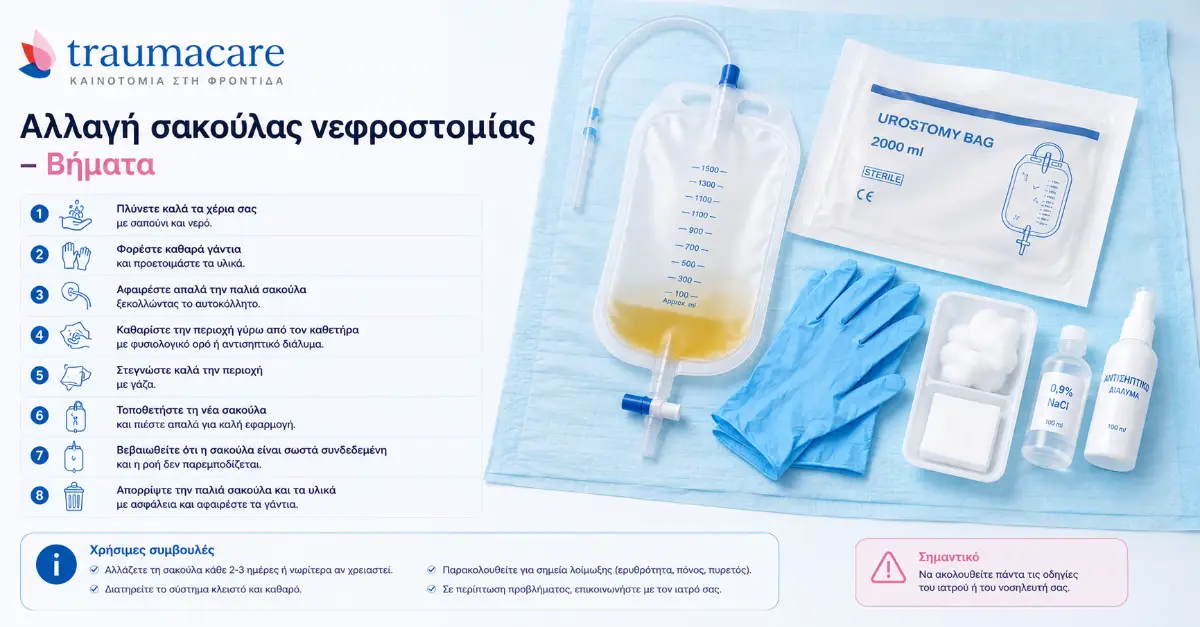
Changing a nephrostomy bag is one of the most common procedures that a patient or someone close to them needs to learn. With proper technique, it dramatically reduces the risk of infection and keeps the tube in good condition. In this guide, we will see in detail what is needed, what are the steps and what mistakes to avoid.
If you don't know what a nephrostomy is , start there. For an overall picture, see the complete care guide .
How often is it done
Under normal conditions, the nephrostomy bag is changed every 5-7 days . An earlier change is needed when:
- Leaks
- Becomes cloudy or has a bad smell
- Knocks or falls on the floor
- After heavy sweating or bathing
What you will need
- 1 new urine collection bag (CE certified — e.g. B Braun Avitum)
- 2 pairs of clean gloves (not sterile — just clean)
- Alcohol swabs or chlorhexidine antiseptic wipes
- Clean gauze
- Medical waste bag or double sealed bag
- Clean table or work tray
Preparation
- Wash your hands thoroughly with soap and water for 30 seconds.
- Clean the work surface with alcohol-based spray.
- Place all materials on a clean table, in order of use.
- Put on the first pair of gloves.
The 7 steps to switching
Step 1 — Empty the old bag
Before you begin, empty the old bag completely into the toilet to avoid leakage when disconnecting.
Step 2 — Close the clamp
At the point where the nephrostomy tube connects to the bag, close the flow stopper (if present). This will prevent urine from leaking when disconnecting.
Step 3 — Clean the connection point
Use an alcohol swab to clean the connection point between the nephrostomy catheter and the old bag. Clean in a circular motion from the inside out for 15–20 seconds. Allow to dry for 30 seconds.
Step 4 — Disconnect the old bag
With one hand, firmly hold the catheter at the connection point. With the other hand, unscrew or gently pull the bag. Caution: do not pull the nephrostomy tube upwards.
Step 5 — Reclean
Use a new alcohol swab to clean the catheter tip. This step is critical — bacterial build-up at the tip is the most common cause of infection.
Step 6 — Attach the new bag
Remove the new bag from the packaging immediately before attaching. Attach the end of the bag to the catheter with a firm motion. The end of the bag should not be touched with your fingers or anything other than the catheter.
Step 7 — Stabilization and Checking
Secure the new bag to the leg (leg bag) with the straps or to the side of the bed (night bag). Open the flow clamp. Confirm that urine begins to flow into the new bag within a few minutes.
Dispose of the old bag properly
The old bag is placed in a medical waste bag or two closed plastic bags, sealed tightly and disposed of in the household waste. In some municipalities there are special medical waste bins.
Common mistakes to avoid
- Changing in an unclean area (bathroom without prior cleaning).
- Touching the end of the new bag before connecting.
- Skipping the second cleaning (step 5).
- Pulling on the nephrostomy tube — dangerous for unintentional removal.
- Reusing an old bag — never .
- Not washing hands before.
When to call the doctor
- Leakage of fluid around the exit site despite proper connection.
- Severe pain when handling the tube.
- Fever or chills after changing.
- Difficulty connecting or damaged tube.
How long does the process take
With some practice, changing the bag can be completed in 5-7 minutes . The first few times, allow 15-20 minutes and do it slowly. It's not difficult — it just takes practice.
| ✉️ Contact form | 💬 Viber channel Traumacare ✓ |
| See all nephrostomy bags → |
Do you have any questions? Send a message
Our team will respond within 24 hours. As exclusive B Braun Avitum representatives and Convatec distributor, we help you choose the right bags with EOPYY coverage.
Contact form
Sources: Nursing Care of a Patient with Percutaneous Nephrostomy (Patras General Hospital), B Braun Avitum, Government Gazette B' 5395/2025. Informative article, does not replace medical advice.