



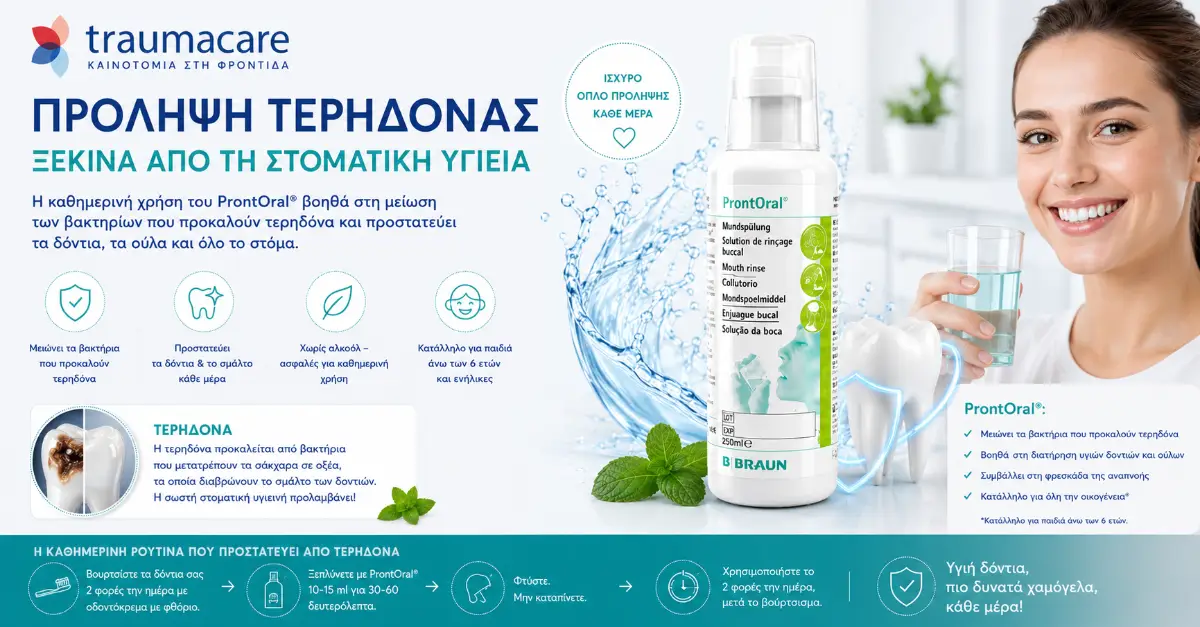
Dental caries is one of the most prevalent diseases in humans. Despite enormous advances in dentistry, 9 out of 10 adults experience dental caries. In preschool children, the incidence reaches 60–80% in many countries—including Greece.
In this article you will see what exactly tooth decay is , why it occurs , who is at increased risk and how modern prevention methods are combined — from fluoride and brushing to the use of antimicrobial solutions with polyhexanide (such as ProntOral® by B|Braun), which target the cause and not just the effect.
1. What is tooth decay
Tooth decay is a multifactorial infectious disease that leads to gradual demineralization and destruction of enamel and dentin. It is not something that “just happens” — it is the result of a specific biochemical cycle.
The quadrilateral of caries
For caries to form, 4 factors are needed simultaneously:
- Tooth vulnerable
- Pathogenic bacteria (mainly Streptococcus mutans )
- Substrate (simple sugars — glucose, sucrose, fructose)
- Time — repeated episodes of acidification
If you remove any of the 4, caries does not occur. Herein lies the key to prevention.
2. How it is created — biochemical mechanism
- Streptococcus mutans adheres to the tooth via biofilm (plaque)
- Produces the enzyme glycosyltransferase that converts sucrose to sticky glucans
- Metabolizes glucose and produces lactic acid as a byproduct
- Lactic acid drops the pH on the tooth surface below 5.5
- At low pH, the hydroxyapatite of the enamel dissolves → demineralization
- With repeated episodes → visible cavity = tooth decay
“Stephan’s curve”
After each meal/snack containing sugar, the pH on the tooth surface drops from the normal 7 to ~4.5 within minutes, and returns to 7 within 30-60 minutes (if no more sugar is ingested). The more often you eat sweets, the longer your teeth are “at risk”.
3. Risk factors
Dietary
- Frequency of sweet consumption > quantity
- Candies, lollipops , pastilles — prolonged presence of sugar in the mouth
- Sugary drinks — especially between meals
- Acidic drinks (lemon-flavored, sports drinks) — double whammy
Behavioral
- Inadequate brushing
- No flossing
- No dental visits > 1 year
- Bedtime snack without brushing
Normal
- Dry mouth (medications, Sjögren's syndrome, radiotherapy)
- Orthodontics — increase retention areas
- Genetic predisposition in enamel composition
- Post-mortem predispositions in the microbiome
Specific risk groups
- Children (enamel still mature)
- Elderly (root caries from xerostomia)
- Diabetics
- Patients undergoing chemo-/radiotherapy (mucositis + xerostomia)
- Pregnant women (acidic pH from vomiting, hormonal changes)
4. Primary prevention — the foundation
Mechanical cleaning
| Item | Frequency | Note |
|---|---|---|
| Brushing | 2× per day × 2 minutes | Soft brush or electric |
| Flossing | 1× per day | Before evening brushing |
| Interdental brushes | 1× per day | In patients with large interdental spaces |
| Cleaning tongue scraping | 1× daily | With a scraper |
Fluoride
- Fluoride toothpaste 1450 ppm (adults) or 1000 ppm (children)
- Rinse with a little water after brushing or not at all (“spit, don't rinse”)
- Professional fluoride application (varnish) 2× annually in high risk
Dietary interventions
- Reduction frequency sugary snacks
- Replacement with xylitol (chewing gum) — has anti-caries effect
- Water between meals instead of juices
- No snacks before bedtime
5. Secondary prevention — antimicrobial approach
In addition to the mechanical approach, in patients at high risk antimicrobial therapy directly targets S. mutans and the biofilm.
Why chlorhexidine is not a long-term solution
Chlorhexidine 0.12-0.2% significantly reduces streptococci, but:
- Not recommended > 14 days (teeth staining)
- Not combined with fluoride toothpaste (neutralization)
- Often causes dysgeusia
Why ProntOral® (polyhexanide) is suitable
The polyhexanide (PHMB) of ProntOral®:
- Acts against S. mutans and other oral streptococci
- Can be used long-term without staining teeth
- Does not interact with fluoride — complements the action of toothpaste
- Alcohol-free — suitable for patients with dry mouth
- Peppermint flavor — maintains compliance
Usage protocol for caries prevention
| Patient condition | Dose | Frequency | Duration |
|---|---|---|---|
| Low risk, daily use | 10 ml | 1× evening | Continuous |
| High risk | 10 ml | 2× daily | Continuous |
| Recent multiple caries | 10 ml | 2× | 3 months, evaluation |
| Orthodontic patient | 10 ml | 2× | All duration |
| Dry mouth | 10 ml | 2× + hydration | Continuously |
| Children > 4 years of age at high risk | 5 ml | 1× evening | Under medical supervision |
| Pregnant women | 10 ml | 1× | On medical recommendation |
6. Special clinical situations
Children
In children, tooth decay in baby teeth (“baby bottle tooth decay”) is mainly due to frequent exposure to sugary drinks/bottles at night. Prevention:
- No bottles with sugary drinks at night
- Cleaning teeth with gauze/brush from 6 months
- Visit to the dentist from the 1st year
- Fluoride varnish 2×/year
- From 4 years: ProntOral® 5 ml 1× evening in high-risk children
Patients undergoing head and neck radiotherapy
Radiation causes severe dry mouth and radiation caries — an attack on the root of the tooth. Prevention:
- Professional cleaning before radiotherapy
- Fluoride trays daily
- ProntOral® 4× daily throughout treatment
Elderly
Root caries is common due to hypersalivated root canals from gingival recession. We recommend:
- Daily ProntOral® on a sponge/brush
- High-fluoride toothpaste (5000 ppm)
- Visit a dentist 3-4× per year
7. When to visit a dentist
- Systematically: Cleaning 2× per year
- Immediately: If you see dark spots, feel sensitivity to cold/hot, or feel “scratching” with your tongue
8. What does NOT prevent tooth decay
- “Good “heredity” (genetic) — does not eliminate the risk
- Natural fruit juices (often as acidic as soft drinks)
- Honey/brown sugar candies (“natural” — but just as cariogenic)
- Alcohol-only solutions without fluoride/PHMB
- Brushing after an acidic meal (erodes already soft enamel — wait 30 minutes)
${{products:190}}
Editor & Editor
Editor: Traumacare Medical Group — exclusive distributor B|Braun in Greece.
Last updated: May 2026 · Disclaimer: Informative article, does not replace medical advice.
Contact the Traumacare Medical Team
Do you have questions about ProntOral®?
Free advice for use in a patient, ICU, nursing home or surgical preparation.
| ✉️ Contact form | 💬 Viber Traumacare ✓ |
📞 Phone: 2311 286262
Contact form
The entire ProntOral® Cluster
- #00 — ProntOral®: complete user guide
- #01 — Polyhexanide (PHMB) in oral decolonization
- #02 — Pre-surgical MDRO decolonization bundle
- #03 — VAP prevention in the ICU
- #04 — Mucositis in oncology patients
- #05 — ProntOral® in home care
- #06 — ProntOral® vs chlorhexidine
- #07 — From dental prophylaxis to hospital-acquired infection
- #08 — Dental plaque
- #09 — Cervical cancer
- #10 — Gingivitis
- #11 — Periodontitis
- #12 — Oral thrush
- #13 — ProntOral® vs Curasept
- #14 — ProntOral® vs Elgydium & Hexoral