



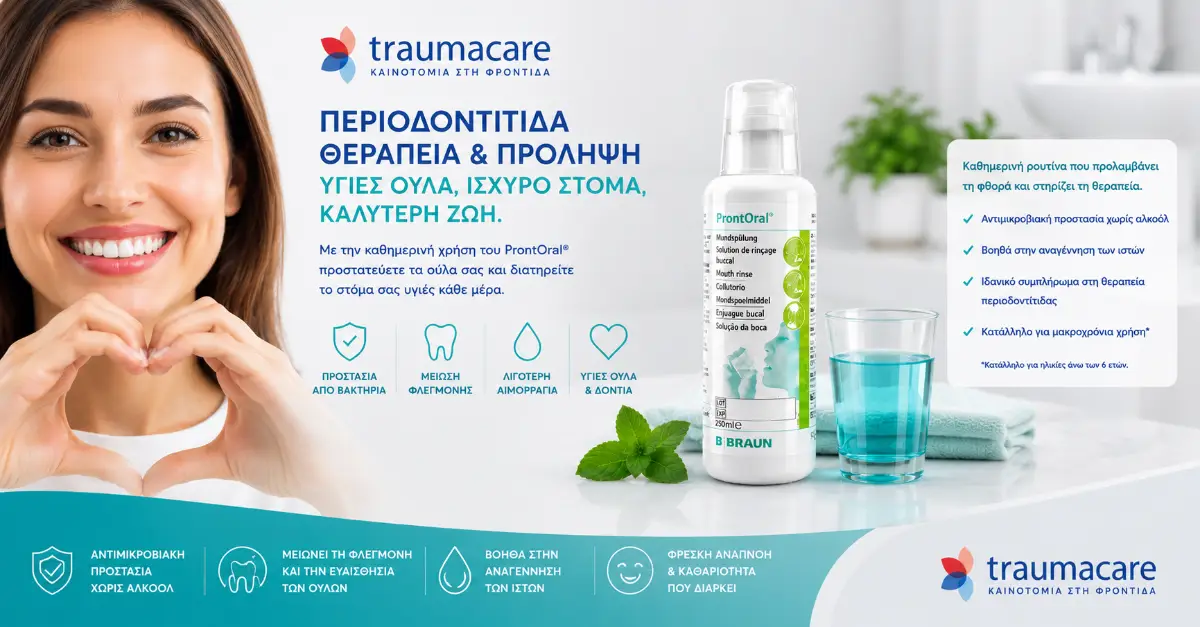
Parodontita este o boală inflamatorie cronică, distructivă a țesuturilor de susținere a dinților. Nu este rară - este a șasea cea mai frecventă boală la nivel mondial, conform OMS, și principala cauză a pierderii dinților la adulții cu vârsta peste 40 de ani.
Cu toate acestea, contrar opiniei populare, parodontita nu duce neapărat la extracție. Cu abordarea conservatoare modernă — combinarea curățării mecanice, a suportului antimicrobian (cum ar fi ProntOral® cu polihexanidă) și a unui program de întreținere — boala poate fi stabilizată, iar dinții conservați pe viață.
1. Ce este mai exact parodontita
Este o boală inflamatorie bacteriană care provoacă:
- Distrugerea colagenului gingiilor
- Formarea pungilor parodontale (pliuri mai adânci de 3 mm)
- Pierderea osoasă în jurul rădăcinilor
- Mobilitatea și, în cele din urmă pierderea dinților
Spre deosebire de gingivita care este reversibilă, parodontita distruge ireversibil țesuturile de susținere. Tratamentul este stabilizator - nu „readuce” starea la starea inițială.
2. Stadializare 2018 (EFP/AAP)
Clasificarea modernă utilizează stadializare (Stadiul I-IV) + gradare (Gradul AC) :
Stadiul — extindere și severitate
| Stadiul | Pierderea aderenței | Pierdere osoasă | Simptome |
|---|---|---|---|
| I — Inițial | 1-2 mm | <15% | Sângerare la sondare, pungi ușoare 4-5 mm |
| II — Moderat | 3-4 mm | 15-33% | Pungi 5-6 mm |
| III — Sever | ≥5 mm | > 33% | Mobilitate posibilă, pierderea unor dinți |
| IV — Foarte sever | ≥5 mm | Extinsă | Mulți dinți deja pierduți, necesită restaurare complexă |
Grad — rata de progresie
| Grad | Rată | Factori de risc |
|---|---|---|
| A — Lentă | <0,25 mm/an | Nefumător, nediabetic |
| B — Moderată | 0,25-1 mm/an | Fumat <10 cig/zi, HbA1c <7% |
| C — Rapidă | > 1 mm/an | Fumat ≥10 cig/zi, HbA1c ≥7% |
3. Cauze și factori de risc
Cauză principală
Microbiomul patogen în pungile parodontale: - Porphyromonas gingivalis (cel mai agresiv) - Tannerella forsythia - Treponema denticola - Aggregatibacter actinomycetemcomitans
Aceste bacterii formează biofilme mature în zonele subgingivale, eliberând toxine (lipopolisaharide) care declanșează inflamația cronică.
Factori exacerbanți
- Fumat (risc multiplu, prognostic nefavorabil)
- Diabet (agravant reciproc)
- Stres
- Predispoziție genetică
- Respirație pe gură
- Igienă orală precară
- Proceduri stomatologice anterioare multiple
- Obezitate
4. Terapie conservatoare modernă (ghiduri EFP)
Faza 1 — Terapie comportamentală
- Renunțarea la fumat
- Gestionarea diabetului
- Schimbări în dietă
- Instrucțiuni privind igiena orală
Faza 2 — Terapie legată de cauză
Detartraj și netezire radiculară (SRP): - Curățare profesională profundă, adesea sub anestezie locală - Îndepărtarea tartrului de la rădăcina dintelui - Lustruirea suprafeței radiculare astfel încât placa să nu revină ușor - De obicei, 2-4 ședințe (1 cadran odată)
Suport antimicrobian: - În parodontita severă, pot fi necesare antibiotice sistemice - ProntOral® de 2 ori pe zi ca tratament suportiv zilnic — de la începutul tratamentului
Faza 3 — Reevaluare (6-8 săptămâni)
- Remăsurarea tuturor markerilor
- Dacă pungile ≤4 mm + fără sângerare → trecerea la întreținere
- Dacă > 5 mm + sângerarea persistă → intervenție chirurgicală (Faza 4)
Faza 4 — Intervenție chirurgicală (unde este necesar)
- Lambouri chirurgicale pentru accesul pungilor adânci
- Chirurgie regenerativă (membrane GTR, factori de creștere)
- Unde este necesar, extracția dinților fără fundament
Faza 5 — Întreținere (Terapie parodontală de susținere)
Program pe tot parcursul vieții : - Reexaminare la fiecare 3 luni (nu este același lucru cu curățarea standard la fiecare 6 luni) - Curățarea mecanică a tuturor pungilor - Verificare pentru recurență - Protocol zilnic la domiciliu strict
5. Protocol zilnic la domiciliu pentru parodontită
| Element | Frecvență | Notă |
|---|---|---|
| Periaj | 2× pe zi × 2 minute | Tehnica Bass modificată |
| Periuțe interdentare | 1-2× pe zi | De neînlocuit în parodontită |
| Ață dentară | 1× pe zi | Ori de câte ori este posibil |
| ProntOral® 10 ml | 2× pe zi × 30 sec | Apoi periaj și folosirea aței dentare |
| Curățarea limbii | 1× pe zi | Cu o racletă |
| Ață dentară cu apă | 1× pe zi | Opțional, în cazuri grave |
6. De ce polihexanida (ProntOral®) este ideală pentru parodontită
Boala parodontală necesită tratament antimicrobian pe termen lung — nu un „tratament de 14 zile” precum clorhexidina.
Avantajele ProntOral® față de clorhexidină în parodontită
| Agent | Clorhexidină | ProntOral® |
|---|---|---|
| Utilizare zilnică pe termen lung | ❌ maxim 14 zile | ✅ continuu |
| Pătarea dinților | ✅ Frecvent | ❌ |
| Disgeuzie | 20-30% | <5% |
| Compatibilitate cu fluorură | ❌ | ✅ |
| Acțiune asupra P. gingivalis | ✅ | |
| Compatibilitate cu ortodonția | Îndoielnică | ✅ |
| La diabetici | Cu precauție | ✅ |
7. Conexiuni sistemice
Parodontita nu este „doar o gură” . Există o asociere documentată cu:
- Boli cardiovasculare (risc crescut de infarct miocardic)
- Diabet zaharat (agravare reciprocă, control glicemic scăzut)
- Naștere prematură
- Boli neurodegenerative (asociere emergentă cu Alzheimer)
- Boli renale
- Artrita reumatoidă
- Unele tipuri de cancer (digestiv)
Așadar, tratarea parodontitei nu este doar o chestiune de dinți — este o chestiune de sănătate generală
8. Prognostic
Cu un tratament adecvat și complet implementat:
- Stadiile I-II: Prognostic excelent. Întreținere pe tot parcursul vieții.
- Stadiul III: Prognostic bun pentru majoritatea dinților. Posibilă intervenție chirurgicală.
- Stadiul IV: Restaurare complexă, posibile extracții, implanturi.
Fără tratament: pierderea treptată a tuturor dinților în decurs de 10-20 de ani.
10. Când este prea târziu?
Aproape niciodată. Chiar și în Stadiul IV, progresia poate fi oprită, iar dinții rămași pot fi conservați. Cu cât mai repede, cu atât mai bine — dar stomatologia modernă revine la realitate cu prognoze prea pesimiste.
Întrebări frecvente
Este parodontita reversibilă? Nu complet. Pierderea osoasă nu este inversată cu tratament conservator (recuperare parțială doar cu chirurgie regenerativă). Cu toate acestea, boala este complet stabilizată.
Cât durează tratamentul complet? Stadiile 1-3: 2-4 luni. Stadiul 4 (dacă este necesar): 3-6 luni. Întreținere: pe tot parcursul vieții.
Am nevoie de antibiotice pentru parodontită? Nu în toate cazurile. Antibioticele sistemice (de obicei amoxicilină + metronidazol) sunt utilizate în boli severe sau cu progresie rapidă.
Este tratamentul acoperit de EOPYY? Parțial. Curățarea și unele intervenții specializate au o acoperire limitată. Consultați întotdeauna parodontologul.
Pot utiliza ProntOral® împreună cu antibioticele prescrise? Da, nicio problemă. Polihexanida nu interacționează cu antibioticele sistemice.
Este ProntOral® sigur pe implanturi? Da, în special. La pacienții cu implanturi, se recomandă utilizarea constantă pentru a preveni peri-implantita - echivalentul implantului al parodontitei.
Articole similare
- Polihexanidă (PHMB) — de ce schimbă regulile
- Gingivită: recunoaștere și tratament
- Placă dentară
- ProntOral®: ghid complet de utilizare
Comandați ProntOral® pentru gestionarea parodontitei
➤ ProntOral® 250 ml · 17,96 € · Livrare gratuită
Bibliografie
- Tonetti MS, et al. Stadializarea și gradarea parodontitei: cadru și propunere pentru o nouă clasificare. J Clin Periodontol. 2018;45 Suppl 20:S149-S161.
- Papapanou PN, et al. Parodontită: Raport de consens al grupului de lucru 2 al Atelierului Mondial din 2017. J Periodontol. 2018;89 Suppl 1:S173-S182.
- Sanz M, et al. Ghid de practică clinică EFP pentru parodontita în stadiul I-III. J Clin Periodontol. 2020;47 Suppl 22:4-60.
- Herrera D, et al. Ghid de practică clinică EFP pentru parodontita în stadiul IV. J Clin Periodontol. 2022;49 Suppl 24:4-71.
- Welk A, și colab. Efectul antimicrobian al polihexametilen biguanidei. Quintessence Int. 2016;47(5):421-431.
- B|Braun. Pagina produsului ProntOral®. catalogs.bbraun.com.
${{products:190}}
Redactor și editor
Redactor: Traumacare Medical Group — distribuitor exclusiv al B|Braun în Grecia.
Ultima actualizare: mai 2026 · Declinare a responsabilității: Articol informativ, nu înlocuiește sfatul medicului.
Contactați echipa medicală Traumacare
Aveți întrebări despre ProntOral®?
Consultație gratuită pentru utilizare în spital, secție de terapie intensivă, azil de bătrâni sau pregătire chirurgicală.
| ✉️ Formular de contact | 💬 Viber Traumacare ✓ |
📞 Telefon: 2311 286262
Formular de contact
Întregul Cluster ProntOral®
- #00 — ProntOral®: ghid complet al utilizatorului
- #01 — Polihexanidă (PHMB) în decolonizarea orală
- #02 — Pachet de decolonizare MDRO preoperatorie
- #03 — Prevenirea VAP în ATI
- #04 — Mucozită la pacienții oncologici
- #05 — ProntOral® în îngrijirea la domiciliu
- #06 — ProntOral® vs. clorhexidină
- #07 — De la profilaxia dentară la infecția nosocomială
- #08 — Placă dentară
- #09 — Cancer de col uterin
- #10 — Gingivită
- #11 — Parodontită
- #12 — Candida orală
- #13 — ProntOral® vs Curasept
- #14 — ProntOral® vs. Elgydium și Hexoral