



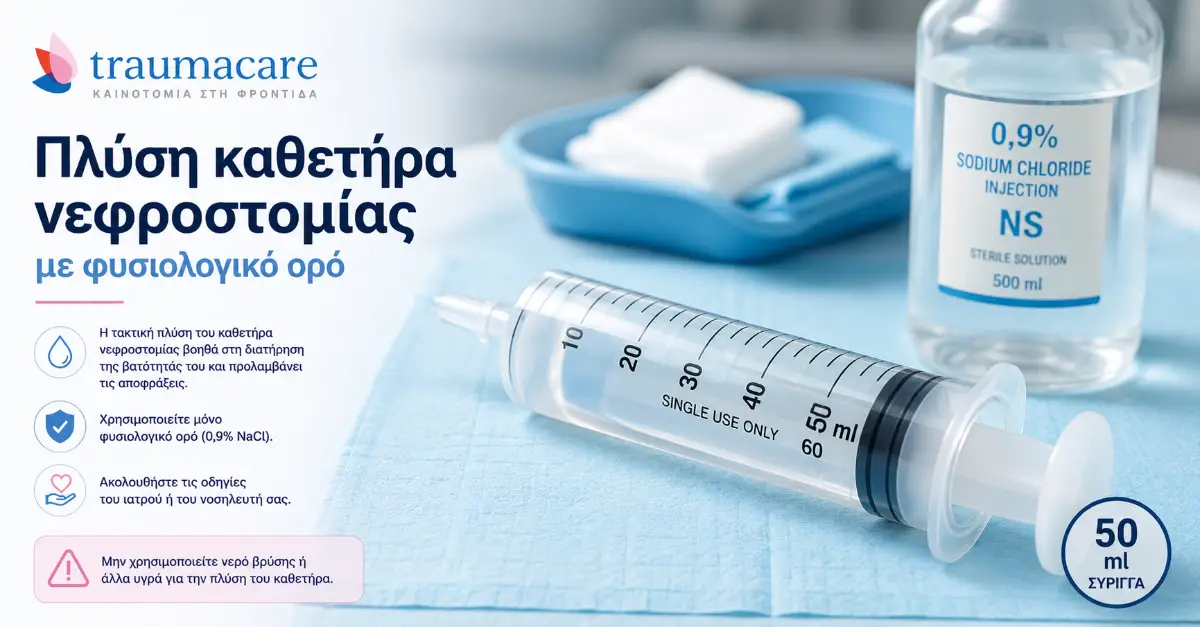
Flushing (or flushing) a nephrostomy catheter is a procedure that is sometimes done by the patient or their caregiver at home, but more often by a nurse or doctor. The purpose: to remove salts, crusts, or clots that have accumulated inside the catheter and are threatening to block it.
If you are not familiar with nephrostomy, first read what is nephrostomy or the complete care guide.
Important: Flushing should be done ONLY after training and approval from a physician. Never flush a catheter yourself without instruction. Incorrect technique can cause serious infection or pelvic rupture.
When to flush
Not routine. Flushing is recommended when:
- Reduced urine flow is observed in the bag.
- Urine becomes cloudy with visible crystalline particles.
- There is fluid leakage around the exit site (possible blockage).
- During scheduled maintenance (usually 1 time/week in patients at high risk of stone formation).
What you need
- 50 ml syringe with Luer-lock connection (clean, sterile).
- Vial of 0.9% saline (10-20 ml — never water!).
- Clean gloves.
- Alcohol swabs.
- 3-way stopcock connector (in complex cases).
Washing steps
- Wash hands, wear gloves.
- Clean the catheter-bag connection with alcohol swabs.
- Temporarily disconnect the bag and close its end with a sterile stopper.
- Connect the saline syringe directly to the catheter.
- Inject SLOWLY 5-10 ml of saline (no pressure applied — stop if resistance is encountered).
- Pull back slightly to allow the fluid to return along with any loose material.
- Remove the syringe, clean the connection again, reconnect a new bag.
Important safety rules
- Maximum amount of saline: usually 10 ml . Never more than the doctor has instructed.
- Never force — if it doesn’t go through, stop and call a doctor.
- Absolute aseptic technique — intrarenal administration of non-sterile fluid causes immediate sepsis.
- Use only 0.9% saline — not tap water, not distilled .
Signs that irrigation is not enough
If despite proper irrigation: flow does not return, there is persistent leakage, or the patient develops a fever — then the catheter probably needs to be changed. Contact a urologist.
Maintenance: how to avoid blockage
- Adequate hydration: 1.5-2 liters of water/day .
- Diet low in salts and rich in fruits/vegetables.
- Early treatment of urinary tract infections (salts increase dramatically).
- Scheduled catheter change at 8-12 weeks — do not neglect it.
Washing is a preventive solution. Correct bag change at a constant rate is of equal importance — when our relevant guide is published, the link will be activated.
| ✉️ Contact form | 💬 Viber channel Traumacare ✓ |
| See all nephrostomy products → |
Do you have any questions? Send a message
Our team will respond within 24 hours. As exclusive B Braun Avitum representatives, we supply you with irrigation syringes and saline with EOPYY coverage.
Contact form
Sources: Percutaneous Nephrostomy Nursing Care (Patras General Hospital), B Braun Avitum, Government Gazette B' 5395/2025. Informative article, does not replace medical advice.