



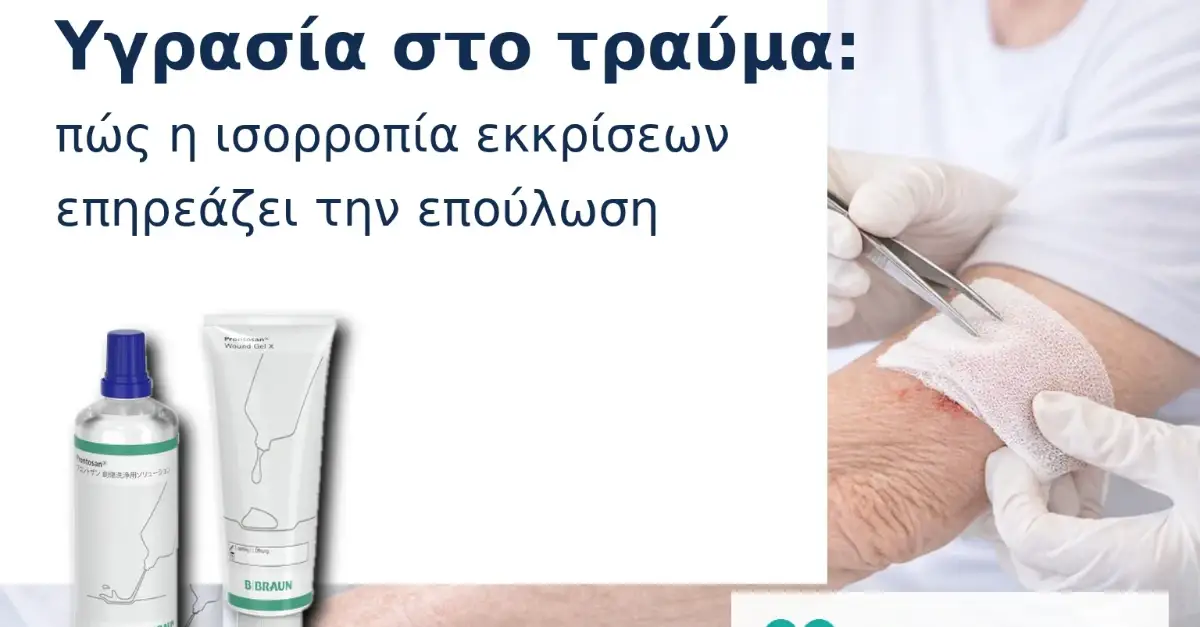
After assessing tissue (T) and inflammation/microbial burden (I), one of the most critical aspects of wound and ulcer care is moisture balance.
In the context of TIME , M (Moisture) refers to the management of exudate and the maintenance of an environment that supports healing, without burdening the wound or surrounding skin.
What does “moisture balance” mean in a wound
Healing is usually favored when the wound maintains appropriate moisture. However, the “right moisture” is not the same for all wounds and depends on:
- the amount of exudate,
- the healing phase,
- the condition of the tissue,
- and the overall clinical picture.
When there is “too much moisture”: why it is a problem
Increased exudate can lead to problems, especially when the dressing becomes saturated quickly or when fluids “run” into the surrounding skin.
In these cases, the following may occur:
- maceration of the surrounding skin,
- irritation/sensitivity and discomfort,
- increased risk of complications,
- difficulty in maintaining consistent care (frequent changes, poor compliance).
When there is “little moisture”: what can happen
On the other hand, a wound that is too dry may have difficulty in proceeding with normal healing. The following may occur:
- pulling sensation or pain,
- crust formation that makes progression difficult,
- delayed epithelialization.
How do we evaluate exudates
The amount of moisture is not the only element that matters. The pattern of discharge should also be monitored, including:
- amount (little/moderate/abundant),
- texture (thin/thick),
- color,
- odor,
- and changes from day to day.
A sudden change (e.g., sudden increase, new odor, or color change) is a reason for reassessment.
Periwound protection
Protecting the skin around the wound is as important as caring for the wound itself. The aim is to reduce skin contact with exudates and avoid irritation.
In international practice, this is usually achieved by:
- correct choice of dressing size and type,
- good fit to limit leakage,
- and appropriate protection of the peri-wound area where indicated.
Indicative categories of solutions in stage M
The following references are informative. The choice is always made depending on the appearance of the wound and in collaboration with a healthcare professional.
- Absorbent dressings for increased secretions (e.g. foam, alginate, superabsorbent), when better moisture control is needed.
- Hydrogels/gels when a more balanced environment is needed, especially when there is a need to maintain appropriate conditions in the wound.
Indicative products frequently mentioned in moisture management
The following are indicative and their use is in accordance with the instructions for use and the guidance of a healthcare professional.
-
Prontosan® Wound Gel X
Can support the maintenance of appropriate wound conditions in the context of modern care. -
Prontosan® Wound Irrigation Solution
Used in the context of care for wound cleansing, when necessary.
Note: The product reference is for informational purposes only and does not replace medical or nursing advice.
When to re-evaluate
Re-evaluation is important when:
- discharge increases sharply or changes in characteristics,
- there is leakage and irritation around the wound,
- there is increased pain,
- or healing remains stagnant.
What comes next
The next article in the series will discuss E (Edge) — that is, why the wound edges and epithelialization play a crucial role in the completion of healing.
This article is for informational purposes only and is based on internationally recognized trauma care practices. It is not a substitute for medical or nursing evaluation.
Edited by: Traumacare Team