



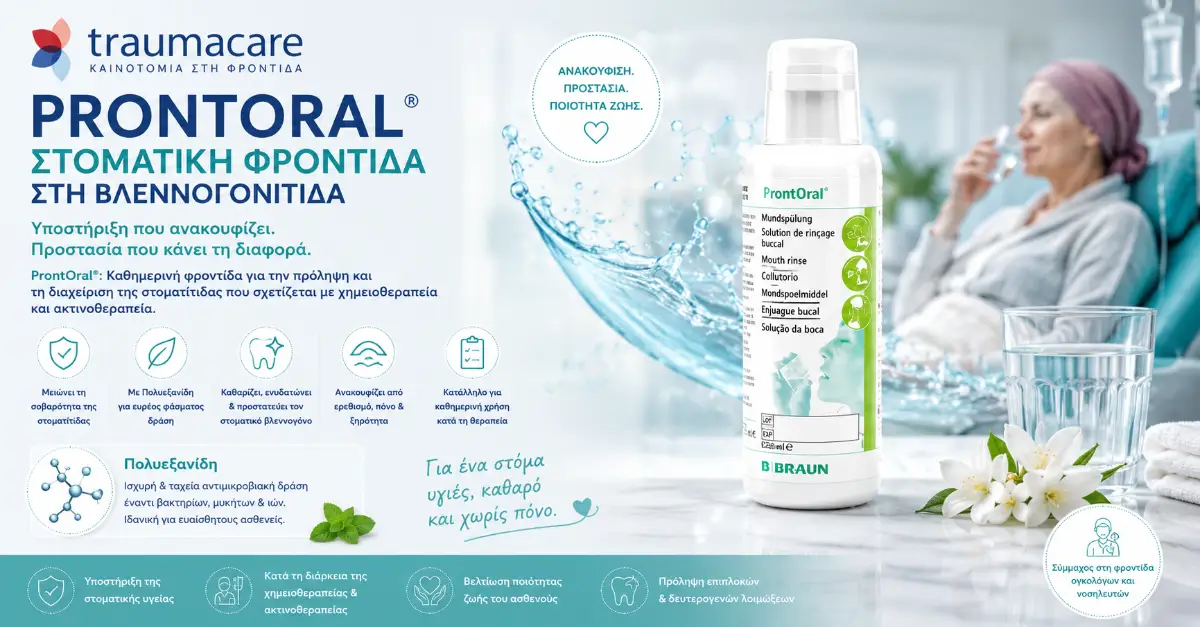
Mucositis is one of the most painful and debilitating side effects of cancer treatment. It occurs in 40% of patients receiving standard chemotherapy, 80% of patients receiving high-dose pre-transplant chemotherapy, and almost all patients receiving head and neck radiotherapy. In addition to physical discomfort, it is associated with increased opioid use, treatment discontinuation, malnutrition and risk of systemic infections.
In this deep-dive article we examine how ProntOral®—with polyhexanide as the active ingredient and without chlorhexidine or alcohol—can be integrated into a comprehensive oral care program for the oncology patient, from the preventive phase to severe WHO stages 3-4.
Traumacare Note: We collaborate with oncology clinics and day chemotherapy clinics in Greece to provide oral hygiene materials personalized to the needs of patients.
1. What is stomatitis and how does it develop
Stomatitis is classified by WHO into 5 grades:
| Grade | Clinical picture |
|---|---|
| 0 | Normal mucosa |
| 1 | Redness, sensitivity |
| 2 | Ulcerations, patient can eat solid foods |
| 3 | Ulcerations requiring a liquid diet |
| 4 | Inability to feed orally — TPN |
Progression typically follows 5 biological phases (Sonis 2004):
- Onset (Day 0-2): chemotherapy/radiotherapy causes DNA damage in epithelial basal cells
- Up-regulation (Day 2-5): inflammatory response, NF-κB activation, cytokine production
- Signal amplification (Day 5-10): reciprocal amplification of inflammatory cycle
- Ulceration (Day 8-14): epithelial loss, ulceration, bacterial colonization
- Healing (Day 14-21): neovascularization, reepithelialization
In the ulcer phase, the mucosa becomes a portal of entry for bacteremia—with significant mortality in neutropenic patients.
2. Why chlorhexidine is not the ideal choice
For years, chlorhexidine 0.12-0.2% has been used as a first-line treatment for mucositis. However, recent meta-analyses and guidelines have significantly limited its recommendation:
- MASCC/ISOO Guidelines (2020): Routine use of chlorhexidine for the prevention of mucositis in head and neck radiotherapy is not recommended due to lack of efficacy and possible worsening of clinical picture
- ESMO Clinical Practice Guidelines (2021): chlorhexidine may cause burning and increased pain in sensitive mucosa
- In addition, the alcohol contained in most chlorhexidine dries the already vulnerable mucosa
3. Why ProntOral® is suitable for the oncology patient
ProntOral® has features that make it uniquely suitable for this group of patients:
| Feature | Benefit for the oncology patient |
|---|---|
| Chlorhexidine-free | Does not aggravate mucositis or dysgeusia |
| Alcohol-free | Does not dry out the vulnerable mucosa |
| Polyhexanide (PHMB) | Targeted antimicrobial activity without cytotoxicity to epithelial cells |
| Anti-Candida activity | Covers common oral candidiasis involving mucositis |
| Good peppermint taste | Maintains compliance when taste is already impaired |
| Non-staining | Aesthetically significant for patients already troubled by image change |
| Treats mouth ulcers | Mouth ulcers are a common concomitant event |
| Treats bad breath | Important for quality of life and social contact |
| Prevention of plaque/gingivitis | In prolonged immunosuppression, gingivitis becomes a portal of entry for sepsis |
4. Prevention: the 7-day protocol before chemotherapy
The best intervention for mucositis is not to let it occur not at all . We recommend:
Days -7 to -1
- Visit to the dentist for plaque removal and repair of sensitive areas (caries, loose crown)
- Daily brushing 3× with a soft brush
- ProntOral® 10 ml 2×/day for 30 seconds
- Daily dental floss
- Oral moisturizing gel if dry mouth is present
Day of administration (Day 0)
- Morning rinse with ProntOral® before administration
- If given 5-FU or methotrexate: cryotherapy for 30 minutes during administration — strong MASCC/ISOO recommendation
Days +1 to +14
- ProntOral® 3×/day (morning - noon - evening)
- Brushing with an ultra-soft brush, avoiding vigorous movements
- Fluid replacement to maintain saliva production
- If aphthous ulcers occur: topical application of ProntOral® with a cotton swab directly to the lesion, 4×/day
5. Management of established mucositis
WHO grade 1-2
- ProntOral® 4×/day, with retention in the oral cavity for 30-60 seconds
- Topical analgesic (lidocaine 2% gel) before each meal
- Soft, high-calorie diet
- Avoid pickles, citrus fruits, hot foods
WHO grade 3
- ProntOral® 6×/day or after each meal
- Systemic analgesia (paracetamol ± opioids)
- If active aphthous ulcers are present: topical triamcinolone in carbopol gel + ProntOral® for bacterial control
- Assessment for TPN / NG tube if feeding is not possible
- If infection (Candida) suspected: topical nystatin alternating with ProntOral® at different times
WHO grade 4
- Referral to specialist team (oncologic dentistry, supportive care)
- Continue ProntOral® as part of gentle cleansing care
- Strict antimicrobial surveillance
- Chemotherapy cycle interruption/postponement if necessary
6. Special clinical conditions
Head and neck radiotherapy
- Systematic intervention from the first session
- ProntOral® 4×/day during the entire treatment and 2 weeks after
- Systematic monitoring for dry mouth and radiation caries
- Combination with high-concentration mineral fluoride
Allogeneic bone marrow transplantation
- ProntOral® part of the supportive care bundle, together with palifermin if available
- Daily monitoring for oral GVHD (Graft-versus-Host Disease)
- In GVHD: combination of ProntOral® with topical corticosteroids
Pediatric oncology
- Dosage adjusted: 5 ml × 3-4
- Children >4 years only, under adult supervision
- Right to spit, not swallow
⚕️ Indications, contraindications and safety profile in oncology patients
Indications
- Prophylactic use from day -7 before the start of chemo-/radiotherapy
- Management of mucositis of all WHO grades 1-4
- Pre-stem cell transplant in allogeneic bone marrow transplantation
- Head and neck radiotherapy throughout + 2 weeks after
- Pediatric oncology (>4 years) with adjusted dosage of 5 ml
- Adjunctive therapy to mTOR inhibitors (stomatitis-prone therapies)
Contraindications
- Known hypersensitivity to biguanides
- Children <4 years outside of specialized neonatal/infant oncology protocols
- Severe thrombocytopenia (<10,000) with active bleeding: oncologist advice before use
Side effects in oncology setting
Compared to chlorhexidine — which is no longer recommended for mucositis (MASCC/ISOO 2020) — ProntOral® exhibits:
| Side effect | ProntOral® | Chlorhexidine |
|---|---|---|
| Burning in active mucositis | <2% | 30-50% |
| Dysgeusia | <5% | 20-30% |
| Worsening xerostomia | Not reported | Common |
| Delayed mucosal healing | Not reported | Possible |
| Tooth discoloration (cosmetic issue) | No | Common |
| Allergic reaction | <0.1% | Increasing reports |
| Increased mortality in immunocompromised | None | Under investigation |
When to notify oncologist
- Increased pain despite use
- New rash or urticaria
- Fever in neutropenia (always medical referral)
- Severe gingival bleeding in thrombocytopenia
- White plaques (possible Candida — may require combination with nystatin)
Compatibility with chemo-/radiotherapy protocols
ProntOral® does not interact with: 5-FU, methotrexate, taxanes, platinum compounds, anthracyclines, or radiotherapy. The local action without systemic absorption makes it compatible with all treatment cycles.
8. Practical daily schedule for an oncology patient
| Time | Activity |
|---|---|
| 07:00 | Brushing + ProntOral® 10 ml |
| 09:00 | Breakfast → rinsing with water |
| 12:00 | Lunch → water + ProntOral® if needed |
| 14:00 | Check for canker sores, application with a swab to spots |
| 18:00 | Evening → water |
| 22:00 | Brushing + ProntOral® 10 ml + lip hydration |
9. When is immediate referral necessary
Contact the oncologist if they occur:
- Fever >38°C in a patient with neutropenia
- Weakness swallowing even liquids
- Diffuse bleeding that does not stop
- White plaques widespread (possible Candida)
- Pain not controlled by topical painkillers
10. Conclusion
Mucositis has stopped being treated as an “unavoidable side effect” and is now recognized as a clinical syndrome that is amenable to preventive and therapeutic intervention. At the heart of the modern approach is systematic oral hygiene with a mild, non-irritating, antimicrobial solution without chlorhexidine or alcohol.
ProntOral® , with only polyhexanide (PHMB) as an active ingredient, combines all the features that the oncology patient needs: activity against MDROs and Candida, no mucosal cytotoxicity, no dysgeusia or staining, and with a peppermint flavor that maintains compliance even when everything seems difficult.
Related articles in the series
- Polyhexanide (PHMB) in oral decolonization
- ProntOral® in home care for the elderly
- ProntOral® vs chlorhexidine
Order ProntOral® for an oncology patient
➤ ProntOral® 250 ml
For group orders for oncology clinics and day chemotherapy units, as well as patient education material (leaflet in A4), please contact the Traumacare team.
Bibliography
- B|Braun Melsungen AG. ProntOral® product page. catalogs.bbraun.com (accessed 2026-05).
- Sonis ST. The pathobiology of mucositis. Nat Rev Cancer. 2004;4(4):277-84.
- Elad S, et al. MASCC/ISOO clinical practice guidelines for the management of mucositis secondary to cancer therapy. Cancer. 2020;126(19):4423-31.
- Peterson DE, et al. Management of oral and gastrointestinal mucosal injury: ESMO Clinical Practice Guidelines. Ann Oncol. 2015;26 Suppl 5:v139-51.
- Lalla RV, et al. Oral complications at 6 months after radiation therapy for head and neck cancer. Oral Dis. 2017;23(8):1134-43.
- Hong CHL, et al. Systematic review of basic oral care for the management of oral mucositis in cancer patients. Support Care Cancer. 2019;27(10):3949-67.
- Müller G, Kramer A. Biocompatibility index of antiseptic agents. J Antimicrob Chemother. 2008;61(6):1281-7.
${{products:190}}
Editor & Editor
Editor: Traumacare Medical Group — exclusive distributor of B|Braun in Greece.
Last updated: May 2026 · Disclaimer: Informative article, does not replace medical advice.
Contact the Traumacare Medical Team
Do you have questions about ProntOral®?
Free advice for use in a patient, ICU, nursing home or surgical preparation.
| ✉️ Contact form | 💬 Viber Traumacare ✓ |
📞 Phone: 2311 286262