



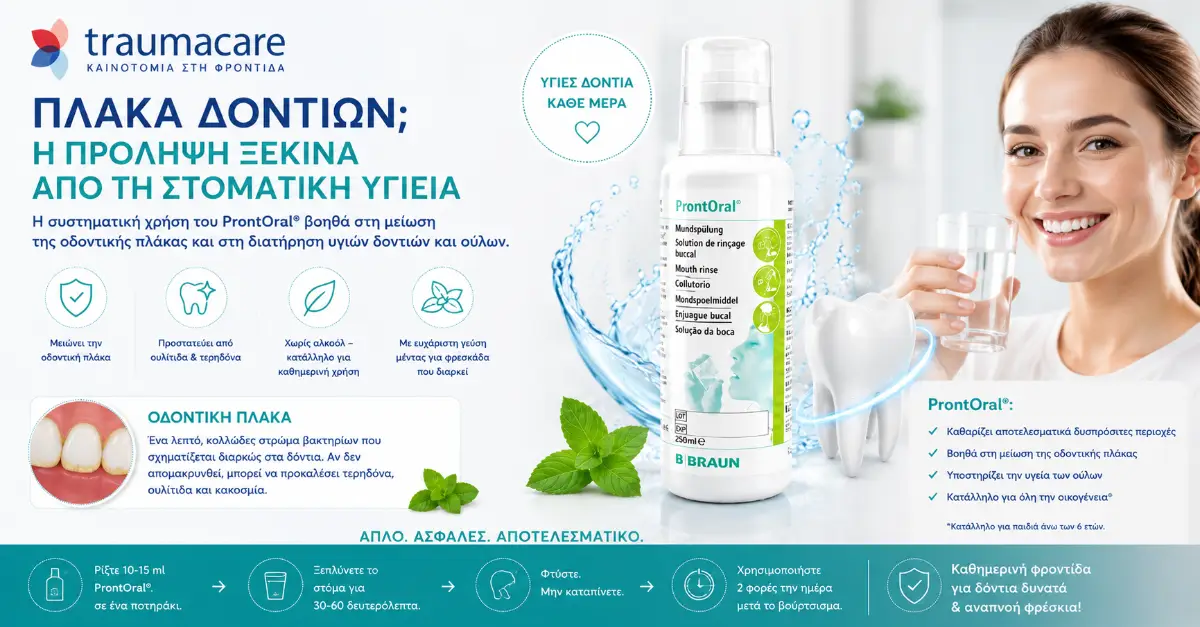
We’ve all heard of dental plaque . But few know exactly what it is, why it keeps coming back every few hours even after brushing, and why removing it is critical — not just for your smile, but for your overall health.
In this guide, you’ll learn what plaque is, how it forms biologically, what the dangers are if left unchecked, and what the most effective methods of prevention are — including using an antimicrobial solution with polyhexanide (such as ProntOral® by B|Braun).
1. What is dental plaque
Dental plaque is a biofilm — an organized community of microbes that forms on the surfaces of teeth and gums. It begins as a thin, almost invisible film and, if not removed, develops into a visible, thick layer.
One gram of mature dental plaque contains up to 10¹¹ bacteria — more than there are cells in the human body.
Plaque composition
| Component | Percentage |
|---|---|
| Water | ~80% |
| Bacteria | ~70% of dry weight |
| Proteins (from saliva) | ~10% |
| Polysaccharides | ~10% |
| Lipids | ~5% |
2. How it forms — the 4 phases
Phase 1: Pellicle (0-2 hours after brushing)
Immediately after brushing, a thin layer of glycoproteins from saliva coats the teeth. This film is essential (protects the enamel) — but it also provides a substrate for bacterial adhesion.
Phase 2: Primary colonization (2–12 hours)
Oral streptococci (mainly Streptococcus sanguinis, mitis, oralis ) adhere to the glycoprotein layer. They are aerobic bacteria, relatively benign.
Phase 3: Secondary colonization (12–48 hours)
Anaerobic bacteria are added: Actinomyces, Fusobacterium, Veillonella . The plaque becomes denser and more aggressive. Acidity around the teeth drops — enamel demineralization begins.
Phase 4: Mature plaque and biofilm (>48 hours)
The most pathogenic bacteria appear: Porphyromonas gingivalis, Tannerella forsythia, Treponema denticola . A mature biofilm is formed — a true “city” of bacteria that:
- Has an extracellular matrix that protects them
- Has “communication networks” between bacteria (quorum sensing)
- Is 1000× more resistant to antiseptics and antibiotics than the same bacteria free
From this stage onwards, the risks begin to become serious.
3. Where is it most likely to form
Plaque is favored in places that are not easily reached by brushing:
- Interdental spaces
- Behind the last molars
- Along the gum line (where the tooth-gum joins)
- Around dental restorations (crowns, implants, orthodontics)
- On rough surfaces
4. Plaque → caries: the connection
When plaque bacteria (particularly Streptococcus mutans ) metabolize sugars , produce acids (mainly lactic acid). These acids:
- Drop the pH on the tooth surface below 5.5
- Demineralize the enamel (calcium and phosphate ions are released)
- After repeated episodes → visible cavity = caries
Brushing and salivary buffering restore pH — but if plaque is mature and dense, the process exceeds nature's ability to rebalance.
5. Plaque → gingivitis → periodontitis
At the same time, plaque along the gums causes an inflammatory reaction:
- Redness of the gums
- Bleeding when brushing
- Swelling
This is gingivitis. If left untreated, over a period of months the inflammation progresses to the supporting tissues:
- Collagen destruction
- Bone loss around the teeth
- Periodontal pocket formation
This is periodontitis — the leading cause of tooth loss in adults.
6. Plaque and systemic diseases
Beyond the teeth, chronic plaque has been associated with:
- Cardiovascular disease : oral bacteria are found in atherosclerotic plaques
- Diabetes mellitus : reciprocal worsening of glycemic control
- Preterm birth : increased risk in pregnant women with severe periodontitis
- Pulmonary infections : particularly in the elderly and bedridden
- Neurodegenerative diseases : emerging association with Alzheimer's disease
7. How to effectively remove plaque
Daily protocol (gold standard)
- Brushing 2× per day , 2 minutes each time, with an electric or soft manual toothbrush
- Flossing or interdental brushes 1× per day — removes plaque where the brush cannot reach
- Antimicrobial mouthwash after brushing
- Tongue cleaning with a scraper or soft brush
Professional cleaning
- Scaling (removal of tartar) by dentist/hygienist: 2-3× per year
- Root planing (deep cleaning) in advanced periodontitis
8. Why is polyhexanide (ProntOral®) effective against plaque
Polyhexanide (PHMB) is a cationic antiseptic that:
- Penetrates the first layers of the biofilm — the surfactants in ProntOral® help destabilize the matrix
- Targets the bacterial cell membrane without to affect human epithelial cells
- Active against Streptococcus mutans — the main culprit of caries
- Active against P. gingivalis and T. forsythia — the main culprits of periodontitis
- Does not create resistance like some antibiotics
- Allows daily use long-term — unlike chlorhexidine
ProntOral® use protocol for plaque prevention
| When | Dose | Frequency |
|---|---|---|
| Daily prevention | 10 ml | 1× after evening brushing |
| Patient with high risk of caries | 10 ml | 2× daily |
| After professional cleaning | 10 ml | 2× for 7 days |
| When using orthodontics | 10 ml | 2× daily throughout the course |
9. For whom prevention is particularly critical
- Diabetics (increased risk of periodontitis)
- Pregnant women (hormonal changes in the gums)
- People with dry mouth (reduced saliva production)
- Denture users
- Patients undergoing orthodontic treatment
- Elderly
- Smokers
10. When is a dentist needed
Visit a dentist immediately if:
- Your gums bleed when brushing systematically
- You feel a constant bad breath that does not go away
- You see dark spots on your teeth
- Your teeth become loose or move
- You have pain when chewing
- You have not had cleaning >1 year
${{products:190}}
Editor & Editor
Editor: Traumacare Medical Group — exclusive distributor of B|Braun in Greece.
Last updated: May 2026 · Disclaimer: Informative article, does not replace medical advice.
Contact the Traumacare Medical Team
Do you have questions about ProntOral®?
Free consultation for use in an inpatient, ICU, nursing home or surgical preparation.
| ✉️ Contact form | 💬 Viber Traumacare ✓ |
📞 Phone: 2311 286262
Contact form
The entire ProntOral® Cluster
- #00 — ProntOral®: complete user guide
- #01 — Polyhexanide (PHMB) in oral decolonization
- #02 — Pre-surgical MDRO decolonization bundle
- #03 — VAP prevention in the ICU
- #04 — Mucositis in oncology patients
- #05 — ProntOral® in home care
- #06 — ProntOral® vs chlorhexidine
- #07 — From dental prophylaxis to hospital-acquired infection
- #08 — Dental plaque
- #09 — Cervical cancer
- #10 — Gingivitis
- #11 — Periodontitis
- #12 — Oral thrush
- #13 — ProntOral® vs Curasept
- #14 — ProntOral® vs Elgydium & Hexoral