



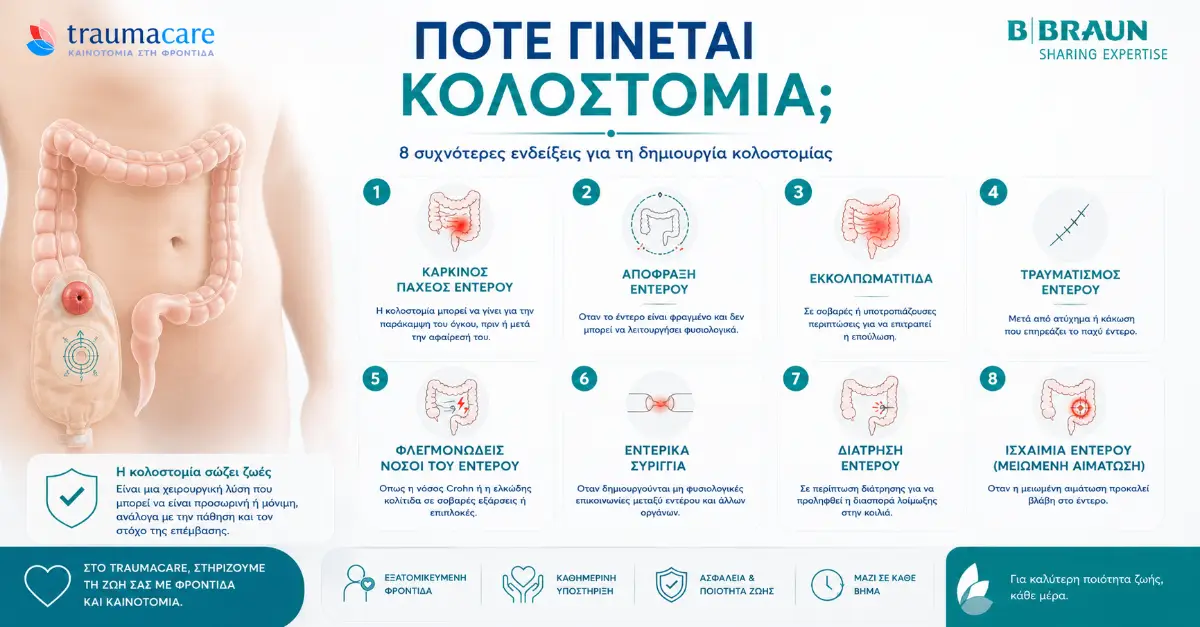
“Why did my doctor suggest a colostomy?”
A colostomy is not a “forced solution” — it is a life-saving treatment option when the colon needs to be removed or rested. In this article we explain:
- The 8 main conditions for which it is needed
- When is it permanent and when temporary
- International recommendations ASCRS, ECCO, AGA
- What does it mean for you
The 8 Basic Indications for Colostomy
| # | Indication | Frequency | Type |
|---|---|---|---|
| 1 | Colorectal cancer | ~70% | Usually permanent |
| 2 | IBD (Crohn's, Ulcerative Colitis) | ~10-15% | Permanent or temporary |
| 3 | Diverticulitis with complications | ~5-8% | Usually temporary |
| 4 | Bowel injuries | ~3-5% | Usually temporary |
| 5 | Radiation enteritis | ~2-3% | Usually permanent |
| 6 | Congenital anomalies (pediatric) | ~2-3% | Usually temporary |
| 7 | Severe fecal incontinence | ~1-2% | Permanent |
| 8 | Fistulas / Abscesses | ~1-2% | Usually temporary |
1. Colorectal Cancer (Main Indication ~70%)
Colorectal or rectal cancer is the main reason for colostomy in Greece. According to the Hellenic Cancer Society , it is the 2nd most common cancer in the country — with ~13,000 new cases per year.
According to the ASCRS Clinical Practice Guidelines [1] , colostomy is indicated when:
- Low rectal cancer — when the tumor is close to the anus and the entire recto-anal system must be removed (Abdominoperineal Resection — APR). Permanent colostomy.
- Mid/high rectal cancer — after anterior resection, often temporary colostomy or ileostomy for 3–6 months to allow the anastomosis to heal.
- Cancer in emergency presentation (obstruction, perforation) — extensive surgery with colostomy.
- Palliative colostomy — in advanced cancer for symptom relief.
➡️ See the step-by-step surgical procedure .
2. Inflammatory Bowel Disease — IBD
IBD (Inflammatory Bowel Disease) is the 2nd most common reason. According to the ECCO Guidelines (European Crohn's and Colitis Organisation) [2] :
Crohn's disease
Chronic inflammation that can affect any part of the digestive tract. Colostomy is indicated when:
- Severe intermodal manifestations (fistulas, abscesses, strictures) unresponsive to medications
- Severe anorectal disease (Crohn's proctitis)
- Emergency presentation (perforation, severe bleeding)
Ulcerative Colitis
Chronic inflammation of the colon. Colostomy (more often ileostomy with J-pouch) is indicated when:
- Not responding to medications (refractory disease)
- Dysplasia or cancer in the colonic epithelium
- Toxic megacolon (emergency)
- Serious side effects of immunosuppressive drugs
Traumacare already has a detailed article on Crohn's disease and the association with ostomy pouches.
3. Diverticulitis with Complications
Diverticulitis is inflammation of the small pouches (diverticula) in the wall of the large intestine. Common in the elderly.
According to the AGA (American Gastroenterological Association) Guidelines [3] , colostomy is indicated in:
- Diverticular perforation with peritonitis (Hinchey III/IV) — emergency
- Severe bleeding not controlled by endoscopic means
- Recurrent episodes of diverticulitis unresponsive to antibiotics
- Colonic stricture as a complication
Usually temporary (Hartmann's procedure) — reversible in 3-6 months after the inflammation has resolved.
4. Injuries to the Large Intestine
In severe abdominal injuries (traffic accidents, blunt force trauma, gunshot wounds), the large intestine may be injured. According to current trauma protocols [4] :
- Small incisions: Primary suturing without colostomy
- Large incisions or extensive infection: Primary suturing + protective colostomy (reversible in 3-6 months)
- Severe tissue destruction: Hartmann's procedure — resection and final colostomy
5. Radiation Enteritis
The Pelvic radiotherapy (most commonly for pelvic, rectal, uterine, prostate cancer) can cause chronic damage to the colon, with strictures, bleeding, and fistulas.
In severe cases that do not respond to conservative treatment, permanent colostomy significantly improves quality of life. It is a rare indication (~2-3%) but critical for selected patients.
6. Congenital Anomalies (Pediatrics)
In neonates and infants, temporary colostomy is indicated in [5] :
- Hirschsprung's disease — absence of ganglion cells causing chronic constipation
- Anorectal malformations — absence of a normal passage from the rectum to the anus
- Necrotizing enterocolitis (NEC) — severe inflammation in premature infants
- Meconium syndrome — in infants with cystic fibrosis
In pediatric cases, the colostomy is almost always reversed when the child is older and the condition is treated surgically.
7. Severe Faecal Incontinence
Rare indication — only when incontinence is refractory to all other treatments (medication, biofeedback, sacral neurotransmission, sphincter surgical repair) and severely impairs quality of life.
Most commonly indicated in elderly patients with: neurological diseases (Parkinson's, multiple sclerosis), nerve damage from previous surgery, or severe bed rest/inability to self-care.
8. Pelvic Fistulas & Abscesses
Complex rectovaginal, rectovesical, or rectodermal fistulas that do not respond to other treatments. Most often after radiation or in severe Crohn's.
Colostomy "unburdens" the rectum and allows the fistulas to heal. Usually temporary — reversible when the fistulas close.
Permanent or Temporary Colostomy;
According to the overall data in Greece [6] :
| Type | Frequency | Most common indications |
|---|---|---|
| Permanent | ~70% | Rectal/anal cancer (APR), severe incontinence, actinic enteritis, severe Crohn's of the anus |
| Temporary | ~30% | After anastomosis (to heal), perforation, trauma, diverticulitis, pediatric cases |
In temporary colostomy, reversal (re-anastomosis) is done with a second operation at:
- 3-6 months (after rectal anastomosis)
- 3-6 months (after Hartmann's for diverticulitis)
- 6-12 months (post-injury, for healing)
International Recommendations (ASCRS, ECCO, AGA)
Decisions about colostomy are made individually by your surgeon, following current international guidelines:
- ASCRS Clinical Practice Guidelines — American Society of Colon and Rectal Surgeons (USA) [1]
- ECCO Guidelines — European Crohn's and Colitis Organisation [2]
- AGA Guidelines — American Gastroenterological Association [3]
- ESCP Guidelines — European Society of Coloproctology [7]
- ACPGBI Guidelines — Association of Coloproctology of GB & Ireland [8]
What It Means for You — Next Steps
If you have been diagnosed with any of the above conditions and your doctor has recommended a colostomy:
- Discuss all options with the surgeon — sometimes there are alternatives (e.g. J-pouch instead of colostomy in UC)
- Find out the type (permanent or temporary) and the expected duration
- Ask for a second opinion if in doubt — in non-emergency cases
- Book a free consultation with Traumacare for B Braun Flexima material selection and EOPYY preparation
- Read our cluster articles about procedure, recovery, daily life
Free Pre-Surgical Consultation
| ✉️ Contact form | 💬 Viber Traumacare ✓ |
Related articles
- Pillar C: Complete Colostomy Guide 2026
- What is a colostomy? (3 types)
- Colostomy surgery: the step-by-step process
- Comparison: colostomy vs ileostomy vs ureterostomy
- Crohn's disease — causes, statistics, pouches
Author: Traumacare Medical Group — exclusive representatives of B Braun Avitum in Greece
Scientific documentation: ASCRS Clinical Practice Guidelines, ECCO Guidelines (Crohn's and UC), AGA Guidelines on Diverticulitis, ESCP Guidelines, ACPGBI Position Statements, Government Gazette B' 5395/09-10-2025
Last updated: May 2026
Note: The decision for a colostomy is made individually by your surgeon. The article is for informational purposes only and is not a substitute for medical advice.
📚 Βιβλιογραφία / Επιστημονικές πηγές
- ASCRS Clinical Practice Guidelines for the Treatment of Rectal Cancer . American Society of Colon and Rectal Surgeons. fascrs.org
- ECCO Guidelines on the Management of Crohn's Disease and Ulcerative Colitis . European Crohn's and Colitis Organisation. ecco-ibd.eu
- Hall J et al. AGA Clinical Practice Guidelines on the Management of Acute Diverticulitis . Gastroenterology . American Gastroenterological Association. gastro.org
- EAST Practice Management Guidelines for Penetrating Trauma to the Colon . Eastern Association for the Surgery of Trauma. east.org
- APSA Clinical Practice Guidelines for Pediatric Stoma Care . American Pediatric Surgical Association. apsapedsurg.org
- Vonk-Klaassen SM et al. Ostomy-related problems and their impact on quality of life . Quality of Life Research , 2016. pubmed.ncbi.nlm.nih.gov
- ESCP Guidelines on Stoma Care . European Society of Coloproctology. escp.eu.com
- ACPGBI Position Statement on Pre-operative Stoma Siting and Education . Association of Coloproctology of Great Britain and Ireland. acpgbi.org.uk
- ΦΕΚ Β' 5395/09-10-2025 — Πίνακας 11, Α/Α 2 (Υλικά Κολοστομίας) . Εθνικό Τυπογραφείο. eopyy.gov.gr