



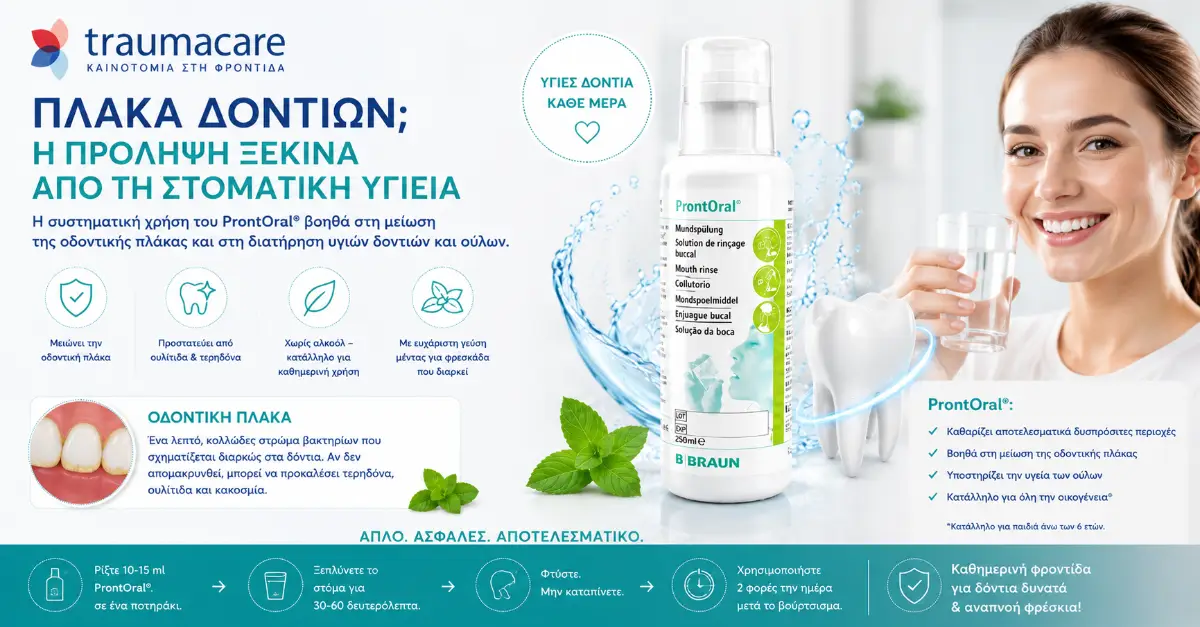
Όλοι έχουμε ακούσει για την οδοντική πλάκα. Λίγοι όμως ξέρουν τι ακριβώς είναι, γιατί επανέρχεται κάθε λίγες ώρες ακόμα και μετά από βούρτσισμα, και γιατί η εξάλειψή της είναι κρίσιμη — όχι μόνο για το χαμόγελο, αλλά και για τη συστηματική υγεία.
Σε αυτόν τον οδηγό θα μάθετε τι είναι η πλάκα, πώς σχηματίζεται σε επίπεδο βιολογίας, τι κινδύνους κρύβει αν την αφήσετε ανεξέλεγκτη και ποιες είναι οι πιο αποτελεσματικές μέθοδοι πρόληψης — συμπεριλαμβανομένης της χρήσης αντιμικροβιακού διαλύματος με πολυεξανίδη (όπως το ProntOral® της B|Braun).
1. Τι είναι η οδοντική πλάκα
Η οδοντική πλάκα είναι ένα βιοφίλμ — μια οργανωμένη μικροβιακή κοινότητα που σχηματίζεται στις επιφάνειες των δοντιών και των ούλων. Ξεκινά ως μια λεπτή, σχεδόν αόρατη μεμβράνη και, αν δεν αφαιρεθεί, μετατρέπεται σε ορατό, παχύ στρώμα.
Σε ένα γραμμάριο ώριμης οδοντικής πλάκας υπάρχουν έως 10¹¹ βακτήρια — περισσότερα από τα ανθρώπινα κύτταρα του σώματος.
Σύνθεση πλάκας
| Συστατικό | Ποσοστό |
|---|---|
| Νερό | ~80% |
| Βακτήρια | ~70% του ξηρού βάρους |
| Πρωτεΐνες (από σάλιο) | ~10% |
| Πολυσακχαρίτες | ~10% |
| Λιπίδια | ~5% |
2. Πώς σχηματίζεται — οι 4 φάσεις
Φάση 1: Pellicle (0-2 ώρες μετά τον καθαρισμό)
Αμέσως μετά το βούρτσισμα, μια λεπτή στιβάδα γλυκοπρωτεϊνών από το σάλιο επικαλύπτει τα δόντια. Αυτή η μεμβράνη είναι απαραίτητη (προστατεύει το σμάλτο) — αλλά αποτελεί και υπόβαθρο για βακτηριακή προσκόλληση.
Φάση 2: Πρωτογενής αποικιοποίηση (2-12 ώρες)
Στρεπτόκοκκοι του στόματος (κυρίως Streptococcus sanguinis, mitis, oralis) προσκολλώνται στη γλυκοπρωτεϊνική στιβάδα. Είναι αερόβια βακτήρια, σχετικά καλόβολα.
Φάση 3: Δευτερογενής αποικιοποίηση (12-48 ώρες)
Αναερόβια βακτήρια προστίθενται: Actinomyces, Fusobacterium, Veillonella. Η πλάκα γίνεται πιο πυκνή και πιο επιθετική. Η οξύτητα γύρω από τα δόντια πέφτει — ξεκινά η απομεταλλοποίηση του σμάλτου.
Φάση 4: Ώριμη πλάκα και βιοφίλμ (>48 ώρες)
Τα πιο παθογόνα βακτήρια εμφανίζονται: Porphyromonas gingivalis, Tannerella forsythia, Treponema denticola. Σχηματίζεται ώριμο βιοφίλμ — μια πραγματική “πόλη” βακτηρίων που:
- Έχει εξωκυττάρια θεμέλια (matrix) που τα προστατεύει
- Έχει “δίκτυα επικοινωνίας” μεταξύ βακτηρίων (quorum sensing)
- Είναι 1000× πιο ανθεκτική σε αντισηπτικά και αντιβιοτικά από τα ίδια βακτήρια ελεύθερα
Από αυτή τη φάση και μετά, οι κίνδυνοι αρχίζουν να γίνονται σοβαροί.
3. Πού σχηματίζεται περισσότερο
Η πλάκα ευνοείται σε σημεία που δεν φτάνει εύκολα το βούρτσισμα:
- Μεσοδόντια διαστήματα
- Πίσω από τους τελευταίους γομφίους
- Κατά μήκος της ουλικής γραμμής (όπου ενώνεται δόντι-ούλα)
- Γύρω από οδοντικές αποκαταστάσεις (στεφάνες, εμφυτεύματα, ορθοδοντικά)
- Σε επιφάνειες με τραχύτητα
4. Πλάκα → τερηδόνα: η σύνδεση
Όταν τα βακτήρια της πλάκας (ιδιαίτερα ο Streptococcus mutans) μεταβολίζουν σάκχαρα, παράγουν οξέα (κυρίως γαλακτικό). Αυτά τα οξέα:
- Πέφτουν το pH στην επιφάνεια του δοντιού κάτω από 5.5
- Απομεταλλοποιούν το σμάλτο (απελευθερώνονται ιόντα ασβεστίου και φωσφορικά)
- Μετά από επανειλημμένα επεισόδια → ορατή κοιλότητα = τερηδόνα
Το βούρτσισμα και το σιελικό buffer επανέρχουν το pH — αλλά αν η πλάκα είναι ώριμη και πυκνή, η διαδικασία υπερβαίνει την ικανότητα της φύσης να επανισορροπεί.
5. Πλάκα → ουλίτιδα → περιοδοντίτιδα
Παράλληλα, η πλάκα κατά μήκος των ούλων προκαλεί φλεγμονώδη αντίδραση:
- Ερυθρότητα ούλων
- Αιμορραγία στο βούρτσισμα
- Πρήξιμο
Αυτή είναι η ουλίτιδα. Αν δεν θεραπευτεί, σε μηνιαία βάση η φλεγμονή προχωρά στους υποστηρικτικούς ιστούς:
- Καταστροφή κολλαγόνου
- Απώλεια οστού γύρω από τα δόντια
- Σχηματισμός περιοδοντικών θυλάκων
Αυτή είναι η περιοδοντίτιδα — η κύρια αιτία απώλειας δοντιών σε ενήλικες.
6. Πλάκα και συστηματικές νόσοι
Πέρα από τα δόντια, η χρόνια πλάκα έχει συσχετιστεί με:
- Καρδιαγγειακή νόσος: στοματικά βακτήρια εντοπίζονται σε αθηρωματικές πλάκες
- Σακχαρώδης διαβήτης: αμοιβαία επιδείνωση του γλυκαιμικού ελέγχου
- Πρόωρος τοκετός: αυξημένος κίνδυνος σε εγκύους με σοβαρή περιοδοντίτιδα
- Πνευμονικές λοιμώξεις: ιδιαίτερα σε ηλικιωμένους και κλινήρεις
- Νευροεκφυλιστικές νόσοι: αναδυόμενη συσχέτιση με νόσο Alzheimer
7. Πώς αφαιρούμε αποτελεσματικά την πλάκα
Καθημερινό πρωτόκολλο (gold standard)
- Βούρτσισμα 2× την ημέρα, 2 λεπτά κάθε φορά, με ηλεκτρική ή μαλακή χειροκίνητη βούρτσα
- Οδοντικό νήμα ή μεσοδόντια βουρτσάκια 1× την ημέρα — αφαιρεί πλάκα όπου δεν φτάνει η βούρτσα
- Αντιμικροβιακό στοματικό διάλυμα μετά το βούρτσισμα
- Καθαρισμός γλώσσας με ξύστρα ή μαλακή βούρτσα
Επαγγελματικός καθαρισμός
- Scaling (αφαίρεση τρυγίας) από οδοντίατρο/υγιεινολόγο: 2-3× ετησίως
- Root planing (βαθύς καθαρισμός) σε προχωρημένη περιοδοντίτιδα
8. Γιατί η πολυεξανίδη (ProntOral®) είναι αποτελεσματική κατά της πλάκας
Η πολυεξανίδη (PHMB) είναι ένα κατιονικό αντισηπτικό που:
- Διεισδύει στα πρώτα στρώματα του βιοφίλμ — τα surfactants του ProntOral® βοηθούν την αποσταθεροποίηση της matrix
- Στοχεύει την κυτταρική μεμβράνη των βακτηρίων χωρίς να επηρεάζει τα ανθρώπινα επιθηλιακά κύτταρα
- Δρα κατά Streptococcus mutans — του κύριου ένοχου της τερηδόνας
- Δρα κατά P. gingivalis και T. forsythia — των κύριων ένοχων της περιοδοντίτιδας
- Δεν δημιουργεί ανθεκτικότητα όπως κάποια αντιβιοτικά
- Επιτρέπει καθημερινή χρήση μακροχρόνια — σε αντίθεση με τη χλωρεξιδίνη
Πρωτόκολλο χρήσης ProntOral® για πρόληψη πλάκας
| Πότε | Δόση | Συχνότητα |
|---|---|---|
| Καθημερινή πρόληψη | 10 ml | 1× μετά το βραδινό βούρτσισμα |
| Ασθενής με υψηλό κίνδυνο τερηδόνας | 10 ml | 2× ημερησίως |
| Μετά από επαγγελματικό καθαρισμό | 10 ml | 2× για 7 ημέρες |
| Σε χρήση ορθοδοντικών | 10 ml | 2× ημερησίως καθ’ όλη τη διάρκεια |
9. Σε ποιους η πρόληψη είναι ιδιαίτερα κρίσιμη
- Διαβητικοί (αυξημένος κίνδυνος περιοδοντίτιδας)
- Έγκυες γυναίκες (ορμονικές αλλαγές στα ούλα)
- Άτομα με ξηροστομία (μειωμένη παραγωγή σάλιου)
- Χρήστες οδοντοστοιχιών
- Ασθενείς υπό ορθοδοντική θεραπεία
- Ηλικιωμένοι
- Καπνιστές
10. Πότε χρειάζεται οδοντίατρος
Επισκεφθείτε άμεσα οδοντίατρο εάν:
- Τα ούλα αιμορραγούν στο βούρτσισμα συστηματικά
- Νιώθετε σταθερή κακοσμία που δεν φεύγει
- Βλέπετε σκουρόχρωμα σημεία στα δόντια
- Τα δόντια χαλαρώνουν ή μετακινούνται
- Έχετε πόνο στο μάσημα
- Δεν έχετε κάνει καθαρισμό >1 χρόνο
${{products:190}}
Συντάκτης & Επιμέλεια
Συντάκτης: Ιατρική Ομάδα Traumacare — αποκλειστικός διανομέας B|Braun στην Ελλάδα.
Τελευταία ενημέρωση: Μάιος 2026 · Disclaimer: Ενημερωτικό άρθρο, δεν αντικαθιστά τη συμβουλή ιατρού.
Επικοινωνία με την Ιατρική Ομάδα Traumacare
Έχετε ερωτήσεις για το ProntOral®;
Δωρεάν συμβουλή για χρήση σε ασθενή, ΜΕΘ, οίκο ευγηρίας ή χειρουργική προετοιμασία.
| ✉️ Φόρμα επικοινωνίας | 💬 Viber Traumacare ✓ |
📞 Τηλέφωνο: 2311 286262
Φόρμα επικοινωνίας
Όλο το Cluster ProntOral®
- #00 — ProntOral®: πλήρης οδηγός χρήσης
- #01 — Πολυεξανίδη (PHMB) στη στοματική αποαποικιοποίηση
- #02 — Pre-surgical MDRO decolonization bundle
- #03 — VAP prevention στη ΜΕΘ
- #04 — Mucositis σε ογκολογικούς ασθενείς
- #05 — ProntOral® στη φροντίδα κατ' οίκον
- #06 — ProntOral® vs χλωρεξιδίνη
- #07 — Από την οδοντιατρική προφύλαξη στη νοσοκομειακή λοίμωξη
- #08 — Πλάκα στα δόντια
- #09 — Τερηδόνα
- #10 — Ουλίτιδα
- #11 — Περιοδοντίτιδα
- #12 — Άφθες στόματος
- #13 — ProntOral® vs Curasept
- #14 — ProntOral® vs Elgydium & Hexoral