



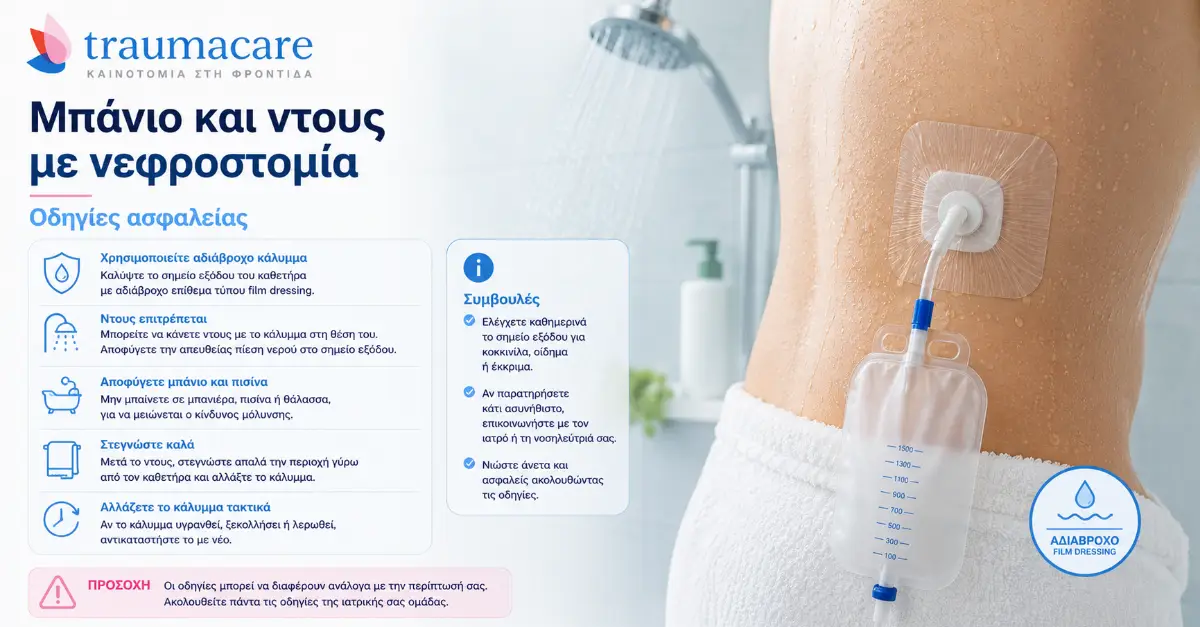
One of the most common questions patients ask after a nephrostomy is: “Can I shower?” The short answer: yes, you can shower with proper preparation. But there are limitations—and rules that are critical to avoiding infection.
If you are not familiar with nephrostomy, read what is nephrostomy or the complete care guide .
Showering — allowed
After the first 48-72 hours after placement, and after your doctor gives the green light, you may shower under the following conditions:
- The exit site is well covered with a waterproof transparent film dressing .
- The nephrostomy bag is emptied before showering.
- The water temperature is moderate (not too hot).
What is NOT allowed
- Bathing in a bathtub — total immersion is not recommended.
- Swimming in a pool or sea — high risk of contamination from untested water quality.
- Sauna and hammam — evaporation and pressure can dislodge the catheter.
- Washing with soap directly at the exit site — prefer mild pH-neutral soap away from the catheter.
Which waterproof dressing to choose
Transparent polyurethane film dressings (such as Tegaderm, OpSite, Hydrofilm) are ideal. They allow the skin to breathe but are impermeable to water. If combined with chlorhexidine, they provide additional antimicrobial protection.
Dimensions: 10×12 cm or 15×20 cm, depending on the size of the wound. Duration: up to 7 days on a dressing, if it does not show moisture or detachment. They are covered by EOPYY as part of ostomy care.
Steps before showering
- Empty the bag.
- Ensure that the film dressing is well positioned and without folds at the edges.
- Additionally cover the foot bag with a waterproof case or plastic bag.
- Set the water to a medium temperature.
- Avoid direct water spray at the exit point.
After showering
- Dry carefully around the dressing.
- Check for looseness or moisture at the edges.
- If necessary, change the dressing using aseptic technique.
- Clean the foot bag thoroughly if it gets wet.
Daily hygiene
Regardless of showering, daily cleaning around the exit site with sterile gauze and antiseptic (usually 2% chlorhexidine) significantly reduces the risk of infection. The correct technique is a circular motion from the inside out, with a new gauze each time.
When do I change the film dressing
- Every 5-7 days under normal conditions.
- Immediately if it becomes flaky or wet.
- After heavy sweating.
- If you notice redness or pus — contact a doctor immediately.
When a quick bag change is needed
If, despite precautions, the leg bag gets wet or dirty, it needs to be changed immediately (link will be activated when our relevant guide is published).
| ✉️ Contact form | 💬 Viber channel Traumacare ✓ |
| See all nephrostomy products → |
Do you have any questions? Send a message
Our team will respond within 24 hours. We are exclusive B Braun Avitum representatives and Convatec distributor, with EOPYY contract since 2014.
Contact form
Sources: Percutaneous Nephrostomy Nursing Care (Patras General Hospital), B Braun Avitum, Government Gazette B' 5395/2025. Informative article, does not replace medical advice.