



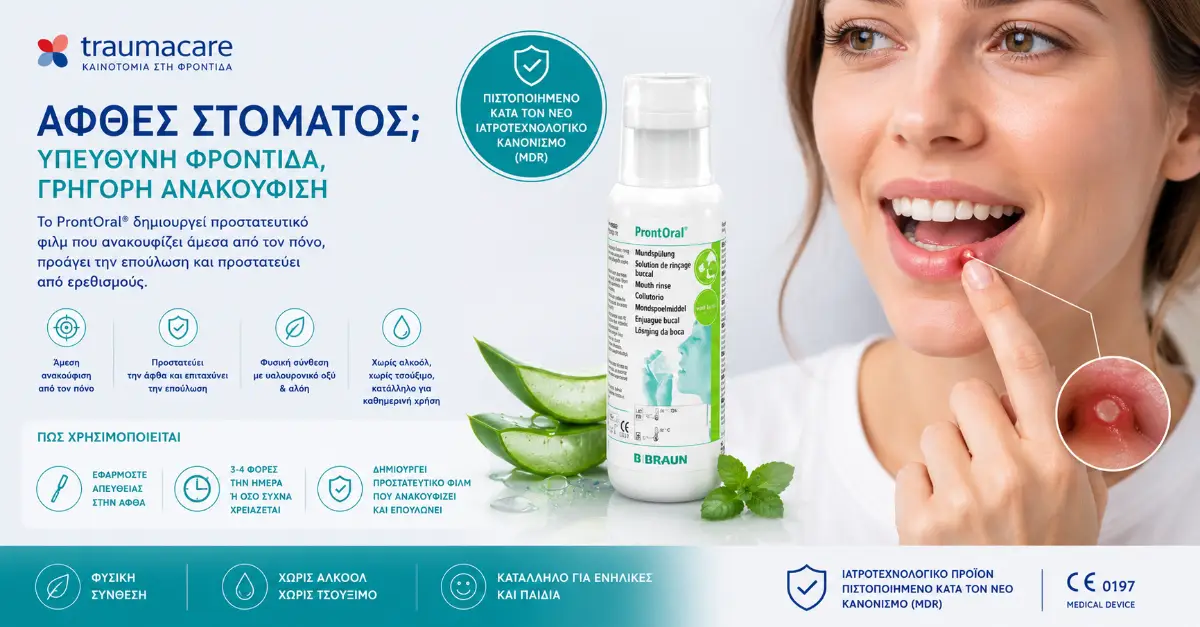
Una afta dentro de la boca o la mejilla puede arruinar la calidad de vida de una persona durante una semana: dificultad para comer, besar, hablar, cualquier contacto con los alimentos. Aunque las aftas son una de las afecciones orales más comunes (que afectan al 20-30% de la población periódicamente), a menudo se tratan con un cuidado inadecuado o incorrecto.
En esta guía, aprenderá exactamente qué son las aftas, por qué ocurren, en qué se diferencian de otras lesiones orales y cómo tratarlas eficazmente, desde tratamientos sintomáticos tópicos hasta una solución antimicrobiana de polihexanida (ProntOral®) que acelera la curación.
1. ¿Qué son las aftas?
Las aftas son úlceras pequeñas, redondas u ovaladas dentro de la boca. Características:
- Redonda u ovalada
- Centro blanco amarillento con un halo rojo alrededor
- Dolorosa, especialmente al contacto con alimentos o líquidos
- No contagiosa
- Ubicada en mucosa móvil (mejillas, labios, lengua, paladar)
- No en partes duras (encías, paladar duro)
2. Diferencias con otras lesiones orales
| Afección | Características | Contagio |
|---|---|---|
| Aftas | Centro amarillo, redondo | No |
| Herpes (HSV-1) | Ampollas que se rompen, comunes en los labios | Sí |
| Candida | Placas blancas que se desprenden | Potencial |
| Leucoplasia | Área blanca que no desaparece | No |
| Cáncer oral | Úlcera >2 semanas sin curación | No |
3. Tipos de úlceras aftosas
Úlceras aftosas menores — 80%
- Diámetro <1 cm
- Curación en 7-14 días
- Sin cicatrices
- Generalmente solitarias o 2-3 a la vez
Úlceras aftosas mayores — 10-15%
- Diámetro >1 cm
- Sana en 4-6 semanas
- Puede dejar una cicatriz
- Más doloroso
Herpetiforme — 5-10%
- Muchos pequeños (<3 mm), en grupos de 10-100
- No está relacionado con el virus del herpes a pesar del nombre
- Sana en 7-14 días
4. Causas — por qué ocurren
La causa exacta no se comprende completamente — pero conocemos muchos desencadenantes :
Factores locales
- Trauma (mordeduras, alimentos duros, alambre de ortodoncia)
- Cepillado vigoroso
- Lauril sulfato de sodio (SLS) en pastas dentales: un posible desencadenante en dientes sensibles
Factores sistémicos
- Estrés intenso
- Privación del sueño
- Cambios hormonales (menstruación)
- Deficiencias vitamínicas B12, ácido fólico, hierro, zinc
- Intolerancia alimentaria (gluten, nueces, chocolate)
Enfermedades sistémicas
- Enfermedad de Crohn
- Enfermedad celíaca
- Enfermedad de Behçet (aftas + úlceras genitales + úlceras oculares)
- Inmunosupresión (VIH, quimioterapia)
Herencia
El 40-50% de las personas con aftas frecuentes tienen antecedentes familiares positivos.
5. Curso y duración
Fases de curación de aftas pequeñas
| Día | Etapa |
|---|---|
| 0-1 | Pródromo (sensibilidad intensa) |
| 1-2 | Formación de aftas: dolor máximo |
| 3-7 | Meseta |
| 7-14 | Curación gradual |
| 14+ | Curación completa |
Con el cuidado adecuado, la mayoría se resuelven en 7-10 días .
6. Tratamiento moderno
El tratamiento apunta a 4 objetivos :
- Reducción del dolor
- Aceleración de la curación
- Reducción de la contaminación bacteriana
- Prevención de recaídas
Analgésicos tópicos
- Gel de lidocaína al 2% — aplicado antes de las comidas
- Benzidamina aerosol/solución oral
- Gel de carbenoxolona
Corticosteroides tópicos (en casos grandes/frecuentes)
- Triamcinolona en gel de carbopol (Kenalog en Orabase)
- Gel de clobetasol en casos graves
- Soluciones de dexametasona para irrigación
Irrigación antimicrobiana: por qué es crítica
Aunque las aftas no son “contagiosas”, la infección bacteriana secundaria retrasa la curación y aumenta el dolor. Un antimicrobiano dirigido:
- Reduce la carga bacteriana alrededor de la lesión
- Acelera la curación
- Reduce la intensidad del dolor
- No irrita la lesión en sí
Por qué ProntOral® (polihexanida) es ideal para las aftas
| Característica | Importancia para las aftas |
|---|---|
| Sin alcohol | No causa ardor en la lesión expuesta |
| Sin clorhexidina | No causa irritación adicional |
| Buena tolerancia de la mucosa | Funciona sin retrasar la curación |
| Acción dirigida sobre las bacterias | Prevención de la contaminación cruzada |
| Sabor a menta | Mantiene el cumplimiento |
Protocolo de uso de ProntOral® en aftas activas
| Fase | Dosis | Frecuencia | Duración |
|---|---|---|---|
| Síntomas prodrómicos | 10 ml | 3-4 veces al día | 2-3 días |
| Aftas activas (pequeñas) | 10 ml | 4 veces al día | Hasta que sanen |
| Localmente en la lesión | Unas gotas con un hisopo | 4-6 veces al día | Hasta la curación |
| Afta grande | 10 ml | 6 veces al día | + corticosteroide tópico |
| Prevención de la recurrencia | 10 ml | 1 vez por la noche | Continuamente |
7. Intervenciones nutricionales
Evitar en aftas activas
- Frutas ácidas (cítricos, tomates)
- Especias picantes
- Alimentos salados (patatas fritas)
- Alimentos duros y crujientes (patatas fritas, galletas saladas)
- Líquidos muy calientes
- Alcohol
Preferido
- Líquidos fríos
- Alimentos blandos (yogur, purés, sopas)
- Vitaminas B (huevos, frutos secos si no causan daño)
Suplementos en caso de recurrencia
- B12 (1000 mcg/día)
- Ácido fólico (400 mcg/día)
- Zinc (15 mg/día)
- Hierro (según análisis de sangre)
8. Situaciones especiales
Niños
- Aftas comunes entre los 5 y los 15 años
- Conexión frecuente con el estrés escolar
- ProntOral® a partir de los 4 años (5 ml) bajo supervisión
- Detección de la enfermedad celíaca si es frecuente
Mujeres embarazadas
- ProntOral® seguro con recomendación médica (a partir del segundo trimestre)
- Evitar los corticosteroides sin recomendación médica
Personas sometidas a quimioterapia (mucositis)
- Frecuentes, grandes, dolorosas
- ProntOral® 4-6 veces al día
- Ver artículo sobre mucositis
Personas con enfermedad de Crohn
- Aftas bucales síntoma extraintestinal común
- ProntOral® diariamente para mantenimiento
- Colaboración con un gastroenterólogo para tratamiento sistémico
9. ¿Cuándo es algo más grave?
Consulte siempre a un médico si:
- La afta permanece >3 semanas sin curar
- Es difícil de presionar
- Tiene bordes irregulares
- Se acompaña de síntomas sistémicos (fiebre, caquexia)
- Múltiples episodios graves al mismo tiempo
- Recaídas frecuentes >6 episodios/año
- Acompañado de úlceras genitales u oculares
10. Prevención de recaídas
| Estrategia | Detalles |
|---|---|
| Higiene bucal | Protocolo diario + ProntOral® |
| Pasta dental sin SLS | Para personas sensibles |
| Manejo del estrés | Atención plena, sueño, ejercicio |
| Identificación de desencadenantes | Diario de alimentos/síntomas |
| Suplementos | B12, folato, zinc en deficiencias |
| Evaluación sistemática | Si es frecuente, excluir la enfermedad celíaca/enfermedad de Crohn |
${{products:190}}
Editor y editor
Editor: Traumacare Medical Group — distribuidor exclusivo de B|Braun en Grecia.
Última actualización: Mayo de 2026 · Descargo de responsabilidad: Artículo informativo, no reemplaza el consejo médico.
Contacte con el equipo médico de Traumacare
¿Tiene preguntas sobre ProntOral®?
Asesoramiento gratuito para su uso en un paciente, UCI, residencia de ancianos o preparación quirúrgica.
| ✉️ Formulario de contacto | 💬 Viber Traumacare ✓ |
📞 Teléfono: 2311 286262
Formulario de contacto
Todo el grupo ProntOral®
- #00 — ProntOral®: guía completa del usuario
- #01 — Polihexanida (PHMB) en la descolonización oral
- #02 — Paquete de descolonización prequirúrgica de MDRO
- #03 — Prevención de VAP en la UCI
- #04 — Mucositis en pacientes oncológicos
- #05 — ProntOral® en el cuidado domiciliario
- #06 — ProntOral® vs clorhexidina
- #07 — De la profilaxis dental a la infección adquirida en el hospital
- #08 — Placa dental
- #09 — Cáncer de cuello uterino
- #10 — Gingivitis
- #11 — Periodontitis
- #12 — Candidiasis oral
- #13 — ProntOral® vs Curasept
- #14 — ProntOral® vs Elgydium y Hexoral