5×7.5 cm SILICONE SHEETS · B. Braun Askina® Scar Repair
A 2 cm strip
will not cover a round scar.
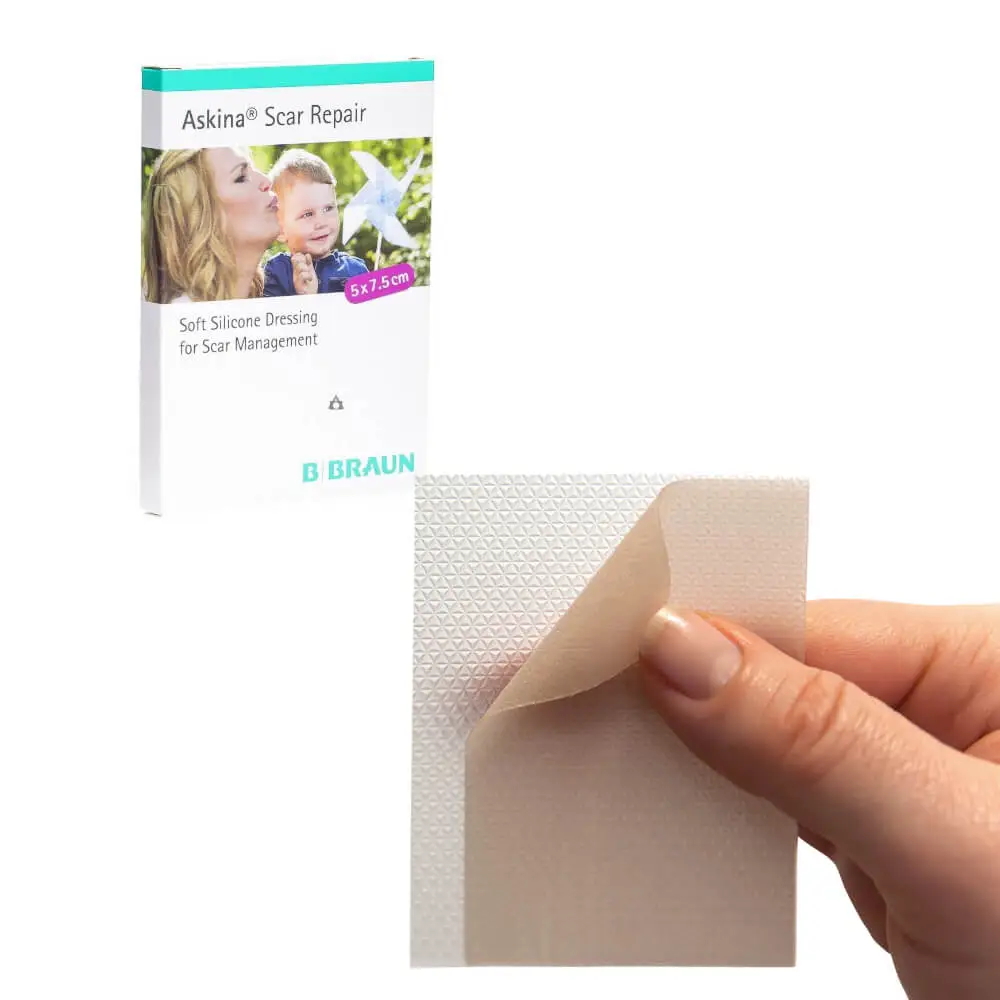
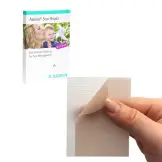
Scars from laparoscopy, a biopsy or a mole removal are not lines — they are dots, corners and irregular shapes. The 5×7.5 cm sheet does not give you length, it gives you area: you cut it to the shape you need, and one sheet yields two or three pieces.
2–6 months
treatment length
🔬 Laparoscopy & biopsies✂️ Cuts into 2–3 pieces💧 Waterproof & UV🚚 Dispatch in 24–48h♻️ 3–7 days per sheet
THE WRONG SIZE
The commonest mistake is not
the product. It is the shape.
Someone with three small laparoscopy scars orders the 2×14 cm strip, because it is the cheapest in the range. Then they sit down to cut it. But B.Braun's rule is at least 1 cm of margin on every side of the scar: across a width of 2 cm, one centimetre on the left and one on the right is the whole sheet — nothing is left over for the width of the scar itself. The strip was made for length: a caesarean incision, a laparotomy. For a scar that is a dot or a corner, the problem is not solved with scissors — it is solved with a different sheet shape.
Area, not length
5×7.5 cm is 37.5 square centimetres of silicone in a shape you can cut as you like: a square for a round scar, two small pieces for two laparoscopy ports, a corner for a scar that turns. Silicone works in exactly the same way at every size — it forms a closed, oxygen-permeable layer that limits water loss from the epidermis and keeps the area hydrated and protected, including from ultraviolet light, which darkens new scars. International scar management guidelines place silicone sheeting first among non-invasive measures. What changes from size to size is not the action — it is how well the sheet sits on your particular scar.
Which scars — and when not
The limit that matters is not the type of scar but its state: the dressing only goes on a closed wound.
YES, FOR THESE
- ✓Laparoscopy ports — two or three small scars from one sheet
- ✓Scars from a biopsy or a mole removal
- ✓Round or angled scars that are not lines
- ✓Scars on a hand, leg or shoulder, where the shape is not straight
- ✓Burns after reepithelialisation, over a small area
- ✓Hypertrophic scars and keloids of limited extent
NO — AND WHY
- ✗NOT on an open or infected wound — an absolute contraindication
- ✗Not before the wound has closed and stitches or clips are out
- ✗Caution with a known silicone allergy
- ✗Not a substitute for medical follow-up — on irritation or worsening, stop and see a doctor
In practice
1
Before the first application
The wound must have closed completely and stitches or clips must be out. The skin should be clean and completely dry, with no cream or oil where the dressing will adhere.
2
Applying it
Choose or cut the sheet so that it overlaps the scar by at least 1 cm on every side. Place it without stretching it — stretching irritates the skin underneath.
3
The daily cycle — every 23 hours
The sheet stays on for almost the whole day. Once a day, roughly every 23 hours, take it off and run the cycle in order: clean the area with a mild wash — Softaskin is made for exactly this —, wash the sheet itself in lukewarm water with mild soap without rubbing, and dry both of them thoroughly. Drying is the critical part: a hairdryer on cool or lukewarm air does it quickly and completely — never hot air on the scar. Skin and sheet must both be completely dry before it goes back on; moisture left underneath is the number one reason a sheet loses its adhesion early.
4
When to change the sheet
The same sheet is reused. You do not change it by the calendar but when its adhesion is spent: when it no longer stays put on its own, lifts at the edges or shifts during the day. In practice that is usually 3 to 7 days — with careful washing and thorough drying it lasts towards the upper end. Then you open the next of the 5 sheets in the box.
5
When to stop
On irritation, rash, pain, signs of infection or unexpected worsening of the scar, stop immediately and contact your doctor. The dressing is not a substitute for medical follow-up.
Four things worth knowing
✂️
One sheet, two or three pieces
A small scar does not need the whole sheet. B.Braun states explicitly that it can be cut to the size of the scar, so a box of 5 sheets covers more than five changes.
🎯
For scars that are not lines
Laparoscopy, biopsy, a mole, a small burn. On those shapes a 2 cm strip does not even leave the one centimetre of margin the manufacturer asks for.
🥇
First line in international guidelines
Silicone sheeting is the first non-invasive measure recommended, ahead of injections or laser. Low cost, low risk — but not a guarantee.
📐
When another size is the better buy
Per square centimetre this box costs roughly 65% more than the 2×14 cm sheet. If the scar is long and straight, the 2×14 is both the right shape and the cheaper one.
Four things people ask before ordering
🔬
“I have three small laparoscopy scars.”
One sheet, cut into three. Each piece needs its own 1 cm margin around its scar.
✂️
“Am I allowed to cut it?”
Yes — B.Braun says so explicitly. Use clean scissors, keep the margin, and apply it without stretching.
📦
“How far do 5 sheets go?”
Each sheet lasts 3–7 days. Cut into pieces it goes further, but for a 2 to 6 month course budget for more than one box.
📐
“5×7.5 or 2×14?”
The shape decides. Long and straight → 2×14. Small, round or angled → this one.
Technical specifications
| 📐 Sheet size | 5×7.5 cm · 37.5 cm² · can be cut to the size of the scar |
|---|
| 📦 Pack | 5 sheets |
|---|
| ✂️ Cutting | One sheet cuts into two or three pieces for small scars · always with 1 cm of margin all round |
|---|
| ⏳ Treatment length | 2–6 months · older scars 3 months to a year |
|---|
| ♻️ Life of one sheet | Until its adhesion is spent · in practice 3–7 days |
|---|
| 🕐 Wear time | Continuous, roughly 23 hours a day · one removal a day for cleaning |
|---|
| 🧴 Material | Soft medical silicone, self-adhesive and transparent |
|---|
| 💧 Waterproof | Yes — it stays put in the shower |
|---|
| ☀️ UV protection | Yes — ultraviolet light darkens new scars |
|---|
| 📏 Application | Overlap of at least 1 cm beyond the edges of the scar · without stretching |
|---|
| ✅ Indications | Closed wounds after laparoscopy, a biopsy, a mole removal or minor surgery · burns after reepithelialisation · hypertrophic scars and keloids of limited extent |
|---|
| ⛔ Contraindications | Open or infected wounds · caution with a known silicone allergy |
|---|
| 🧼 Cleaning the sheet | Mild soap and lukewarm water, without rubbing · dry it completely before reapplying — a hairdryer on cool air speeds it up |
|---|
| 🏭 Manufactured by | B. Braun — the B. Braun Melsungen AG group, Germany |
|---|
| 🔢 Codes | SKU W0238 · EAN 26941094079788 |
|---|
Genuine B. Braun
EAN 26941094079788
Dispatch 24–48h
Tracked courier delivery
All four sizes
5×7.5 · 2×14 · 4×30 · 10×18
Just ask
Tell us the shape of the scar
Compliance and safe use
Medical device. The following applies to every unit Traumacare ships.
Manufacturer
B. Braun — the B. Braun Melsungen AG group, Carl-Braun-Straße 1, 34212 Melsungen, Germany
Regulatory status
A medical device CE marked under Regulation (EU) 2017/745. It is intended exclusively for closed wounds and for scars — it is not applied to an open or infected wound, nor before stitches or clips have been removed. Caution is required with a known silicone allergy. If irritation, signs of infection or unexpected worsening of the scar appear, stop using it and contact your doctor. The legal manufacturer, batch number and expiry date are printed on the packaging and in the instructions for use supplied with it.
Instructions for use
Supplied in print inside the box, in Greek. Read them before first use and keep them for as long as you own the device.
Batch and traceability
The batch number (LOT) of the unit we ship you is recorded on your invoice. If the manufacturer ever recalls a batch, we know exactly who to contact.
Returns
A sealed product that, for hygiene reasons, cannot be returned once unsealed. Sealed and intact, it is returnable as normal —
returns policy.
Reporting a problem
If anything is wrong with the packaging, the labelling or the way the device works,
get in touch or write to
[email protected]. We log every report and pass it to the manufacturer.
This page is a commercial description of the product. It does not replace the manufacturer’s instructions for use, or the advice of your doctor or nurse.
Which size for which scar
The Askina range comes in four sizes and we stock them all. The shape of the scar picks the sheet — not the price.
Frequently asked questions
How many pieces does one sheet make?
It depends on the size of the scar, because every piece needs at least 1 cm of overlap all round. In practice: for a 1 cm scar each piece needs about 3×3 cm, so a 5×7.5 cm sheet comfortably yields two pieces and often three. For a 3 cm scar, most of the sheet goes into a single piece.
How do I cut it properly?
With clean, dry scissors, on a clean surface, before you peel off the backing film. Picture the scar and add 1 cm on every side. Avoid very sharp corners — a rounded edge holds better and does not lift. Whatever is left of the sheet keeps in its original packaging, clean and dry, for next time.
5×7.5 or 2×14 — which suits my scar?
The shape decides, not the price. If the scar is long and straight — a caesarean, a laparotomy — take the 2×14 cm: it covers it in one piece and costs appreciably less per square centimetre. If the scar is small, round or angled, or if you have two or three small scars, the 5×7.5 is the right shape: a strip 2 cm wide does not even leave the margin the manufacturer asks for.
How far does a box of 5 sheets go?
Each sheet is reused for 3 to 7 days, or for as long as it keeps its adhesion. Five sheets is therefore 15 to 35 days — and more if you cut each sheet into pieces for a small scar. But since a course runs 2 to 6 months, budget realistically for more than one box. Better to know that at the start.
Is it suitable for a scar on the face?
Technically yes, practically it is hard. The dressing has to stay on for almost the whole day, and on a face that shows. The skin there also moves constantly and the sheet lifts at the edges. For scars on the face and neck, a gel is the more realistic option — it absorbs and does not show.
Does silicone actually work?
We will give you both halves. International scar management guidelines put silicone sheeting first among non-invasive measures — ahead of corticosteroid injections or laser — precisely because the cost and the risk are low. The second half: Cochrane describes the available evidence as weak and prone to bias. So: a sensible first move, not a guarantee. And under no circumstances does it erase a scar.







.jpg.webp)