



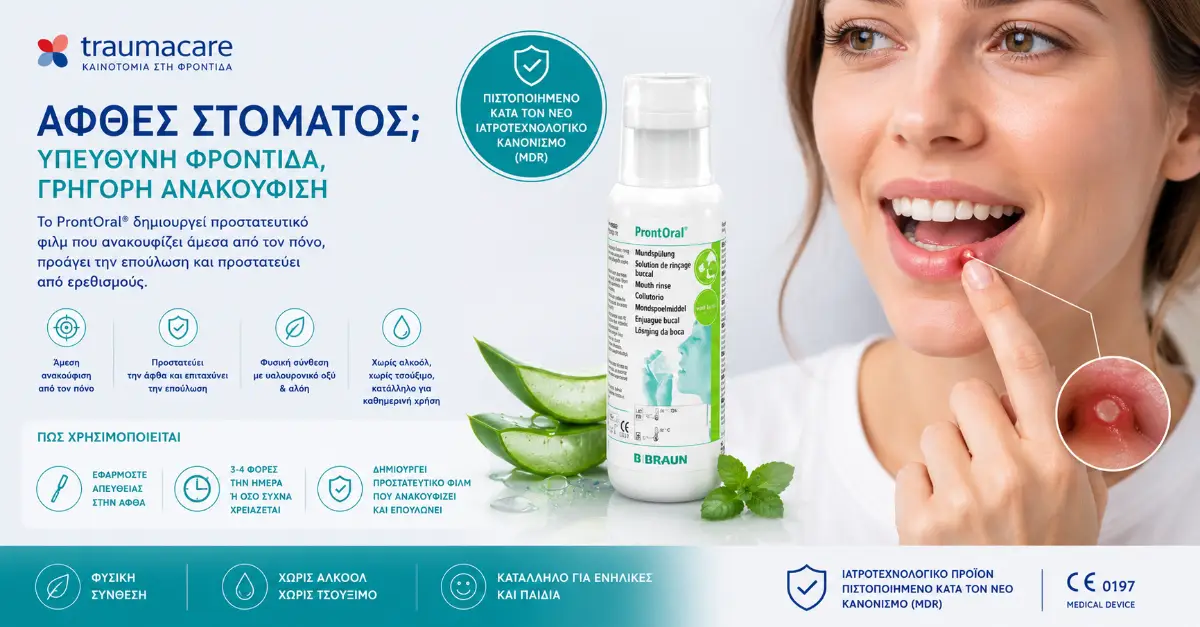
A canker sore inside the mouth or cheek can ruin a person's quality of life for a week — difficulty eating, kissing, speaking, any contact with food. Although canker sores are one of the most common oral conditions (affecting 20–30% of the population periodically), they are often treated with inadequate or incorrect care.
In this guide, you will learn exactly what canker sores are , why they occur , how they differ from other oral lesions , and how to effectively treat them — from topical symptomatic treatments to an antimicrobial solution of polyhexanide (ProntOral®) that accelerates healing.
1. What are canker sores
Canker sores are small, round or oval ulcers inside the mouth. Characteristics:
- Round or oval
- Yellow-white center with a red halo around
- Painful , especially on contact with food or liquids
- Non-contagious
- Located on mobile mucosa (cheeks, lips, tongue, palate)
- Not on hard parts (gums, hard palate)
2. Differences from other oral lesions
| Condition | Characteristics | Contagiousness |
|---|---|---|
| Canker sores | Yellow center, round | No |
| Herpes (HSV-1) | Blisters that break, common on lips | Yes |
| Candida | White plaques that peel off | Potential |
| Leukoplakia | White area that does not go away | No |
| Oral cancer | Ulcer >2 weeks without healing | No |
3. Types of aphthous ulcers
Minor aphthous ulcers — 80%
- Diameter <1 cm
- Healing in 7-14 days
- No scarring
- Usually solitary or 2-3 at a time
Major aphthous ulcers — 10-15%
- Diameter >1 cm
- Heals in 4-6 weeks
- May leave a scar
- More painful
Herpetiform — 5-10%
- Many tiny (<3 mm), in groups of 10-100
- Not related to herpes virus despite name
- Heals in 7-14 days
4. Causes — why they occur
The exact cause is not fully understood — but we know of many triggers:
Local factors
- Trauma (biting, hard food, orthodontic wire)
- Vigorous brushing
- Sodium Lauryl Sulfate (SLS) in toothpastes — a possible trigger in sensitive
Systemic factors
- Intense stress
- Sleep deprivation
- Hormonal changes (menstruation)
- Vitamin deficiencies B12, folic acid, iron, zinc
- Food intolerance (gluten, nuts, chocolate)
Systemic diseases
- Crohn's disease
- Celiac disease
- Behçet's disease (canker sores + genital ulcers + eye ulcers)
- Immunosuppression (HIV, chemotherapy)
Heredity
40–50% of people with frequent canker sores have a positive family history.
5. Course and duration
Phases of healing of small aphtha
| Day | Stage |
|---|---|
| 0-1 | Prodromal (intense sensitivity) |
| 1-2 | Aphtha formation — maximum pain |
| 3-7 | Plateau |
| 7-14 | Gradual healing |
| 14+ | Complete healing |
With proper care, most resolve in 7-10 days.
6. Modern treatment
Treatment aims at 4 goals:
- Pain reduction
- Acceleration of healing
- Reduction of bacterial contamination
- Relapse prevention
Topical analgesics
- Lidocaine gel 2% — applied before meals
- Benzydamine oral spray/solution
- Carbenoxolone gel
Topical corticosteroids (in large/frequent cases)
- Triamcinolone in carbopol gel (Kenalog in Orabase)
- Clobetasol gel in severe cases
- Solutions dexamethasone for irrigation
Antimicrobial irrigation — why critical
Although canker sores are not “contagious,” secondary bacterial infection delays healing and increases pain. A targeted antimicrobial:
- Reduces the bacterial load around the lesion
- Accelerates healing
- Reduces pain intensity
- Does not irritate the lesion itself
Why ProntOral® (polyhexanide) is ideal for canker sores
| Feature | Importance for canker sores |
|---|---|
| Alcohol-free | Does not cause burning on the bare lesion |
| Chlorhexidine-free | Does not cause additional irritation |
| Good mucosal tolerance | Works without delaying healing |
| Targeted action on bacteria | Prevention of cross-contamination |
| Peppermint flavor | Maintains compliance |
ProntOral® use protocol in active Canker sores
| Phase | Dose | Frequency | Duration |
|---|---|---|---|
| Prodromal symptoms | 10 ml | 3-4× daily | 2-3 days |
| Active canker sores (small) | 10 ml | 4× daily | Until healed |
| Locally to the lesion | A few drops with a swab | 4-6× daily | Until healing |
| Large aphtha | 10 ml | 6× daily | + topical corticosteroid |
| Prevention of recurrence | 10 ml | 1× evening | Continuously |
7. Nutritional interventions
Avoid in active canker sores
- Acidic fruits (citrus fruits, tomatoes)
- Hot spices
- Salty foods (potato chips)
- Hard crunchy foods (chips, crackers)
- Very hot liquids
- Alcohol
Preferred
- Cool liquids
- Soft foods (yogurt, purees, soups)
- B vitamins (eggs, nuts if they do not hurt)
Supplements in recurrent
- B12 (1000 mcg/day)
- Folic acid (400 mcg/day)
- Zinc (15 mg/day)
- Iron (according to blood tests)
8. Special situations
Children
- Canker sores common in ages 5-15 years
- Frequent connection with school stress
- ProntOral® from 4 years (5 ml) under supervision
- Screening for celiac disease if frequent
Pregnant women
- ProntOral® safe with medical recommendation (from 2nd trimester)
- Avoid corticosteroids without medical recommendation
People undergoing chemotherapy (mucositis)
- Frequent, large, painful
- ProntOral® 4-6× daily
- See article on mucositis
People with Crohn's disease
- Canker sores common extra-intestinal symptom
- ProntOral® daily for maintenance
- Collaboration with a gastroenterologist for systemic treatment
9. When is it something more serious
Always consult a doctor if :
- The aphtha remains >3 weeks without healing
- It is hard to press
- It has irregular borders
- It is accompanied by systemic symptoms (fever, cachexia)
- Multiple large ones at the same time
- Frequent relapses >6 episodes/year
- Accompanied by genital or eye ulcers
10. Prevention of relapse
| Strategy | Details |
|---|---|
| Oral hygiene | Daily protocol + ProntOral® |
| SLS-free toothpaste | For sensitive people |
| Stress management | Mindfulness, sleep, exercise |
| Identifying triggers | Food/symptom diary |
| Supplements | B12, folate, zinc in deficiencies |
| Systematic evaluation | If frequent, exclude celiac/Crohn's disease |
${{products:190}}
Editor & Editor
Editor: Traumacare Medical Group — exclusive distributor of B|Braun in Greece.
Last updated: May 2026 · Disclaimer: Informative article, does not replace medical advice.
Contact the Traumacare Medical Team
Do you have questions about ProntOral®?
Free advice for use in a patient, ICU, nursing home or surgical preparation.
| ✉️ Contact form | 💬 Viber Traumacare ✓ |
📞 Phone: 2311 286262
Contact form
The entire ProntOral® Cluster
- #00 — ProntOral®: complete user guide
- #01 — Polyhexanide (PHMB) in oral decolonization
- #02 — Pre-surgical MDRO decolonization bundle
- #03 — VAP prevention in the ICU
- #04 — Mucositis in oncology patients
- #05 — ProntOral® in home care
- #06 — ProntOral® vs chlorhexidine
- #07 — From dental prophylaxis to hospital-acquired infection
- #08 — Dental plaque
- #09 — Cervical cancer
- #10 — Gingivitis
- #11 — Periodontitis
- #12 — Oral thrush
- #13 — ProntOral® vs Curasept
- #14 — ProntOral® vs Elgydium & Hexoral