



Scar — Natural Result of Healing
When our skin is injured, the body begins an automatic repair process. The result of this process is the scar — a new skin tissue that replaces the damaged one. Unlike the original skin, the scar has a different collagen structure : instead of the organized lattice of healthy skin, the collagen fibers in the scar are arranged in parallel — this makes it less elastic and more visible.
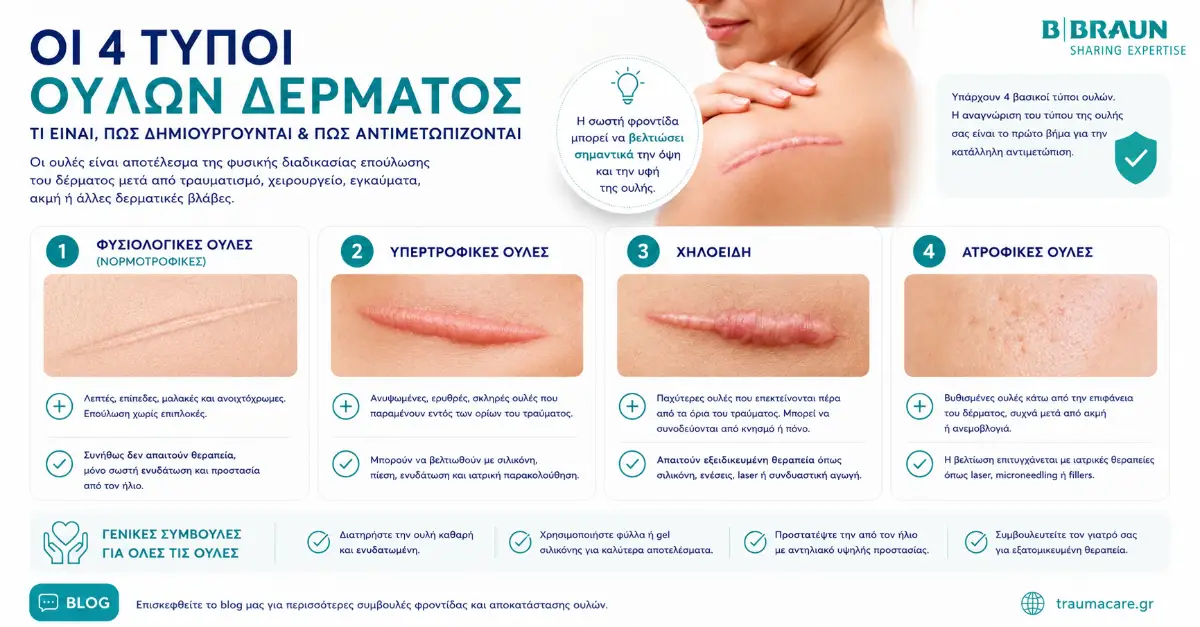
Not all scars are the same. According to modern dermatological classification, there are 4 main types that differ in appearance, cause, and required treatment. Correct recognition is the first step to appropriate treatment.
1️⃣ Mature Scar
The mature scar is the final stage of all scars that heal properly.
Characteristics
- Flat or slightly raised (<1mm)
- Pale, pink, or slightly lighter than the surrounding skin
- Within the boundaries of the original injury
- Not itchy or painful
- Does not restrict movement
When Does It Form
Usually in 6-12 months after injury, if healing occurs without complications.
Prognosis & Treatment
No active treatment is needed. Only care: sun protection (SPF 50+) to prevent darkening in the sun. Over time, it becomes less and less visible.
2️⃣ Hypertrophic Scar
When healing overproduces collagen, the scar becomes raised and red.
Characteristics
- Raised above the skin (up to 4mm)
- Bright red or pink
- Within the boundaries of the original injury (this differentiates it from a keloid)
- May be itchy or painful
- Often hard to the touch
Frequency & Causes
Occurs in 30-50% of postoperative patients — especially after cesarean section, mastectomy, colostomy, or thoracotomy. Risk factors:
- Skin tension at the incision site
- Infection or delayed healing
- Genetic predisposition
- Dark skin (Fitzpatrick III-VI)
Prognosis & Treatment
Good prognosis. With 6-12 months of silicone therapy, it can improve by 65-90%. B Braun's Askina Scar Repair silicone sheets are the No.1 first line.
${{products:172}}
3️⃣ Keloid Scar
A keloid is pathological healing — the body produces excessive collagen beyond the limits of the original injury.
Characteristics
- Highly raised (usually > 4mm)
- Dark red, purple, or brown
- Extends beyond the boundaries of the original lesion—expands
- Continues to grow for months or years
- Severe itching, pain, cosmetic problem
Common Areas
Sternum, shoulders, ears (after piercing), jaw. Rare on hands/face.
Prognosis & Treatment
More difficult than hypertrophic. Combination of treatments required:
- Silicone (Askina Scar Repair) — first line
- Cortisone injections by a dermatologist
- Cryotherapy or PDL laser
- In severe cases: surgical removal + radiation
➡️ Full comparison of hypertrophic vs keloid scars
4️⃣ Atrophic Scar
Unlike the previous two, the atrophic scar is sunken — below the level of the skin. It forms when the body produces less collagen than it needs.
Subtypes
- Ice-pick: narrow, deep, like nail holes
- Boxcar: wide with vertical walls
- Rolling: wavy, smooth peaks and valleys
Common Causes
Acne (the No. 1 cause), chickenpox, chemical burns, deep injuries.
Prognosis & Treatment
Important: silicone does NOT treat atrophic scars. It only works on raised scars. For atrophic scars you need:
- Microneedling with dermaroller
- Fractional CO2 laser
- Dermal fillers (hyaluronic)
- Subcision (for rolling)
- Chemical peeling (TCA cross)
➡️ Complete guide to acne scars
Summary — Comparison Table
| Type | Appearance | Borders | 1st Line Treatment |
|---|---|---|---|
| Normal | Flat, pale | Inside | Sun protection |
| Hypertrophic | Raised, red | Inside | Silicone Askina |
| Keloid | Very raised, dark | Exceeds | Silicone + Cortisone |
| Atrophic | Dimpled | Intra | Microneedling, laser |
Next Steps
If you have a scar that worries you:
- Identify the type with this guide
- If it is raised (hypertrophic or keloid): start Askina Scar Repair
- If it is atrophic: consult a dermatologist
- Always: apply SPF 50+ to prevent darkening
➡️ Back to the Complete Scar Guide