



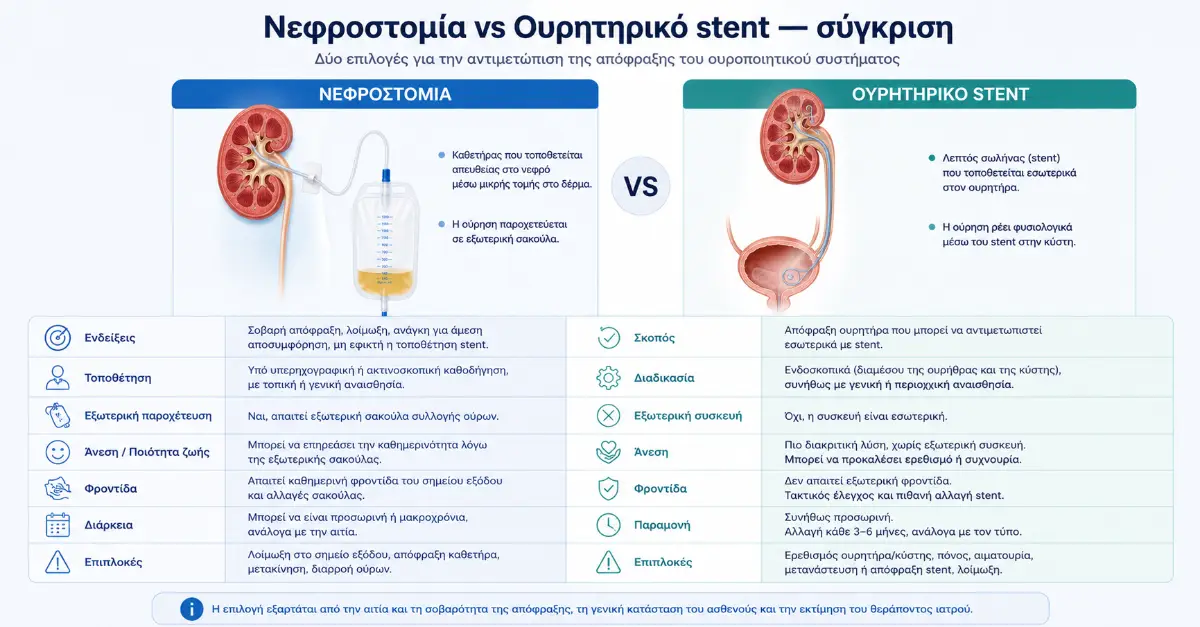
Όταν ο νεφρός παρουσιάζει απόφραξη, ο γιατρός έχει δύο βασικές επιλογές για να αποσυμπιέσει το σύστημα: τοποθέτηση εξωτερικής νεφροστομίας ή εσωτερικού ουρητηρικού stent (double-J). Ποια είναι η σωστή επιλογή; Στην πραγματικότητα δεν είναι θέμα ανωτερότητας μεταξύ των δύο — είναι θέμα κατάλληλης ένδειξης.
Αν θέλετε γενικές πληροφορίες πρώτα, διαβάστε τι είναι η νεφροστομία, πότε γίνεται ή τον πλήρη οδηγό φροντίδας.
Πώς λειτουργεί η νεφροστομία
Σωλήνας από το δέρμα → πύελος νεφρού → εξωτερική σακούλα. Τα ούρα παρακάμπτουν εντελώς τον ουρητήρα. Πλεονέκτημα: λειτουργεί ανεξάρτητα από το πόσο φραγμένος είναι ο ουρητήρας.
Πώς λειτουργεί το stent
Ένα ευλύγιστο σωληνάκι (συνήθως 6-7 Fr) τοποθετείται από την ουρήθρα μέσω της κύστης στον ουρητήρα και ως την πύελο του νεφρού. Έχει σπιράλ άκρα και στις δύο πλευρές που το κρατούν στη θέση του (γι’ αυτό λέγεται «double-J»). Τα ούρα ρέουν εσωτερικά.
Συγκριτικός πίνακας
| Παράμετρος | Νεφροστομία | Ουρητηρικό stent |
|---|---|---|
| Εμφάνιση | Εξωτερικός σωλήνας + σακούλα | Δεν φαίνεται |
| Άνεση | Καθημερινή φροντίδα | Σχεδόν καμία |
| Κίνδυνος λοίμωξης | Μέτριος-υψηλός | Μικρότερος |
| Δραστηριότητες | Όχι κολύμπι, περιορισμοί | Σχεδόν ελεύθερες |
| Αλλαγή | Κάθε 8-12 εβδομάδες | Κάθε 3-6 μήνες |
| Τεχνική προϋπόθεση | Πάντα εφικτή σε υδρονέφρωση | Όχι αν ο ουρητήρας είναι ολικά αποφραγμένος |
| Σε σήψη | Πρώτη επιλογή | Δεύτερη επιλογή |
| ΕΟΠΥΥ κάλυψη | Πλήρης (υλικά νεφροστομίας) | Πλήρης (το stent αλλάζεται σε νοσοκομείο) |
Πότε υπερτερεί η νεφροστομία
- Σήψη από αποφραγμένο νεφρό — άμεση και ασφαλέστερη παροχέτευση.
- Ολική απόφραξη ουρητήρα όπου το stent δεν περνά.
- Προγραμματισμένη επεμβατική θεραπεία λίθων (η νεφροστομία θα γίνει οδός εργαλείων).
- Όταν χρειάζεται παρακολούθηση παραγωγής ούρων κάθε νεφρού ξεχωριστά.
Πότε υπερτερεί το stent
- Μερική απόφραξη όπου τα ούρα μπορούν να ρεύσουν εσωτερικά.
- Νεαροί ασθενείς που δίνουν προτεραιότητα στην εικόνα και τη δραστηριότητα.
- Ασθενείς με ενεργό επαγγελματική ή αθλητική ζωή.
- Όταν η αναμενόμενη διάρκεια ανάγκης παροχέτευσης είναι σύντομη (π.χ. προεγχειρητικά).
Συνδυασμός — δεν είναι σπάνιος
Σε αρκετές περιπτώσεις τοποθετείται προσωρινά νεφροστομία (επείγον) και αργότερα μετατρέπεται σε stent όταν η οξεία κατάσταση έχει ελεγχθεί. Αυτή η προσέγγιση συνδυάζει το άμεσο όφελος της νεφροστομίας (γρήγορη αποσυμπίεση) με τη μακροπρόθεσμη άνεση του stent.
Τι λέει ο γιατρός — τι αποφασίζετε εσείς
Η ιατρική απόφαση βασίζεται σε αντικειμενικά δεδομένα: τύπος και αιτία απόφραξης, ύπαρξη λοίμωξης, αναμενόμενη διάρκεια, νεφρική λειτουργία.
Όμως ο ασθενής έχει λόγο: αν η εικόνα και η δραστηριότητα είναι σημαντικές για εσάς, αυτό πρέπει να συζητηθεί. Σε ίδια ένδειξη, μερικές φορές υπάρχουν και οι δύο επιλογές και η προτίμηση του ασθενούς υπερισχύει.
| ✉️ Φόρμα επικοινωνίας | 💬 Viber κανάλι Traumacare ✓ |
| Δείτε όλα τα προϊόντα νεφροστομίας → |
Έχετε ερωτήσεις; Στείλτε μήνυμα
Η ομάδα μας θα σας απαντήσει εντός 24 ωρών. Είμαστε αποκλειστικοί αντιπρόσωποι B Braun Avitum και διανομέας Convatec, με σύμβαση ΕΟΠΥΥ από το 2014.
Δοκιμάστε πρώτα — δωρεάν δείγμα
Για ουροστομία και νεφροστομία δουλεύουμε τους σάκους Flexima Uro Silk της B|Braun, με επίπεδη ή κυρτή (convex) βάση. Για την προστασία του δέρματος γύρω από τη στομία: Ally πάστα και πούδρα, Askina Barrier Film και Ally Adhesive Remover της B|Braun.
${{products:47,48,50,51}}
Δεν χρειάζεται να αποφασίσετε στα τυφλά: ζητήστε δωρεάν δείγμα ή καλέστε στο 2311 286 262. Δείτε και όλα τα δωρεάν δείγματα.
Φόρμα επικοινωνίας
Πηγές: Ελληνική Ουρολογική Εταιρεία, Ελληνική Εταιρεία Επεμβατικής Ακτινολογίας, ΦΕΚ Β’ 5395/2025. Ενημερωτικό άρθρο, δεν αντικαθιστά την ιατρική συμβουλή.