



“I’m afraid I’ll smell in public places...”
This is perhaps the most psychologically burdensome issue after a colostomy. According to a systematic review by Vonk-Klaassen et al. (2016) [1] , odor and flatulence are reported as the #1 psychosocial problem by colostomy patients — even surpassing leakage. Many avoid social events, work, and sexual relationships out of fear.
The good news: there are specific solutions . In this guide we analyze 8 practical interventions that work — from the B Braun Flexima activated carbon filter to dietary adjustments.
Why does the odor occur?
The odor in colostomy bags comes from:
- Volatile organic compounds (VOCs) — indole, skatole, hydrogen sulfide, methyl mercaptan [2]
- Bacterial fermentation in the colon — the microflora produces gases when breaking down food
- Stool accumulation in the bag — the longer it is left, the more intense the odor odor
- Poor quality plastic — cheap bags let the odor permeate the material
Gas (flatulence) comes from:
- Swallowing air while chewing/drinking (aerophagia)
- Bacterial fermentation of indigestible carbohydrates (FODMAPs)
- Carbonated drinks
🎯 The 8 Practical Solutions
1. Activated Carbon Filter (Standard on Flexima)
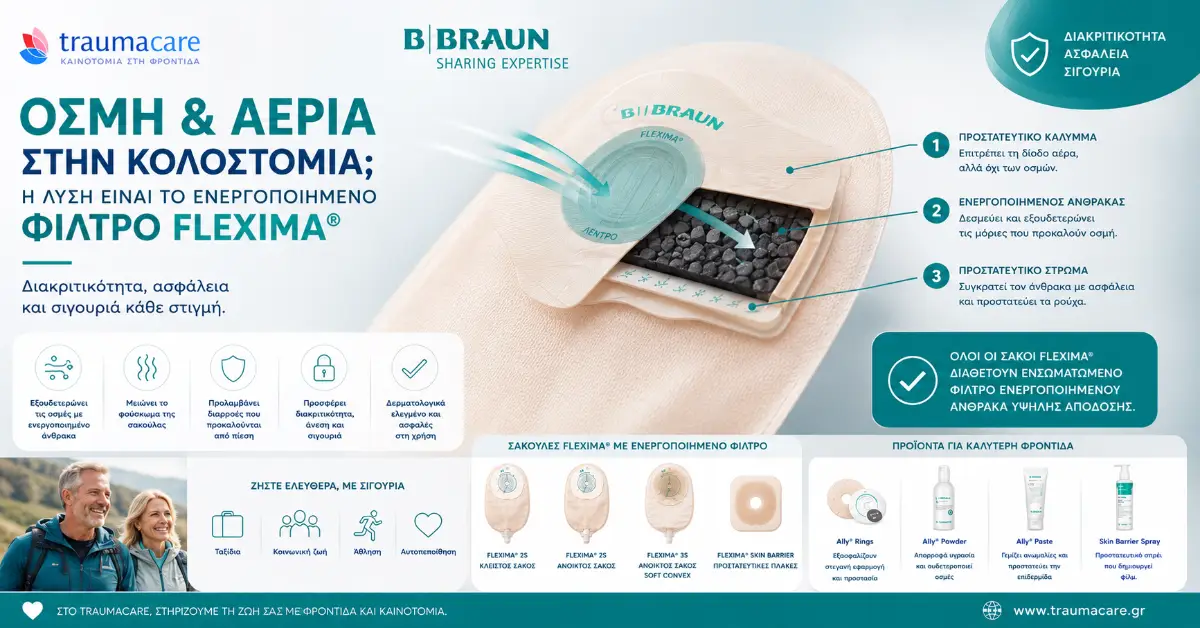
The activated carbon filter is the No. 1 technological solution. It works as follows:
- Allows gases to escape from the bag — prevents “bloating”/ballooning
- Activated carbon absorbs volatile odor compounds before they reach the air
- Keeps the bag discreet in social situations
✅ All B Braun Flexima Colo bags (Active, Flat, 3S, Convex, Flat Drainable) have a built-in activated carbon filter as STANDARD — not as an extra. If your current bag does not have a filter, this is the most immediate improvement you can make today [3] .
2. Empty/change bag more frequently
The longer stool remains in the bag, the stronger the odor becomes due to continued bacterial activity. Practical:
- Drainable bag: Empty when 1/3 full — no more
- Closed bag: Change every 24 hours or when 50% full
- Before social events: Always empty/change 30 minutes before
3. Dietary Adjustments
According to the guidelines of UOAA [4] :
| ❌ Foods that increase odor | ⚠️ Foods that cause gas | ✅ Foods that reduce odor |
|---|---|---|
| Asparagus | Beans, chickpeas, lentils | Yogurt (probiotics) |
| Eggs, fish | Cabbage, broccoli, cauliflower | Cranberry juice |
| Garlic, onion | Carbonated drinks, beer | Parsley, butter |
| Hard cheese | Chewing gum (air swallowing) | Fresh milk cheesecake |
| Coffee (limitation) | Apples, pears (fructose) | Lemon, chamomile |
Tip: Try keeping a food diary for 2 weeks — note what you eat and when the smell occurs. This will help you identify your own profile.
4. Probiotics & yogurt
Probiotics (Lactobacillus, Bifidobacterium) improve intestinal flora and reduce malodorous fermentation byproducts [5] .
- Natural yogurt with live cultures — 1-2 times a day
- Kefir — alternative with higher bacterial diversity
- Probiotic supplements (discuss with doctor)
- Fermented foods: sauerkraut, kimchi, miso (in moderation)
5. Discreet beige midi cover (Flexima)
In addition to the activated carbon filter, the design of the bag plays a role. Flexima bags have:
- Discreet beige midi cover — invisible under regular clothes
- Soft fabric backing — breathable, anti-perspirant
- Multi-layer film — prevents odor diffusion through the plastic
These details reduce the psychological burden and increase self-confidence.
6. Deodorant Drops / Tablets (when needed)
In persistent cases or for extra peace of mind, you can use:
- Deodorant drops: Drops placed in the pouch after changing
- Pouch deodorant tablets: Tablets that dissolve in the pouch
- Air freshener spray for the ballad in the bathroom after emptying
These are partially covered by EOPYY as part of “irritation treatment products” (Table 11, A/A 2) [6] .
7. Correct technique when changing/emptying
- Emptying into the toilet with a low opening — not from above (air + odor circulates)
- Cleaning the outlet of the tap with toilet paper or wipes after emptying
- Toilet closed during use
- Air freshener or candle in the bathroom
- Do not fill the bag with water for flushing — unnecessary and creates humidity in the filter that makes it useless
8. Manage gas by the way you eat
- Eat slowly with your mouth closed — less air swallowed
- Avoid chewing gum and candy (increase aerophagia)
- No soda or beer
- No cigarettes (swallow air)
- Simethicone (anti-gas) — over-the-counter medication that reduces gas in the intestines. Discussion with a pharmacist.
🎯 Decision Tree: How to reduce odor today
| Situation | Solution |
|---|---|
| Bag without activated carbon filter | Immediate change to Flexima (all models have filter standard) |
| Bag with filter but odor | More frequent change + food diary |
| Bag inflation due to gases | Check filter (is it getting wet?) + change diet |
| Strong odor suddenly | Leakage? Fungus? — skin check + doctor |
| Social anxiety about odor | Deodorant drops + adding Pouch covers + psychological support |
| Constant gas | Probiotics + simethicone + slow food + avoiding carbonated drinks |
⚠️ When Odor Is a Sign of a Problem
Usually odor is manageable. But in some cases it is a sign of a medical problem [7] :
- 🚨 Sudden very strong odor + fever = possible gastrointestinal infection
- 🚨 “Fatty” odor (not normal stool) = possible small intestinal bacterial overgrowth (SIBO) or C. difficile
- 🚨 Odor around stoma (not inside the pouch) = stool leakage under the base = see leakage guide
- 🚨 Odor with blood in the stool = immediate contact with a doctor
Try Flexima with activated carbon filter for free
| ✉️ Request a free sample | 💬 Viber Traumacare ✓ |
Related articles
- Pillar C: Complete Colostomy Guide
- Colostomy bag: which one to choose?
- Colostomy diet — 30 foods you need to know
- Bag leakage — 7 causes & solutions
Author: Traumacare Medical Team — exclusive representatives of B Braun Avitum Greece
Scientific documentation: Vonk-Klaassen SM et al. QoL Research 2016, WOCN Society Clinical Practice Guideline, UOAA Diet & Nutrition Guide, B Braun Flexima Technical Specifications, Government Gazette B' 5395/09-10-2025
Last updated: May 2026
Note: In case of a sudden change in odor character with fever or blood in the stool, contact a doctor immediately. Possible infection or medical problem.
📚 Bibliography / Scientific sources
- Vonk-Klaassen SM et al. Ostomy-related problems and their impact on quality of life of colorectal cancer ostomates: a systematic review . Quality of Life Research , 2016. pubmed.ncbi.nlm.nih.gov
- Jiang T, Suarez FL, Levitt MD. Gas production by feces of infants . Journal of Pediatric Gastroenterology and Nutrition . pubmed.ncbi.nlm.nih.gov
- B Braun Flexima Active Colostomy Bag — Technical Specifications (Activated Carbon Filter) . B Braun Avitum. catalogs.bbraun.com
- UOAA — United Ostomy Associations of America: Diet & Nutrition Guide for People with Ostomies . ostomy.org/diet-nutrition
- Hill C et al. The International Scientific Association for Probiotics and Prebiotics consensus statement . Nature Reviews Gastroenterology & Hepatology . pubmed.ncbi.nlm.nih.gov
- Government Gazette B' 5395/09-10-2025 — Table 11, No. 2 (Colostomy Materials) . National Printing House. eopyy.gov.gr
- WOCN Society Clinical Practice Guideline for Management of the Adult Patient with a Fecal or Urinary Ostomy . Wound, Ostomy and Continence Nurses Society. wocn.org
- Colwell JC, Pittman J. Ostomy Care and Management . Journal of Wound, Ostomy and Continence Nursing , 2017. pubmed.ncbi.nlm.nih.gov