



A ureterostomy is a surgical procedure that changes daily life — but less dramatically than one might imagine before the operation. With proper care and the right materials, patients return to almost all the activities of their previous life.
In this guide you will find everything you need to know: types of ureterostomy, procedure, how to choose the right bag for your stoma, daily care, lifestyle, possible complications and what EOPYY covers.
Do you have a recent diagnosis for cystectomy? Don't waste time. Send us a message using the form at the end of the article or Viber Traumacare — we will prepare you for free with a complete B Braun Avitum pre-op kit before the operation. So when you get home, you won't be looking.
What is a ureterostomy
A urostomy is the permanent surgical diversion of urine from the bladder to a stoma in the abdominal wall, where the urine is collected in an external bag. It is done when the bladder needs to be removed or bypassed.
Unlike nephrostomy which is usually temporary and done percutaneously, a ureterostomy is permanent and done surgically.
The two main types of ureterostomy
1. Cutaneous Ureterostomy
The ureters are detached from the bladder and implanted directly into the skin of the abdominal wall. It is the simplest solution , without the use of the bowel, with fewer complications. Catheters are often placed to maintain patency.
Advantages: shorter operation time, fewer complications, no effect on the digestive tract. Disadvantages: use of catheters, small stoma, higher risk of strictures.
2. Ileal Conduit (Bricker procedure)
The most common option . The surgeon isolates a small section of small intestine (15-20 cm), connects the ureters to it, and brings the other end of the intestine out as a stoma in the abdominal wall. Urine flows from the kidneys, into the ureters, into the intestinal conduit, and finally into the bag.
Advantages: wider stoma, less risk of strictures, no need for catheters. Disadvantages: longer procedure, produces mucus (expected, not a problem), requires bowel recovery.
When is a ureterostomy performed
The main indications:
- Radical cystectomy for invasive bladder cancer (the most common cause)
- Neurogenic bladder with severe dysfunction
- Congenital anomalies (mainly in children)
- Incontinence resistant to other treatments
- Damaged bladder from radiation or trauma
How the operation is performed
It is a major surgical procedure performed under general anesthesia and lasts 4-6 hours (usually part of a radical cystectomy). Hospital stay 7-14 days. Full recovery 6-8 weeks.
- Preoperative examination, fasting, bowel cleansing
- Selection of stoma site (usually right below the navel)
- Marking by ostomy specialist
- Surgery (open, laparoscopic or robotic)
- Stoma creation with attention to size and height
- Placement of initial urostomy bag
What your stoma looks like
- Color: red, moist — healthy indication of good blood supply
- Sensation: none — no nerves
- Dimensions: 2-3 cm in ileal conduit, smaller in cutaneous
- Discharge: continuous flow of urine (not controlled)
- Mucus: white threadlike particles in urine — normal for ileal conduit (gut produces mucus)
- Slight bleeding with contact — normal
Important: In the first 6-8 weeks after surgery, the stoma is slightly swollen and will shrink. That is why the initial pouch may not fit in a few months — schedule a re-evaluation in the meantime.
🎯 Which pouch is right for your stoma?
This is the most important decision after surgery. The right pouch means: less leakage, less infections, better quality of life.
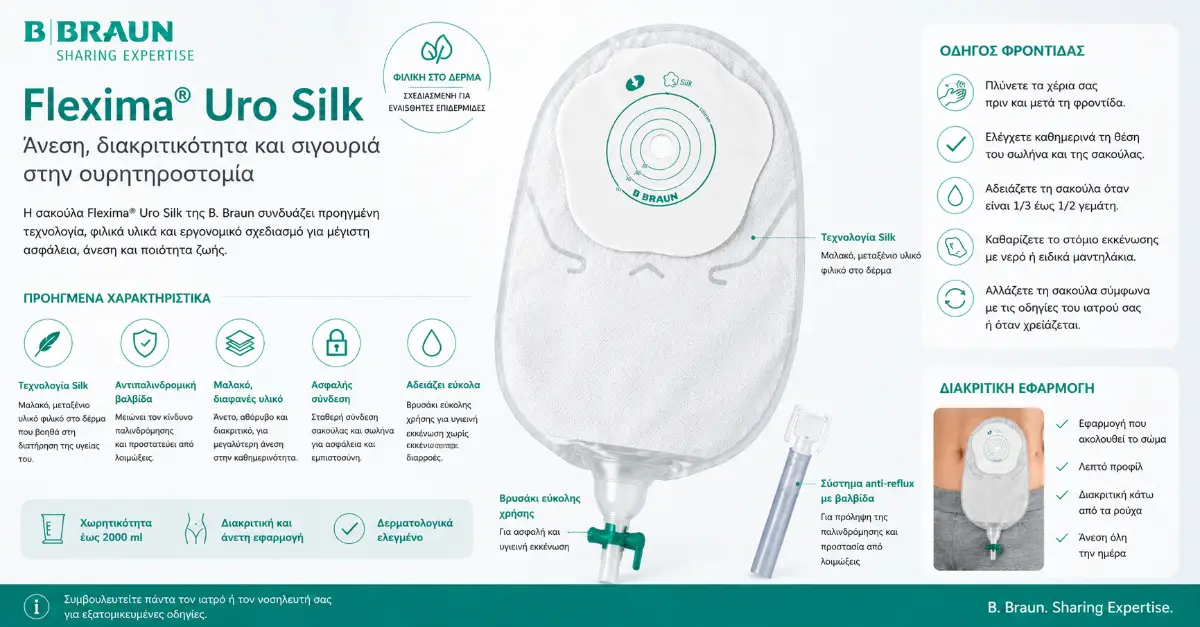
Traumacare is the exclusive distributor of B Braun Avitum in Greece — we offer the entire Flexima range used by specialized European hospitals. Below we present which pouch is right for which type of stoma.
Decision tree — Which Flexima for which stoma?
| Stoma type | Recommended Flexima product | System |
|---|---|---|
| Flat, quite high | Flexima® Uro Silk Flat (beige or transparent) | 1 piece |
| Slightly retracted (short) | Flexima® Uro Silk Convex | 1 piece |
| Flush or very retracted | Flexima® Active O' convex (with soft convexity) | 1 piece |
| Sensitive skin | Flexima® Key (bag change without removing the base) | 2 pieces |
| More economical option | Flexima® 3S (mechanical coupling) | 2 pieces |
| Supplementary (night) | B Braun Uribag (2L drainable) | Nighttime |
All the above bags are 100% covered by EOPYY (codes Z93.6/Z43.6, Government Gazette B' 5395/2025). Traumacare undertakes the prescription and shipping to your home.
Why Flexima — the 5 advantages
All advanced urostomy systems have specific specifications. See why Flexima is considered a premium choice in European hospitals:
- Anti-reflux valve in all models — prevents urine from returning to the stoma. Significant protection against urinary tract infections.
- Drainage tap with open/close positions — safe emptying without leaks, even when your hands are shaking.
- Hydrocolloid skin protector with flower-shape (Uro Silk) — conforms to the body, prevents wrinkles and leaks.
- Soft convexity (Active O' convex) — uniform pressure and comfort for flush/retracted orifices.
- Discreet midi beige split cover — invisible under clothing, maintains dignity.
German engineering · FDA-cleared · Used in specialist European urology hospitals. When you choose Flexima, you know you are trusting a proven system.
Daily care
Emptying the bag
The bag has a tap at the bottom. Empty 3-5 times a day when it is 2/3 full. Always with washed hands. At night it is connected to a larger collection bag (B Braun Uribag 2L) so you don't have to get up.
Bag change
1-piece system: change every 2-3 days. 2-piece system: change bag every 2-3 days, base every 5-7 days. Always with aseptic technique and attention to the skin around the stoma.
Skin care
The skin around the stoma is sensitive. It should be cleaned with lukewarm water, dried thoroughly and a protective barrier applied. In case of irritation, use protective sprays or pastes (covered by EOPYY).
Lifestyle with a ureterostomy
Showering and bathing
Allowed with or without a bag after the first 6-8 weeks of recovery. The stoma and urine do not stain the water. Swimming in public waters is avoided for the first 8 weeks.
Diet
There are no strict prohibitions. Adequate hydration (2+ liters/day) is important to prevent mucus and infections. Asparagus, garlic and seafood can temporarily change the smell of urine.
Travel
Allowed with proper preparation: medical certificate, double materials, protective bags for the plane. Traumacare provides a B Braun Avitum travel kit with everything you need for a 7-14 day trip.
Sexual life
It is possible. Consult your doctor and partner. Special sexual activity bags are available (Flexima mini bags for discretion).
Work
Most patients return to work after 6-8 weeks of recovery. With discreet bags (Flexima Uro Silk with midi beige split cover), ureterostomy does not affect professional presence.
Possible complications
Infection
Fever, cloudy urine, pain, redness at the site. Contact a doctor immediately. The anti-reflux valve of Flexima significantly reduces the risk.
Stoma stenosis
More common in cutaneous ureterostomy. Reduced urine flow is the main sign.
Parastomal hernia
Swelling around the stoma due to weakness of the abdominal wall. Common in the first 12-24 months. A support belt (covered by EOPYY) may help.
Dermatitis
Irritation, redness, sores around the stoma. Usually from poor bag fit. Flexima Uro Silk with flower-shape skin protector minimizes the risk.
EOPYY coverage
Ureterostomy is classified under ICD-10 codes Z93.6 and Z43.6. According to the Government Gazette B' 5395/09-10-2025, EOPYY covers a 1 or 2-piece system with a maximum monthly cost of 270€ and a patient participation of 0%.
The prescription is made by a Pathologist, Nephrologist, Surgeon, Urologist, Oncologist, General Practitioner or Rural. As an EOPYY contracted provider since 2014 , Traumacare takes care of the paperwork and sends the B Braun materials to your home.
Pre-op consultation: why it's worth it
Before the operation, we recommend a free consultation with our team:
- Choosing the right bag before an emergency supply is needed
- Setup with the attending physician for an EOPYY prescription
- Complete B Braun Avitum pre-op kit waiting for you at home
- Caregiver training in bag change
- Direct line with our team for post-op questions
This saves you stress, time and possible first infections from poor fit to embarrassment.
Frequently asked questions
Is a ureterostomy reversible?
Usually not. It is a permanent procedure. In rare cases, it can be reversed or converted to a neocyst.
Will the pouch be visible under clothing?
No, with the right pouch and clothing. Flexima Uro Silk is very thin with a midi beige split cover — discreet under everyday clothing.
Can I work?
Yes, most patients return to work after 6-8 weeks of recovery.
How long does a Flexima base last?
Up to 4 days in a 2-piece system (Flexima Key, 3S). In a 1-piece system, change the entire bag every 2-3 days.
Why does my bag (ileal conduit) produce mucus?
The intestine used for the ileal conduit normally produces mucus. This is to be expected, not a sign of a problem. Adequate hydration reduces the amount.
Is it covered by EOPYY?
Yes, with 0% patient participation. Maximum monthly cost €270. Traumacare takes care of the entire procedure.
How long can I live with a ureterostomy?
With proper care, life expectancy is not affected. It is a matter of adaptation.
| ✉️ Contact form | 💬 Viber channel Traumacare ✓ |
| See all Flexima Urostomy → |
Do you have any questions? Send a message
Our team will respond within 24 hours. As exclusive B Braun Avitum representatives in Greece, we offer you free pre-op consultation to choose your pouch correctly before your cystectomy.
Contact form
Sources: B Braun Avitum, Government Gazette B' 5395/09-10-2025, Hellenic Urological Society. Informative article, does not replace medical advice. Last updated: May 2026.