



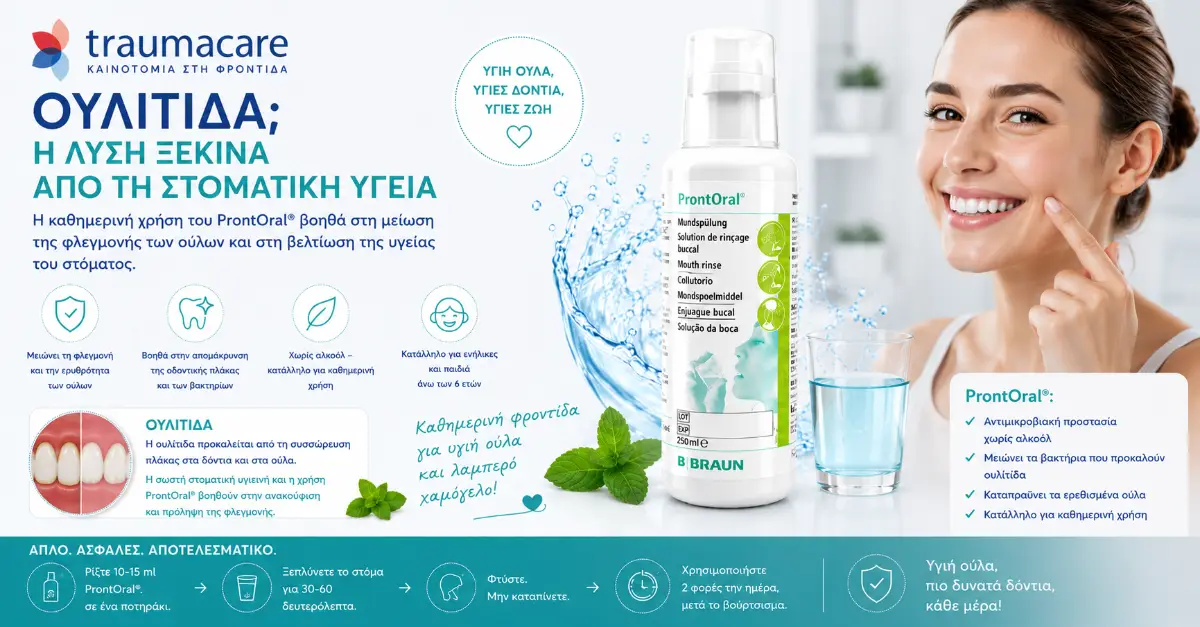
When gums bleed when brushed or appear red and swollen , the body is giving us a clear signal: there is inflammation. Gingivitis is the most common oral disease in the adult population—reports show that nearly 7 in 10 adults have at least one area of gingivitis at any given time.
In this guide you will learn exactly what gingivitis is , how to recognize it early , how to treat it and how to prevent recurrence with proper oral hygiene — including the use of an antimicrobial solution with polyhexanide (ProntOral®).
1. What is gingivitis
Gingivitis is a reversible inflammation of the gums without loss of bone or supporting tissues. It is the first stage of periodontal disease — and if left untreated, it progresses to periodontitis , which is irreversible.
Normal gums
- Pink or slightly red
- Firm texture
- Do not bleed when brushing
- Form “slices” around the teeth
- Do not hurt
Gums with gingivitis
- Bright red or purple
- Swollen, lose their shape
- Bleed when brushing or flossing
- May be slightly painful or burning
- Often accompanied by bad breath
2. Etiology — why it occurs
Almost all gingivitis is due to the accumulation of microbial plaque at the gum line. When plaque remains in place for > 24-48 hours:
- Pathogenic bacteria (mainly Porphyromonas gingivalis, Fusobacterium nucleatum ) multiply
- Their toxins and enzymes irritate the gums
- The body sends inflammatory factors (cytokines) in response
- The blood vessels of the gums dilate — hence the redness
- Edema is created — hence the swelling
- Sensitive capillaries break easily → bleeding
Risk factors that increase
- Hormonal changes (pregnancy, menopause, contraceptives)
- Diabetes (especially uncontrolled)
- Medications (anticonvulsants, immunosuppressants, calcium channel blockers)
- Smoking
- Stress
- Poor nutrition (vitamin C, K)
- Infections (HIV)
- Mouth breathing (dryness)
3. How is it diagnosed
Diagnosis is mainly clinical by a dentist/periodontist. Searching for:
| Point | Significance |
|---|---|
| Bleeding on Probing (BoP) | Key indicator — bleeding on gentle pressure |
| Plaque Index | How much plaque is present |
| Gingival Index | Degree of inflammation |
| Probing Depth | Normally 1-3 mm — > 4 mm = periodontitis |
| No bone loss | In simple gingivitis, the x-ray is normal |
4. Types of gingivitis
Plaque-induced gingivitis (90% of cases)
The most common form. Treated with proper oral hygiene.
Pregnancy gingivitis
In 50-70% of pregnant women. Hormonal changes (increased estrogen, progesterone) intensify the inflammatory response. A “pregnancy tumor” may also form. It usually resolves after delivery.
Drug-induced gingival hyperplasia
From drugs such as nifedipine, phenytoin, cyclosporine. The gums swell intensely. Requires cooperation between the dentist and the physician for possible change of medication.
Necrotizing ulcerative gingivitis (ANUG)
Rare, severe. Pain, bleeding, necrosis of interdental papillae, bad breath (“trench mouth”). Associated with stress, immunosuppression, poor hygiene. Requires immediate dental intervention and antibiotics.
5. Treatment — step-by-step
Phase 1: Professional cleaning
The dentist/hygienist: - Removes tartar and plaque from all surfaces - Polishes the teeth - Quickly cleans any “dental pockets” - Provides instructions on proper brushing
Phase 2: Daily home protocol
| Item | Frequency | Note |
|---|---|---|
| Brushing | 2× daily × 2 minutes | Soft brush, modified Bass technique |
| Dental floss | 1× daily | Before evening brushing |
| Interdental brushes | If > 3 mm interdental | Particularly critical |
| ProntOral® 10 ml | 2× daily × 30 sec | After brushing and flossing |
| Tongue cleaning | 1× daily day | With a scaler |
Phase 3: Reassessment in 2-3 weeks
With proper implementation of the protocol, gingivitis completely resolves in 14-21 days. If no improvement:
- Reassess brushing technique
- Check for coexisting factors (diabetes, hormonal changes)
- Check for possible progression to periodontitis
Phase 4: Maintenance
Even after remission, maintenance is lifelong: - Daily protocol - Dental visits 2-3× per year - ProntOral® daily to prevent relapse
6. Why polyhexanide (ProntOral®) is effective
In gingivitis, antimicrobial mouthwash is critical because:
- Reaches areas where a brush cannot reach (interdental spaces, gingival pockets)
- Reduces the total bacterial load of the oral cavity
- Targets specific pathogens ( P. gingivalis , F. nucleatum )
ProntOral® combines the critical features:
| Feature | Benefit for gingivitis |
|---|---|
| Polyhexanide (PHMB) | Targeted action against pathogens |
| Chlorhexidine-free | No staining, no dysgeusia |
| Alcohol-free | Does not irritate already sensitive gums |
| Daily long-term use | Stable relapse prevention |
| Fluoride-compatible | Complementary action |
7. Special situations
Pregnant women with pregnancy gingivitis
- Cleaning in the 2nd trimester (not 1st or 3rd)
- ProntOral® 1-2× daily from the 2nd trimester, under medical recommendation
- Recommendation: periodontal inflammation has been associated with an increased risk of premature birth
Diabetics
- Glycemic control simultaneously with periodontal therapy
- ProntOral® 2× daily as part of daily hygiene
- Increased frequency of dental visits (3-4× annually)
Patients under orthodontics
- ProntOral® daily for the entire duration of treatment
- Interdental brushes suitable for orthodontics
- More frequent check-ups
Elderly
- Frequent gingivitis due to dry mouth and poor oral hygiene
- ProntOral® with a sponge if unable to rinse
- Caregiver education
9. When to call a doctor immediately
- Pain that does not subside
- Pus from the gums
- Fever
- Diffuse bleeding that does not stop
- Necrosis/black spots on the gums
- Suspected ANUG
Frequently asked questions
How long does gingivitis treatment last? With proper implementation of the protocol, it resolves in 14-21 days. Prevention of recurrence is lifelong.
Can gingivitis resolve without a dentist? In mild cases, with perfect oral hygiene. However, in most cases there is accumulated tartar that requires professional removal.
Is gingivitis contagious? Pathogenic bacteria can be transmitted through saliva (kissing, sharing utensils). This does not mean that everyone who is exposed will develop gingivitis — it depends on their microbiome and hygiene.
I am taking anticoagulants — should I stop flossing? No. Proceed with caution and use a soft brush. Inform your dentist before each cleaning.
Does pregnancy gingivitis require chlorhexidine? No. In pregnant women ProntOral® is preferred for safety and tolerability, after medical recommendation.
How quickly do you see a difference with ProntOral®? Bleeding reduction usually occurs within 7-10 days of consistent use. Complete resolution of inflammation by week 3 — along with proper brushing and flossing.
Related articles
- Polyhexanide (PHMB) — why it changes the norm
- Dental plaque: how it is formed
- Periodontitis: modern treatment
- ProntOral®: complete user guide
Order ProntOral® for gingivitis
➤ ProntOral® 250 ml · €17.96 · Free delivery
Bibliography
- Kornman KS. Mapping the pathogenesis of periodontitis: a new look. J Periodontol. 2008;79(8 Suppl):1560-8.
- Trombelli L, et al. Plaque-induced gingivitis: case definition and diagnostic considerations. J Clin Periodontol. 2018;45 Suppl 20:S44-S67.
- Welk A, et al. Antimicrobial effect of polyhexamethylene biguanide. Quintessence Int. 2016;47(5):421-431.
- Sanz M, et al. Periodontitis and adverse pregnancy outcomes. J Clin Periodontol. 2013;40 Suppl 14:S70-84.
- B|Braun. ProntOral® product page. catalogs.bbraun.com.
- Tonetti MS, et al. Staging and grading of periodontitis. J Clin Periodontol. 2018;45 Suppl 20:S149-S161.
${{products:190}}
Editor & Editor
Editor: Traumacare Medical Group — exclusive distributor of B|Braun in Greece.
Last updated: May 2026 · Disclaimer: Informative article, does not replace medical advice.
Contact the Traumacare Medical Team
Do you have questions about ProntOral®?
Free advice for use in a patient, ICU, nursing home or surgical preparation.
| ✉️ Contact form | 💬 Viber Traumacare ✓ |
📞 Phone: 2311 286262
Contact form
The entire ProntOral® Cluster
- #00 — ProntOral®: complete user guide
- #01 — Polyhexanide (PHMB) in oral decolonization
- #02 — Pre-surgical MDRO decolonization bundle
- #03 — VAP prevention in the ICU
- #04 — Mucositis in oncology patients
- #05 — ProntOral® in home care
- #06 — ProntOral® vs chlorhexidine
- #07 — From dental prophylaxis to hospital-acquired infection
- #08 — Dental plaque
- #09 — Cervical cancer
- #10 — Gingivitis
- #11 — Periodontitis
- #12 — Oral thrush
- #13 — ProntOral® vs Curasept
- #14 — ProntOral® vs Elgydium & Hexoral