



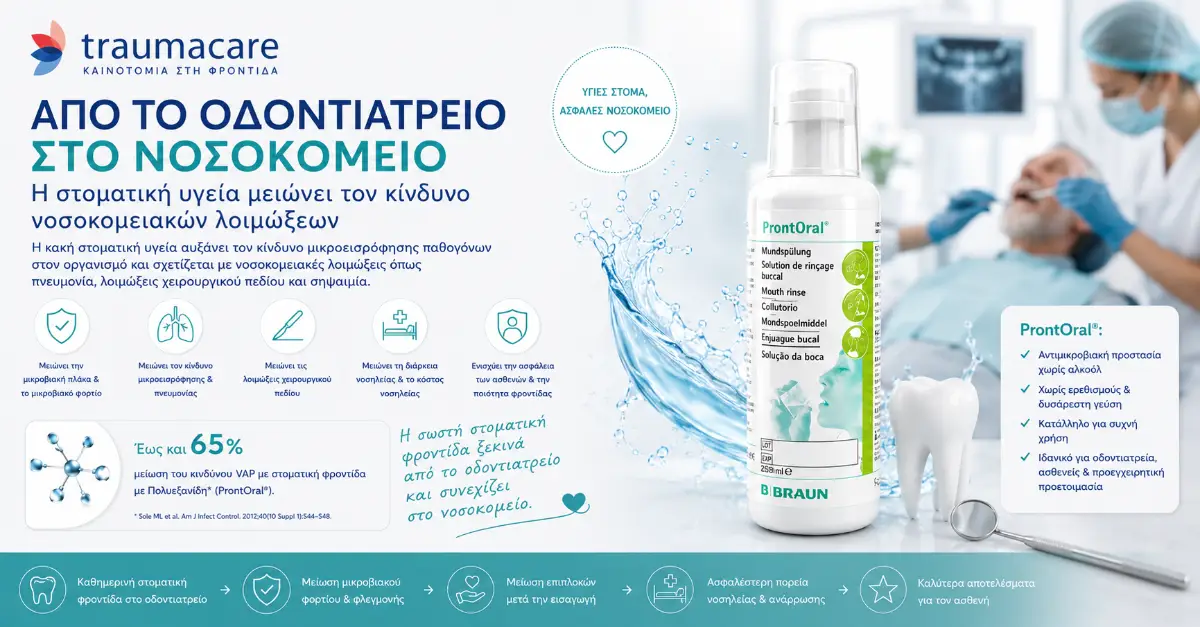
Oral hygiene is often considered a “dental” concern. However, this perception is dangerously narrow. The mouth is the first filter for the respiratory and digestive systems, one of the largest bacterial reservoirs in the body, and a critical factor in the development of a variety of systemic diseases — from atherosclerosis to pneumonia to hospital-acquired events.
In this article, we examine the continuum from dental prophylaxis to the prevention of hospital-acquired infection — and how B|Braun’s ProntOral® is one of the few commercial products designed to span this continuum.
Traumacare Note: We work with dental practices and hospital units simultaneously — we see firsthand how the B|Braun product family bridges these two fragmented areas.
1. The mouth as an ecosystem
The human mouth is home to more than 700 different species of bacteria , including:
- Streptococcus mutans, sanguinis, salivarius : oral streptococci
- Porphyromonas gingivalis, Tannerella forsythia : main culprits of periodontitis
- Fusobacterium nucleatum : anaerobic, linked to atherosclerosis
- Candida albicans : common fungus
- Lactobacilli, Veillonella : less aggressive
- In hospitalised patients: Pseudomonas, Klebsiella, MRSA, VRE
In a healthy adult, the total weight of the dental plaque biofilm is approximately 0.2 g. It takes just a few days without good brushing for it to increase dramatically, shifting the composition towards more aggressive pathogens.
2. From plaque to chronic diseases
The sequence is clear:
- Accumulation of plaque on teeth and gums
- Gingivitis : inflammatory reaction in the gums
- Periodontitis : destruction of supporting tissues and bone
- Systemic inflammation : increase in CRP, IL-6
- Exacerbation of systemic diseases :
- Cardiovascular disease (atheromatosis)
- Diabetes mellitus (mutual worsening glycemic control)
- Premature birth/low birth weight
- Neurodegenerative diseases (associated with Alzheimer's)
- Pulmonary infections (especially in the elderly)
3. The bridge: the dental office
The dentist is not just a “dentist”. He is the first line of prevention of oral pathogens that can affect overall health. In the modern dental office:
- Cleanings restore normal biofilm
- Patient education on proper oral hygiene
- Treatment of gingivitis/periodontitis in early stages
- Referral for further testing in special cases
ProntOral® is integrated into the dental protocol in several ways:
After scaling / root planing
After a deep cleaning, the patient has exposed sensitive areas. ProntOral® rinse 2× daily for 5-7 days: - Reduces bacterial load in periodontal folds - Facilitates mucosal healing without irritating - Does not stain teeth — important for patients who have just had a professional cleaning
After dental extraction or surgery
In wisdom tooth extraction, implant, or other surgical procedure: - ProntOral® started 24 hours after surgery - 3× daily for 7 days - Does not interfere with hemostasis - Does not cause wound burning - Similar antimicrobial protection to chlorhexidine, without the staining
In patients with frequent caries
In addition to brushing and using fluoride toothpaste: - ProntOral® 1-2× daily - Targeting Streptococcus mutans - Prevention of plaque and therefore new caries
In patients with frequent aphthae
- Topical application of ProntOral® with a cotton swab directly to the aphthae
- 3-4× per day
- No irritating effect
- Acceleration of healing
In patients with halitosis
The main sources of halitosis are anaerobic bacteria on the posterior dorsal surface of the tongue. ProntOral® with peppermint flavor: - Reduces bacterial load - Covers odor quickly - Provides long-term improvement without just covering up with flavors
4. When should the dentist consider the systemic picture
Below are some signs that should concern the dentist:
- Severe periodontitis in a young person → possible uncontrolled diabetes
- Recurrent aphthous ulcers → possible Crohn's disease, celiac disease, or immunosuppression
- Severe oral Candida in apparently healthy individuals → rule out HIV, diabetes
- Unexplained severe bad breath → exclude gastroesophageal reflux or liver disease
- Recurrent ulcers → leukemia, autoimmune
In all these cases, the dentist also recommends ProntOral® to treat the local problem while the patient searches for a systemic etiology.
5. Hospital transfer
When the patient himself/herself is transferred from the dental office to the hospital for an unrelated illness , oral hygiene continues to be critical:
In the ICU
- VAP prevention through systematic oral care 4× daily
- See related article: VAP prevention in the ICU
In surgical preparation
- Pre-surgical MDRO decolonization bundle (Prontoderm® + ProntOral®)
- See: Pre-surgical MDRO decolonization
In oncology clinics
- Management of mucositis in chemo-/radiotherapy
- See: Mucositis in oncology patients
In geriatric clinics
- Prevention of aspiration pneumonia in bedridden elderly
- See: ProntOral® in home care for the elderly
6. Returning home
When the patient returns from the hospital:
- Often has acquired microbial colonization (including MDROs)
- Often has altered oral status (mucositis, xerostomia)
- Requires continuation of the oral hygiene practiced in the hospital
ProntOral® at home: - Continues decolonization of MDROs - Does not change the chemistry of oral care abruptly - Available through Traumacare with free delivery
7. How the dentist can educate his patients
In a dental office, the opportunity for education is unique. The patient comes for an appointment 2-4 times a year and is open to advice.
Recommended daily protocol:
- Morning : brushing 2 minutes + flossing + ProntOral® 10 ml for 30 seconds
- After each meal : rinsing with water
- Evening : brushing 2 minutes + flossing + ProntOral® 10 ml for 30 seconds
Dental check-up frequency:
- Healthy adults: 2× per year
- Elderly: 3-4× per year
- Patients with chronic problems (diabetes, immunosuppression): 4× per year
Points to note:
- Not all mouthwashes are the same
- Alcohol can worsen dry mouth
- Chlorhexidine stains with prolonged use
- ProntOral® combines effectiveness and safety for daily and long-term use
9. Combination of services for the dental professional
At Traumacare we support dental practices with:
- ProntOral® available for sale from the practice
- Prontosan® Wound Gel for post-operative healing
- Prontoderm® Wipes for patient antisepsis in surgical procedures
- Helimatic® for automatic sterilization of dental instruments (in larger practices)
- Lifo-Scrub® for surgical hand washing
The entire B|Braun family is designed with the same philosophy of safety and biocompatibility.
10. Conclusion
Oral hygiene is not a product category. It is a clinical strategy that extends from the dental office, through the hospital, to home care. When the patient changes environments — from office to hospital, from hospital to home — continuity of the oral care protocol is critical.
ProntOral®, due to its mucosal friendliness, absence of chlorhexidine, and possibility of long-term use without side effects, is one of the few products that can be used across this entire continuum . From post-extraction care at the dentist, to preoperative preparation in the hospital, to ICU oral care, to oncology mucositis, to the elderly family member at home.
Prevention of plaque, caries, gingivitis, periodontitis. Treatment of aphthae and halitosis. Targeted antimicrobial activity against MDROs. All in one product, one goal: the bridge between dental prophylaxis and nosocomial infection.
Related articles in the series
- Polyhexanide (PHMB) in oral decolonization
- Pre-surgical MDRO decolonization bundle
- VAP prevention in the ICU
- Mucositis in oncology patients
- ProntOral® in home care for the elderly
- ProntOral® vs chlorhexidine
For dental practices and hospital units
➤ ProntOral® 250 ml
For bulk orders, in-house training and patient education materials, please contact the Traumacare team.
References
- B|Braun Melsungen AG. ProntOral® product page. catalogs.bbraun.com (accessed 2026-05).
- Tonetti MS, et al. Periodontitis and cardiovascular disease. Lancet Diabetes Endocrinol. 2014;2(11):800-2.
- Sanz M, et al. Periodontitis and adverse pregnancy outcomes. J Clin Periodontol. 2013;40 Suppl 14:S70-84.
- Holmstrup P, et al. Comorbidity of periodontal disease: systematic review. J Clin Periodontol. 2017;44 Suppl 18:S31-S43.
- Yoneyama T, et al. Oral care and pneumonia. Lancet. 1999;354(9177):515.
- Müller G, Kramer A. Biocompatibility index of antiseptic agents. J Antimicrob Chemother. 2008;61(6):1281-7.
- Welk A, et al. The antimicrobial effect of a polyhexamethylene biguanide-containing mouth rinse. Quintessence Int. 2016;47(5):421-431.
${{products:190}}
Editor & Editor
Author: Traumacare Medical Group — exclusive distributor of B|Braun in Greece.
Last updated: May 2026 · Disclaimer: Informative article, does not replace medical advice.
Contact the Traumacare Medical Team
Do you have questions about ProntOral®?
Free consultation for use in an inpatient, ICU, nursing home or surgical preparation.
| ✉️ Contact form | 💬 Viber Traumacare ✓ |
📞 Phone: 2311 286262