



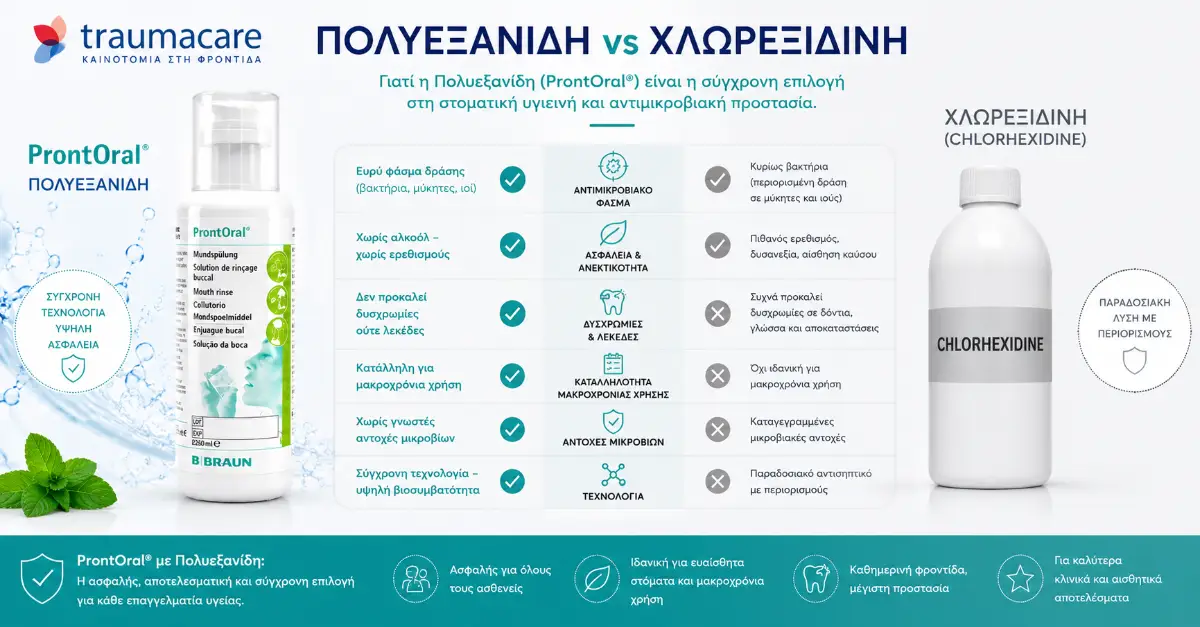
Chlorhexidine has dominated the antimicrobial oral hygiene field for over 50 years. It is the best-known, most studied, and most widely available oral antiseptic worldwide. More recently, however, polyhexanide (PHMB) — which has crossed over from wound care to oral care via B|Braun’s ProntOral® — is creating a new range of options for the clinician.
The question for the healthcare professional is clear: when to choose polyhexanide, when to choose chlorhexidine, and why? This deep-dive article provides a systematic, evidence-based answer.
Traumacare Note: We always advise you to base clinical decisions on individual assessment. This article does not replace professional judgment and local guidelines of each unit.
1. Two different antiseptics from the same chemical family
Polyhexanide and chlorhexidine both belong to the biguanides — a class of cationic antiseptics. However, their molecular differences are significant:
| Characteristic | Chlorhexidine | Polyhexanide (PHMB) |
|---|---|---|
| Molecular structure | Small biguanide dimer | Biguanide polymer (large molecular) |
| Molecular weight | 505 g/mol | 1,500–10,000 g/mol |
| Charge | Cationic | Cationic (more extensive) |
| Cell membrane penetration | Also penetrates eukaryotic membranes | Remains on the surface, targeted to prokaryotes |
| Use concentration | 0.12–0.2% oral, 0.5–4% dermal | 0.02–0.1% mouth and wounds |
| First use | 1950s | 1980s |
The crucial difference: polyhexanide is a polymer with a higher molecular weight. This keeps it on the bacterial cell membrane without easily entering eukaryotic cells.
2. Mechanism of action — detailed comparison
Chlorhexidine
- Adhesion to the bacterial surface (negatively charged)
- Penetration into the membrane
- At low concentrations: increased permeability → bacteriostatic effect
- At high concentrations: membrane rupture, cytoplasm coagulation → bactericidal effect
- A similar mechanism applies to eukaryotic cells
Polyhexanide
- Electrostatic adhesion to charged membrane sites
- Creation of multiple “bonds” due to repetition of cationic units
- Stabilized membrane deformation without complete penetration
- Gradual increase in permeability → bactericidal activity
- Selectivity: does not significantly affect cholesterol membranes of human cells
3. Spectrum of action
| Pathogen | Chlorhexidine | Polyhexanide |
|---|---|---|
| Gram-positive (incl. MRSA) | +++ | +++ |
| Gram-negative (incl. ESBL, Pseudomonas) | ++ | +++ |
| Fungi (Candida) | ++ | +++ |
| Enveloped viruses | ++ | ++ |
| Non-enveloped viruses | + | + |
| Spores (Clostridium) | – | – |
| Mycobacteria | + | + |
| Biofilms | + | ++ |
Spectrum conclusion: Comparable or slightly broader activity of polyhexanide, especially on biofilms and Candida — important for ICU and oncology patients.
4. Side effects — here is the main difference
Chlorhexidine
| Side effect | Frequency | Effect |
|---|---|---|
| Teeth/tongue staining | 30-50% in >7 days of use | Brown-black stain, requires professional cleaning |
| Dysgeusia | 20-30% | Taste alteration, reduced food intake |
| Oral mucosa | 5-10% | Burning, dryness, desquamation |
| Interaction with fluoride | 100% | Reduced toothpaste efficacy |
| Allergies | 0.1-1% | From urticaria to anaphylaxis |
| Increased ICU mortality | Questionable | Recent studies with worrying findings |
| Antimicrobial resistance | Increasing reports | qac genes, plasmid-mediated |
Polyhexanide
| Side effect | Frequency | Effect |
|---|---|---|
| Tooth staining | Rare/none | – |
| Dysgeusia | <5% | Usually mild |
| Oral mucosa | <2% | Well tolerated |
| Interaction with fluoride | None | – |
| Allergies | <0.1% | Very rare |
| Increased mortality | Not associated | In no studies |
| Persistence | Very rare reports | Due to multiple binding mechanisms |
5. Comparative table of clinical indications
| Clinical scenario | Preference |
|---|---|
| Short periodontal therapy (1-2 weeks) | Chlorhexidine (historical choice, strong evidence) |
| Prolonged oral care ICU (>7 days) | Polyhexanide (better tolerability) |
| Mucositis chemo/radiotherapy | Polyhexanide (no mucosal deterioration) |
| Pre-surgical MDRO bundle (Prontoderm® Set) | Polyhexanide (compatibility with PHMB system) |
| Home oral hygiene for the elderly | Polyhexanide (safety, tolerability) |
| Allergic to chlorhexidine | Polyhexanide (only option) |
| Pediatrics (>4 years) | Polyhexanide (better safety profile) |
| Patients with dry mouth | Polyhexanide (alcohol-free) |
| Canker sores, mouth ulcers | Polyhexanide (no irritant effect) |
| Intended prevention of tooth staining | Polyhexanide |
| Concurrent use with fluoride toothpaste | Polyhexanide |
| Pharmacy availability | Chlorhexidine (wider) |
| Cost | Chlorhexidine (cheaper on average) |
| Infected mouth wounds/ulcers | Polyhexanide (no effect on healing) |
6. What the guidelines say
| Guideline/Agency | Comment on chlorhexidine | Comment on polyhexanide |
|---|---|---|
| MASCC/ISOO (mucositis) | Not recommended for routine use | Recognized as an alternative |
| SHEA/IDSA (VAP prevention) | With caution in non-surgical patients | Increasing adoption |
| CDC/HICPAC | Preferred use | Not contraindicated |
| EAU (urology, pre-surgical) | Standard | Increasing inclusion |
| EFP (periodontology) | Strong recommendation for short-term use | Recommended in patients with intolerance |
| NHS England (elderly) | Preferred use | Recommended |
7. Scenarios where chlorhexidine remains the first choice
Despite its disadvantages, chlorhexidine remains an important tool in:
- Very short-term acute periodontal crisis (as little as 5-7 days)
- Postoperative oral surgery where strong bactericidal activity is critical and duration of use is limited
- Lack of alternative in some countries/health systems
8. Scenarios where ProntOral® is clearly superior
Polyhexanide should be is first choice in:
- Prolonged use (>1 week)
- All oncology patients undergoing chemo-/radiotherapy
- ICU patients especially non-surgical diagnoses
- Pre-surgical MDRO decolonization bundles (Prontoderm® Set)
- Elderly bedridden at home
- Children >4 years
- Patients with known hypersensitivity to chlorhexidine
- Patients who need to maintain normal taste and no tooth staining
- Mucositis of any etiology
- Canker sores and other oral ulcers
- Daily prevention of plaque, caries, gingivitis, periodontitis long-term
- Treatment of halitosis without concomitant taste alteration
- Compatibility with fluoride toothpaste (no interaction)
10. Conclusion
The comparison polyhexanide and chlorhexidine is not a battle between “old and new”. It is a clinical evaluation of the right tool for the right job.
- Chlorhexidine : potent in short, targeted, acute periodontal intervention
- Polyhexanide (ProntOral®) : broader safety and tolerability in all scenarios of prolonged or sensitive use — from the ICU to the nursing home
ProntOral® is not “the alternative to chlorhexidine”. It is the current preference for the majority of clinical indications encountered today.
Related articles in the series
- Polyhexanide (PHMB) in oral decolonization
- Pre-surgical MDRO decolonization bundle
- VAP prevention in the ICU
- Mucositis in oncology patients
Order ProntOral® from Traumacare
➤ ProntOral® 250 ml
Bibliography
- B|Braun Melsungen AG. ProntOral® product page. catalogs.bbraun.com (accessed 2026-05).
- Müller G, Kramer A. Biocompatibility index of antiseptic agents. J Antimicrob Chemother. 2008;61(6):1281-7.
- Pitten FA, Kramer A. Efficacy of cetylpyridinium chloride used as oropharyngeal antiseptic. Arzneimittelforschung. 2001;51(7):588-95.
- Welk A, et al. The antimicrobial effect of a polyhexamethylene biguanide-containing mouth rinse. Quintessence Int. 2016;47(5):421-431.
- Klompas M, et al. Reappraisal of routine oral care with chlorhexidine gluconate. JAMA Intern Med. 2014;174(5):751-61.
- Price R, et al. Selective digestive or oropharyngeal decontamination and topical oropharyngeal chlorhexidine for prevention of death in general intensive care. BMJ. 2014;348:g2197.
- Elad S, et al. MASCC/ISOO clinical practice guidelines for the management of mucositis. Cancer. 2020;126(19):4423-31.
- Lemiengre MB, et al. Antiseptics and disinfectants for treatment of HCAI. Cochrane Database Syst Rev. 2017.
${{products:190}}
Editor & Editor
Editor: Traumacare Medical Group — exclusive distributor of B|Braun in Greece.
Last updated: May 2026 · Disclaimer: Informative article, does not replace medical advice.
Contact the Traumacare Medical Team
Do you have questions about ProntOral®?
Free consultation for use in an inpatient, ICU, nursing home or surgical preparation.
| ✉️ Contact form | 💬 Viber Traumacare ✓ |
📞 Phone: 2311 286262