



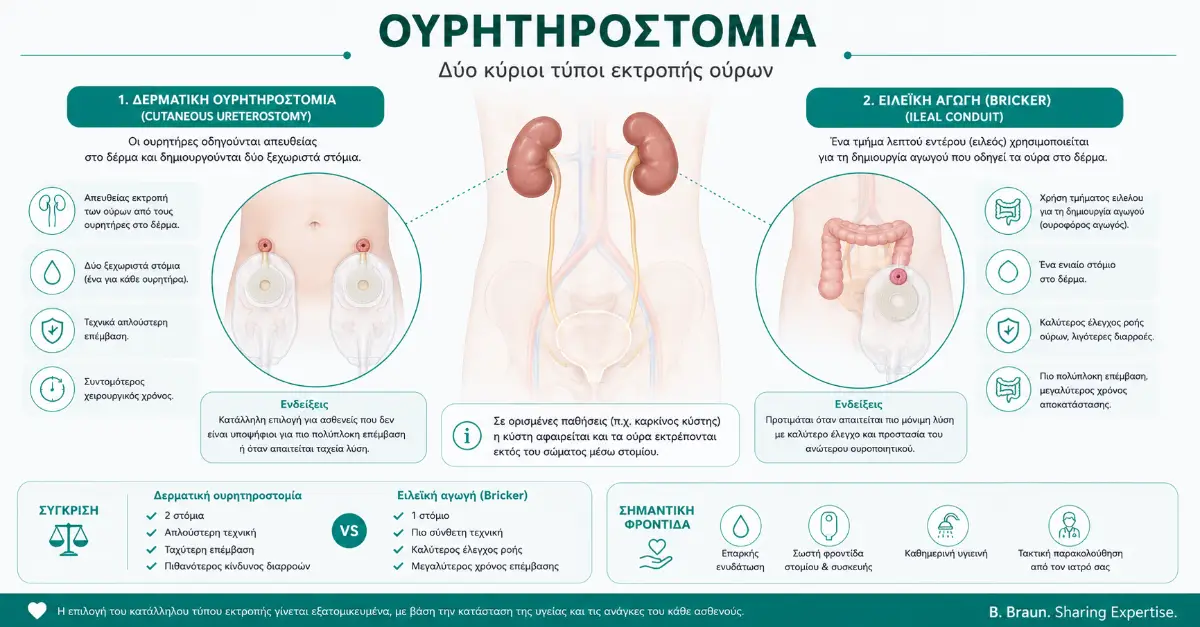
Have you been told you need a ureterostomy and are feeling lost? That’s normal. Before the procedure, it’s worth understanding exactly what it is , what types it includes, and how it will change your daily life.
The short answer: A ureterostomy is a surgical procedure that changes the path of urine from the bladder to an opening in the abdominal wall — from there, urine is collected in an external bag. It’s a permanent procedure, but life can continue as normal with the right supplies and support.
For a comprehensive overview of care, see the complete guide to ureterostomy care (Pillar B).
Before the operation: Contact us for free pre-op consultation . As exclusive B Braun Avitum representatives, we prepare you with the appropriate materials before you return home. This way you avoid stress and early infections due to poor fit.
The term and its meaning
“Urostomy” means the surgical creation of a stoma (opening) that diverts urine from the bladder or ureter to the abdominal wall. It is a form of urinary diversion.
It is done when the bladder is removed (e.g. due to cancer) or when it is not functioning (neurogenic dysfunction, destruction).
1. Cutaneous Ureterostomy
In the simplest form of ureterostomy, the ureters (which carry urine from the kidneys) are detached from the bladder and implanted directly into the skin. This creates one or two small openings (one for each ureter or both together).
Advantages
- Simpler and faster procedure
- No need to use the bowel — the digestive system is kept intact
- Shorter recovery
- Fewer complications in the short term
Disadvantages
- Frequent use of catheters (J-stents) to keep the stoma open
- Small stoma, more difficult to apply a bag
- Higher risk of strictures in the long term
- More common urinary tract infections
Which Flexima is suitable for cutaneous stoma?
Because the stoma is small and often flush or retracted, the Flexima Active O' convex with soft convexity is ideal. The flexible base ensures a seal without putting excessive pressure on the stoma. It is covered by EOPYY.
2. Ileal Conduit — Ileal Conduit (Bricker Procedure)
The most common technique worldwide — and is considered the “gold standard” in urology. The surgeon isolates a small section of 15-20 cm from the ileum (last part of the small intestine). It connects the ureters to one end of the intestinal tract, and the other end exits as a stoma in the skin.
The intestine acts as a "conduit" — it does NOT store urine . Urine continuously passes through it to the bag. The name is due to Eugene Bricker who described the technique in 1950 — it has been used with minimal changes since then.
Advantages
- Wider stoma (2-3 cm) — easy bag application
- Less strictures in the long term
- No need for catheters
- Better quality of life in the long term
- Used since 1950 — proven technique
Disadvantages
- Longer operation, duration 4-6 hours
- Bowel recovery — milder bowel function 2-3 weeks later
- Produces mucus in the urine (normal)
- Rare complication: metabolic acidosis from reabsorption
Which Flexima is suitable for ileal conduit?
Because the stoma is wide (2-3 cm), you have flexibility in choosing :
- Flat and fairly high stoma: Flexima Uro Silk Flat (discreet 1-piece — beige or clear)
- Slightly retracted: Flexima Uro Silk Convex (1-piece with slight concave)
- Flush or very retracted (common after cystectomy): Flexima Active O' convex (soft convexity for sealing)
- Sensitive skin: Flexima Key (2-piece — change bag without removing the base)
- More economical 2-piece: Flexima 3S (mechanical coupling)
All covered by EOPYY (ICD-10 Z93.6 + Z43.6, Government Gazette B' 5395/2025). One of our specialists will recommend the appropriate one based on your specific profile.
Other variants (rare)
Neobladder
Orthotopic neobladder: a larger section of bowel is formed into a bladder shape, connected to the ureters and urethra. Does not require an external pouch — the patient urinates from the urethra. However, training is required and partial incontinence is common in the first months.
Ortholateral ureterostomies (Indiana pouch, Mainz)
Continuous ureteral diversions with an internal “reservoir” that the patient empties by self-catheterization. Less common in Greece.
How is the technique decided
The doctor considers:
- Patient's age and general condition
- Experience and self-management
- Extent of cancer or disease
- Kidney function
- Bowel quality and condition
- Patient's body image preference
In most cases of radical cystectomy for cancer, the ileal conduit (Bricker) is the choice because it combines safety, long-term reliability, and good quality of life.
What you need to know as a patient before surgery
- Request a pre-op meeting with an ostomy nurse to mark the correct stoma position on your body.
- Contact a contracted EOPYY provider (such as Traumacare) before surgery. This way, when you return home, you will have the materials ready.
- Find out about pouch options. 1-piece or 2-piece system; Convex or flat; Transparent or beige; They all play a role in everyday life.
- Talk to your family. You will need support in the first few weeks.
Why choose B Braun Flexima
All advanced urostomy systems have specific specifications. B Braun Flexima stands out for:
- Anti-reflux valve in all models — prevents urine from returning to the stoma
- Hydrocolloid skin protector with flower-shape — adapts to the body
- Soft convexity (Active O' convex) — ideal for flush stomas
- Discreet midi beige split cover — invisible under clothing
- German engineering · FDA-cleared — used in European urology centers
Traumacare chose B Braun Avitum as its exclusive representative because quality is non-negotiable when we are talking about devices that you will wear every day for years.
| ✉️ Contact form | 💬 Viber channel Traumacare ✓ |
| See all Flexima Urostomy → |
Do you have any questions? Send a message
Our team will respond within 24 hours. As exclusive B Braun Avitum representatives, we offer you a free pre-op consultation to choose your pouch correctly before the operation.
Contact form
Sources: B Braun Avitum, Hellenic Urological Society, Government Gazette B' 5395/2025. Informational article, not a substitute for medical advice.