



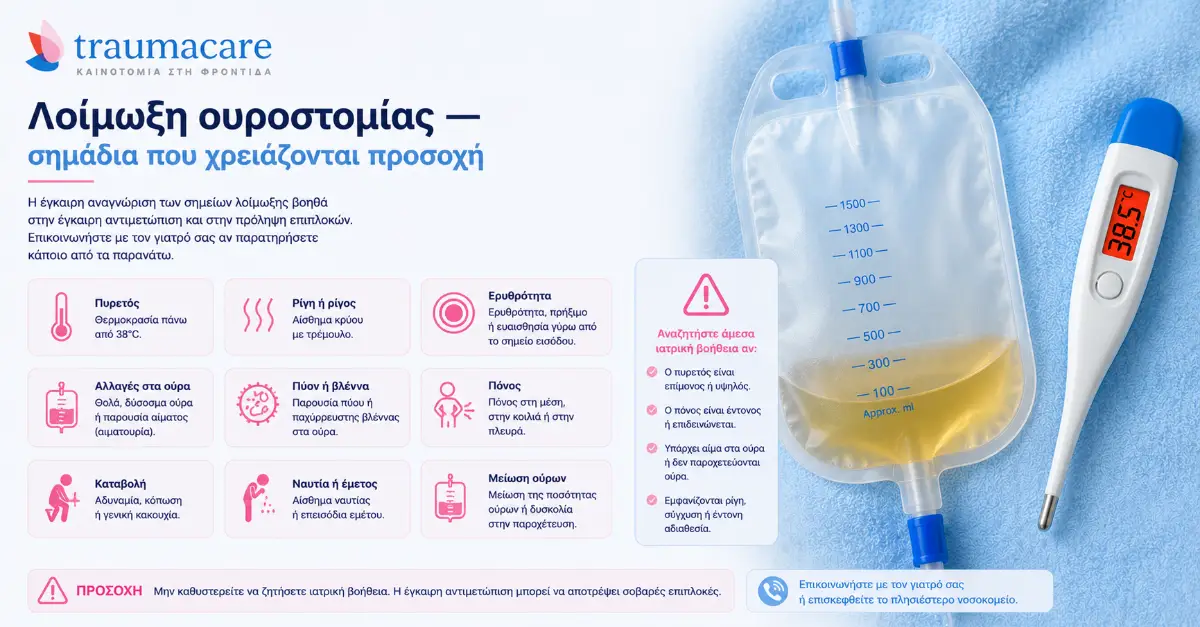
Urinary tract infection is the most common complication of nephrostomy. However, unlike a common bladder infection, a urinary tract infection that occurs through a catheter can rapidly progress to sepsis — a life-threatening condition. Therefore, early recognition is critical.
Emergency: If you have fever > 38.5°C, chills, confusion, or severe back pain — go IMMEDIATELY to the emergency room. Don't wait.
If you don't know what nephrostomy is or the overall care , start there.
Why it is more serious than a common urinary tract infection
The catheter creates a direct “highway” from the outside environment to the kidney. The protective barrier of the bladder is not present. In addition, the kidney is more vascular, so germs can pass into the blood more quickly.
Statistics: in patients with a nephrostomy > 2 weeks, the risk of a urinary tract infection is 30-50% in one year. In patients with poor hygiene, it can reach 70%.
The 7 signs — in order of severity
1. Fever > 38°C
The most reliable sign. Fever without obvious other cause (cold, gastroenteritis) in a nephrostomy patient should always be evaluated by a physician. It is often accompanied by chills.
2. Low back pain
Pain on the side of the catheter, especially if it is aggravated by percussion (knockdown), suggests pyelonephritis — an infection of the kidney itself.
3. Cloudy or foul-smelling urine
A change in the color and odor of the urine in the bag is an indication of microbial activity. Normally, urine is yellow and clear.
4. Redness or pus at the exit site
Local skin infection (cellulitis) around the catheter. May develop into a hematoma or abscess if not treated promptly.
5. Fatigue and weakness
Unexplained extreme fatigue, decreased appetite, low mood. Early symptoms of systemic infection that many overlook.
6. Confusion or difficulty concentrating
In elderly patients , acute infection often presents with confusion before fever. Serious sign — immediate evaluation by a physician.
7. Tachycardia or low blood pressure
Pulse > 100, blood pressure <90/60, or rapid breathing are signs of advanced sepsis . Immediate transport to the emergency room is required.
What to do when a sign appears
- Take temperature and pulse.
- Record what signs you have and when they started.
- If there is fever > 38.5 or back pain or confusion : immediately to the emergency room.
- If there is only local redness without fever: call your doctor within 24 hours.
- Take your prescribed medication and medical history with you.
Prevention — the best treatment
- Meticulous aseptic technique at every bag change .
- Daily cleaning around the exit site with 2% chlorhexidine.
- Adequate hydration (1.5-2 liters/day).
- Prompt catheter change every 8-12 weeks.
- Change the bag every 5-7 days.
- Avoid swimming in water of uncontrolled quality.
When prophylactic antibiotics are needed
In patients with frequent recurrent infections, the doctor may recommend scheduled antibiotics before changing the catheter. This is a strictly individual decision and never take antibiotics yourself .
What to do in the emergency room
In the hospital, the following will be done:
- Urine culture from the catheter
- Blood tests (CRP, leukocytes, blood culture if sepsis is suspected)
- Kidney ultrasound to exclude an abscess
- Start broad-spectrum intravenous antibiotics
- Possible catheter change — the old one is often a “home” for germs
| ✉️ Contact form | 💬 Viber channel Traumacare ✓ |
| See all nephrostomy products → |
Have questions? Send a message
Our team will respond within 24 hours. If you have an urgent symptom, call your primary care physician or emergency room IMMEDIATELY — the form is for supply questions and non-urgent questions.
Contact form
Sources: Percutaneous Nephrostomy Nursing Care (Patras General Hospital), Hellenic Urological Society, Government Gazette B' 5395/2025. Informative article, does not replace medical advice.