



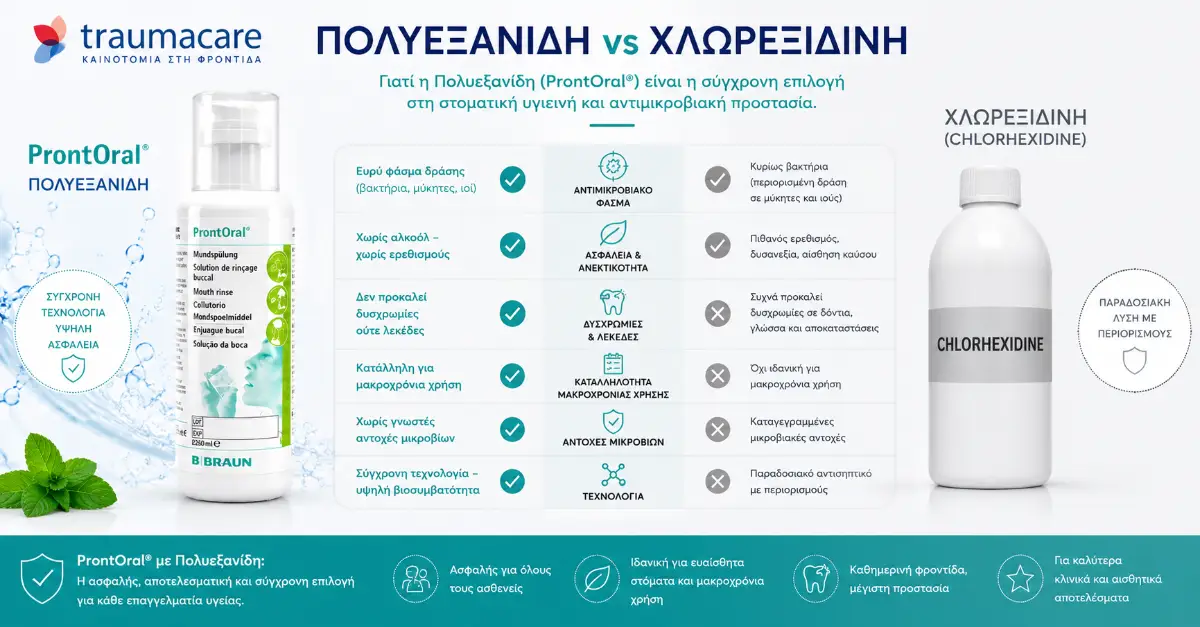
Η χλωρεξιδίνη κυριάρχησε για περισσότερα από 50 χρόνια στο πεδίο της αντιμικροβιακής στοματικής υγιεινής. Είναι το πιο γνωστό, πιο μελετημένο και ευρέως διαθέσιμο στοματικό αντισηπτικό παγκοσμίως. Πιο πρόσφατα όμως, η πολυεξανίδη (PHMB) — που πέρασε από τη φροντίδα τραυμάτων στη στοματική φροντίδα μέσω του ProntOral® της B|Braun — δημιουργεί μια νέα διεύρυνση επιλογών για τον κλινικό.
Το ερώτημα που τίθεται στον επαγγελματία υγείας είναι ξεκάθαρο: πότε επιλέγουμε πολυεξανίδη, πότε χλωρεξιδίνη και γιατί; Αυτό το deep-dive άρθρο παρέχει μια συστηματική, βασισμένη σε στοιχεία απάντηση.
Σημείωση Traumacare: Σας συμβουλεύουμε πάντα να βασίζετε τις κλινικές αποφάσεις σε εξατομικευμένη αξιολόγηση. Το άρθρο αυτό δεν αντικαθιστά την επαγγελματική κρίση και τις τοπικές κατευθυντήριες οδηγίες της κάθε μονάδας.
1. Δύο διαφορετικά αντισηπτικά της ίδιας χημικής οικογένειας
Η πολυεξανίδη και η χλωρεξιδίνη ανήκουν αμφότερες στις βιγουανίδες — μια κατηγορία κατιονικών αντισηπτικών. Ωστόσο, οι μοριακές τους διαφορές είναι σημαντικές:
| Χαρακτηριστικό | Χλωρεξιδίνη | Πολυεξανίδη (PHMB) |
|---|---|---|
| Μοριακή δομή | Μικρό διμερές βιγουανίδης | Πολυμερές βιγουανίδης (μεγαλομοριακό) |
| Μοριακό βάρος | 505 g/mol | 1.500–10.000 g/mol |
| Φορτίο | Κατιονικό | Κατιονικό (πιο εκτεταμένο) |
| Διείσδυση κυτταρικής μεμβράνης | Διαπερνά και τις μεμβράνες των ευκαρυωτικών | Παραμένει στην επιφάνεια, στοχευμένη σε προκαρυωτικές |
| Συγκέντρωση χρήσης | 0,12–0,2% στόμα, 0,5–4% δέρμα | 0,02–0,1% στόμα και τραύματα |
| Πρώτη χρήση | 1950s | 1980s |
Η κρίσιμη διαφορά: η πολυεξανίδη είναι πολυμερές με μεγαλύτερο μοριακό βάρος. Αυτό την κρατά επί της κυτταρικής μεμβράνης των βακτηρίων χωρίς να εισέρχεται εύκολα σε ευκαρυωτικά κύτταρα.
2. Μηχανισμός δράσης — λεπτομερής σύγκριση
Χλωρεξιδίνη
- Προσκόλληση στην επιφάνεια του βακτηρίου (αρνητικά φορτισμένη)
- Διείσδυση στη μεμβράνη
- Σε χαμηλές συγκεντρώσεις: αύξηση περατότητας → βακτηριοστατική δράση
- Σε υψηλές συγκεντρώσεις: ρήξη μεμβράνης, πήξη κυτταροπλάσματος → βακτηριοκτονική δράση
- Παρόμοιος μηχανισμός εφαρμόζεται και σε ευκαρυωτικά κύτταρα
Πολυεξανίδη
- Ηλεκτροστατική προσκόλληση στις φορτισμένες θέσεις της μεμβράνης
- Δημιουργία πολλαπλών “δεσμών” λόγω επανάληψης κατιονικών μονάδων
- Σταθεροποιημένη παραμόρφωση μεμβράνης χωρίς πλήρη διείσδυση
- Σταδιακή αύξηση περατότητας → βακτηριοκτονική δράση
- Εκλεκτικότητα: δεν επηρεάζει σημαντικά τις χοληστερολούχες μεμβράνες των ανθρώπινων κυττάρων
3. Φάσμα δράσης
| Παθογόνο | Χλωρεξιδίνη | Πολυεξανίδη |
|---|---|---|
| Gram-θετικά (incl. MRSA) | +++ | +++ |
| Gram-αρνητικά (incl. ESBL, Pseudomonas) | ++ | +++ |
| Μύκητες (Candida) | ++ | +++ |
| Επικαλυμμένοι ιοί | ++ | ++ |
| Μη επικαλυμμένοι ιοί | + | + |
| Σπόρια (Clostridium) | – | – |
| Mycobacteria | + | + |
| Βιοφίλμ | + | ++ |
Συμπέρασμα φάσματος: Συγκρίσιμη ή ελαφρώς ευρύτερη δράση της πολυεξανίδης, ιδιαίτερα σε βιοφίλμ και Candida — σημαντικό για ασθενείς ΜΕΘ και ογκολογικούς.
4. Παρενέργειες — εδώ είναι η κύρια διαφορά
Χλωρεξιδίνη
| Παρενέργεια | Συχνότητα | Επίδραση |
|---|---|---|
| Χρώση δοντιών/γλώσσας | 30-50% σε >7 ημέρες χρήση | Καφέ-μαύρη χρωστική, χρειάζεται επαγγελματικός καθαρισμός |
| Δυσγευσία | 20-30% | Αλλοίωση γεύσης, μειωμένη πρόσληψη τροφής |
| Στοματικός βλεννογόνος | 5-10% | Καύσος, ξηρότητα, αποφολίδωση |
| Αλληλεπίδραση με fluoride | 100% | Μειωμένη δράση οδοντόκρεμας |
| Αλλεργίες | 0,1-1% | Από κνίδωση έως αναφυλαξία |
| Αυξημένη θνητότητα ΜΕΘ | Αμφισβητούμενο | Πρόσφατες μελέτες με ανησυχητικά ευρήματα |
| Ανθεκτικότητα μικροβιακή | Αυξανόμενες αναφορές | qac genes, plasmid-mediated |
Πολυεξανίδη
| Παρενέργεια | Συχνότητα | Επίδραση |
|---|---|---|
| Χρώση δοντιών | Σπάνια / μηδαμινή | – |
| Δυσγευσία | <5% | Συνήθως ήπια |
| Στοματικός βλεννογόνος | <2% | Καλά ανεκτή |
| Αλληλεπίδραση με fluoride | Καμία | – |
| Αλλεργίες | <0,1% | Πολύ σπάνιες |
| Αυξημένη θνητότητα | Δεν έχει συσχετιστεί | Σε καμία μελέτη |
| Ανθεκτικότητα | Πολύ σπάνιες αναφορές | Λόγω πολλαπλού μηχανισμού δέσμευσης |
5. Συγκριτικός πίνακας κλινικών ενδείξεων
| Κλινικό σενάριο | Προτίμηση |
|---|---|
| Βραχεία περιοδοντική θεραπεία (1-2 εβδομάδες) | Χλωρεξιδίνη (ιστορική επιλογή, ισχυρή τεκμηρίωση) |
| Παρατεταμένη στοματική φροντίδα ΜΕΘ (>7 ημέρες) | Πολυεξανίδη (καλύτερη ανεκτικότητα) |
| Mucositis χημειο-/ακτινοθεραπείας | Πολυεξανίδη (καμία επιδείνωση βλεννογόνου) |
| Pre-surgical MDRO bundle (Prontoderm® Set) | Πολυεξανίδη (συμβατότητα με σύστημα PHMB) |
| Στοματική υγιεινή ηλικιωμένων κατ’ οίκον | Πολυεξανίδη (ασφάλεια, ανεκτικότητα) |
| Αλλεργικός σε χλωρεξιδίνη | Πολυεξανίδη (μοναδική επιλογή) |
| Παιδιατρική (>4 ετών) | Πολυεξανίδη (καλύτερο προφίλ ασφαλείας) |
| Ασθενείς με ξηροστομία | Πολυεξανίδη (χωρίς αλκοόλη) |
| Άφθες, στοματικά έλκη | Πολυεξανίδη (καμία ερεθιστική δράση) |
| Επιδιωκόμενη πρόληψη χρώσης δοντιών | Πολυεξανίδη |
| Παράλληλη χρήση με fluoride οδοντόκρεμα | Πολυεξανίδη |
| Διαθεσιμότητα στο φαρμακείο | Χλωρεξιδίνη (ευρύτερη) |
| Κόστος | Χλωρεξιδίνη (φθηνότερη σε μέσο όρο) |
| Επιμολυσμένα τραύματα στόματος / έλκη | Πολυεξανίδη (καμία επίδραση στην επούλωση) |
6. Τι δείχνει η δημοσιευμένη βιβλιογραφία
Εδώ χρειάζεται ειλικρίνεια, γιατί ο όγκος της τεκμηρίωσης δεν είναι ίδιος για τα δύο αντισηπτικά.
Η χλωρεξιδίνη έχει δεκαετίες μελετών και παραμένει το αντισηπτικό αναφοράς στη στοματολογία. Οι ανεπιθύμητες ενέργειες της παρατεταμένης χρήσης —χρώση δοντιών και αλλοίωση της γεύσης— είναι εξίσου καλά τεκμηριωμένες σε συστηματικές ανασκοπήσεις.
Η πολυεξανίδη ως στοματικό διάλυμα έχει σαφώς μικρότερη βιβλιογραφία. Οι βασικές κλινικές μελέτες είναι λίγες, μικρές, και εστιάζουν στην αναστολή της οδοντικής πλάκας σε ορίζοντα ημερών. Σε αυτές τις συγκρίσεις η πολυεξανίδη υπερέχει του εικονικού διαλύματος, αλλά δεν έχει δείξει υπεροχή έναντι της χλωρεξιδίνης στην αναστολή της πλάκας.
Με άλλα λόγια: η πολυεξανίδη είναι μια εύλογη εναλλακτική με διαφορετικό προφίλ ανεκτικότητας — όχι ένα αποδεδειγμένα ισχυρότερο αντισηπτικό. Όπου συναντάτε ισχυρισμούς υπεροχής, από οποιαδήποτε πλευρά, αξίζει να ζητάτε τη μελέτη που τους στηρίζει.
7. Σενάρια όπου η χλωρεξιδίνη παραμένει η πρώτη επιλογή
Παρά τα μειονεκτήματα, η χλωρεξιδίνη παραμένει σημαντικό εργαλείο σε:
- Πολύ βραχεία οξεία περιοδοντική κρίση (μόλις 5-7 ημέρες)
- Postoperative oral surgery όπου η ισχυρή βακτηριοκτονική δράση είναι κρίσιμη και η διάρκεια χρήσης είναι περιορισμένη
- Έλλειψη εναλλακτικής σε κάποιες χώρες/συστήματα υγείας
8. Πότε αξίζει να συζητήσετε την πολυεξανίδη
Με βάση το προφίλ ανεκτικότητας και τις εγκεκριμένες ενδείξεις του προϊόντος, η πολυεξανίδη είναι λογική επιλογή προς συζήτηση με τον γιατρό ή τον οδοντίατρό σας όταν:
- υπάρχει γνωστή υπερευαισθησία ή δυσανεξία στη χλωρεξιδίνη
- η χρήση αναμένεται να είναι παρατεταμένη και η χρώση των δοντιών ή η αλλοίωση της γεύσης αποτελεί πραγματικό πρόβλημα για τον ασθενή
- ο ασθενής δυσκολεύεται να συμμορφωθεί με τη χλωρεξιδίνη ακριβώς εξαιτίας της γεύσης
Σε νοσοκομειακά πρωτόκολλα —ΜΕΘ, ογκολογικοί ασθενείς, προεγχειρητική αποαποικιοποίηση— η επιλογή αντισηπτικού καθορίζεται από το πρωτόκολλο της κάθε μονάδας και την επιτροπή λοιμώξεων. Δεν προτείνουμε αντικατάσταση καθιερωμένου πρωτοκόλλου με βάση αυτό το άρθρο.
9. Συμπέρασμα
Η σύγκριση πολυεξανίδης και χλωρεξιδίνης δεν είναι μάχη μεταξύ “παλιού και νέου”. Είναι κλινική αξιολόγηση σωστού εργαλείου για σωστή εργασία.
- Χλωρεξιδίνη: ισχυρή σε βραχεία, στοχευμένη, οξεία περιοδοντική παρέμβαση
- Πολυεξανίδη (ProntOral®): ευρύτερη ασφάλεια και ανεκτικότητα σε όλα τα σενάρια παρατεταμένης ή ευαίσθητης χρήσης — από τη ΜΕΘ μέχρι το σπίτι του ηλικιωμένου
Το ProntOral® δεν είναι “η εναλλακτική στη χλωρεξιδίνη”. Είναι η σύγχρονη προτίμηση για το μεγαλύτερο μέρος των κλινικών ενδείξεων που συναντάμε σήμερα.
Σχετικά άρθρα της σειράς
- Πολυεξανίδη (PHMB) στη στοματική αποαποικιοποίηση
- Pre-surgical MDRO decolonization bundle
- VAP prevention στη ΜΕΘ
- Mucositis σε ογκολογικούς ασθενείς
Παραγγείλτε ProntOral® από την Traumacare
➤ ProntOral® 250 ml
Πηγές
Οι συγκρίσεις μηχανισμού, φάσματος και ανεπιθύμητων ενεργειών αυτού του άρθρου βασίζονται στις παρακάτω δημοσιευμένες πηγές:
- B. Braun Melsungen AG. ProntOral® product information. catalogs.bbraun.com (πρόσβαση 2026).
- Rosin M, Welk A, Kocher T, Majic-Todt A, Kramer A, Pitten FA. The effect of a polyhexamethylene biguanide mouthrinse compared to an essential oil rinse and a chlorhexidine rinse on bacterial counts and 4-day plaque regrowth. J Clin Periodontol. 2002;29(5):392-399.
- Welk A, Splieth CH, Schmidt-Martens G, Schwahn C, Kocher T, Kramer A, Rosin M. The effect of a polyhexamethylene biguanide mouthrinse compared with a triclosan rinse and a chlorhexidine rinse on bacterial counts and 4-day plaque re-growth. J Clin Periodontol. 2005;32(5):499-505.
- Welk A, et al. The antimicrobial effect of a polyhexamethylene biguanide-containing mouth rinse. Quintessence Int. 2016;47(5):421-431.
- Van Strydonck DAC, Slot DE, Van der Velden U, Van der Weijden F. Effect of a chlorhexidine mouthrinse on plaque, gingival inflammation and staining in gingivitis patients: a systematic review. J Clin Periodontol. 2012;39(11):1042-1055.
- Müller G, Kramer A. Biocompatibility index of antiseptic agents. J Antimicrob Chemother. 2008;61(6):1281-1287.
- Klompas M, Speck K, Howell MD, Greene LR, Berenholtz SM. Reappraisal of routine oral care with chlorhexidine gluconate for patients receiving mechanical ventilation: systematic review and meta-analysis. JAMA Intern Med. 2014;174(5):751-761.
- Price R, MacLennan G, Glen J. Selective digestive or oropharyngeal decontamination and topical oropharyngeal chlorhexidine for prevention of death in general intensive care: systematic review and network meta-analysis. BMJ. 2014;348:g2197.
- Elad S, Cheng KKF, Lalla RV, et al. MASCC/ISOO clinical practice guidelines for the management of mucositis secondary to cancer therapy. Cancer. 2020;126(19):4423-4431.
Τελευταία ενημέρωση περιεχομένου: Αύγουστος 2026.
${{products:190}}
Συντάκτης & Επιμέλεια
Συντάκτης: Ιατρική Ομάδα Traumacare — αποκλειστικός διανομέας B|Braun στην Ελλάδα.
Τελευταία ενημέρωση: Μάιος 2026 · Disclaimer: Ενημερωτικό άρθρο, δεν αντικαθιστά τη συμβουλή ιατρού.
Επικοινωνία με την Ιατρική Ομάδα Traumacare
Έχετε ερωτήσεις για το ProntOral®;
Δωρεάν συμβουλή για χρήση σε ασθενή, ΜΕΘ, οίκο ευγηρίας ή χειρουργική προετοιμασία.
| ✉️ Φόρμα επικοινωνίας | 💬 Viber Traumacare ✓ |
📞 Τηλέφωνο: 2311 286262