



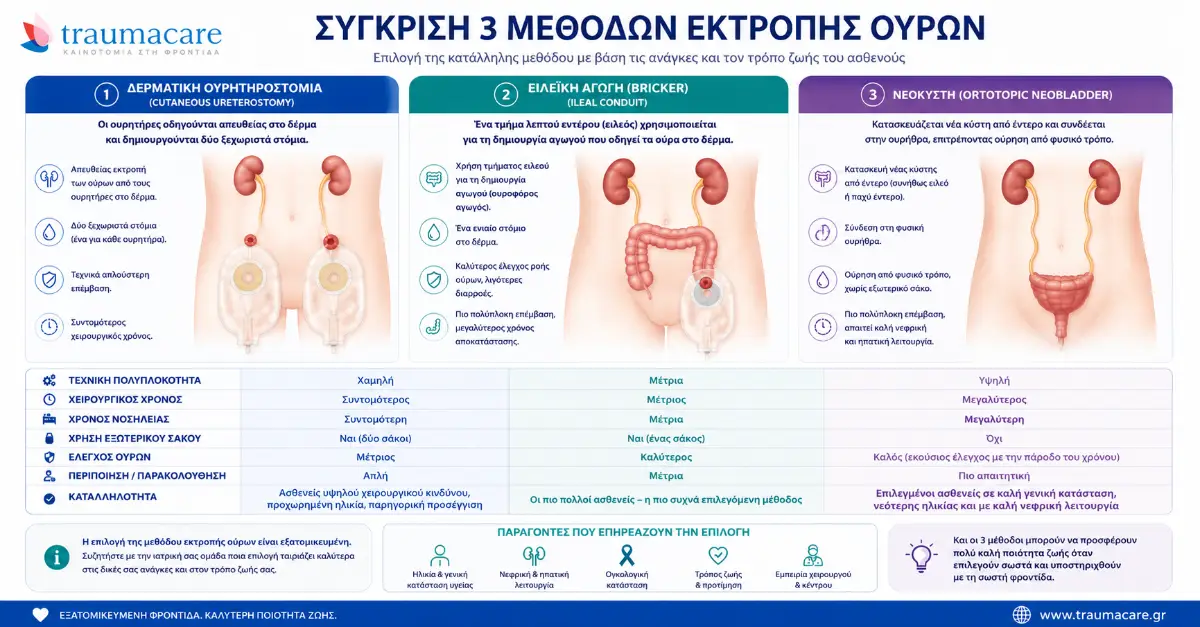
Tre metoda të devijimit të urinës — një vendim
Kur fshikëza duhet të hiqet ose të anashkalohet, ekzistojnë tre opsione themelore për devijimin e urinës. Secila ka indikacione, teknika dhe ndikim të ndryshëm në jetën e përditshme. Në këtë artikull, ne i krahasojmë ato në detaje për t'ju ndihmuar të kuptoni pse mjeku juaj ka rekomanduar një të veçantë.
Sipas Udhëzimeve të EAU 2024 [1] , zgjedhja e metodës është individuale dhe varet nga sëmundja themelore, mosha, gjendja e përgjithshme, funksioni renal, anatomia e uretrës dhe preferencat personale të pacientit.
3 metodat me një vështrim
| Karakteristikë | 🔵 Nefrostomi (PCN) | 🟢 Ureterostomi (Bricker) | 🟣 Neocist |
|---|---|---|---|
| Lloji | Kateter i jashtëm në veshkë | Stoma + qese stomaku | Neocist nga zorra |
| Kohëzgjatja | I përkohshëm (zakonisht) | I përhershëm | I përhershëm |
| Invazivitet | Minimalisht invaziv (15-30 minuta) | Ndërhyrje kirurgjikale e madhe (4-7 orë) | Ndërhyrje kirurgjikale e madhe (5-9 orë) |
| Shtrim në spital | 1-3 ditë | 7-9 ditë | 9-14 ditë |
| Urinim | Në një qese | Në një qese ostomie | Normale (përmes uretrës) |
| Imazhi i trupit | Qese e dukshme | Qese diskrete nën rroba | Pa ndryshim të dukshëm |
🔵 Nefrostomia (PCN — Nefrostomia Perkutane)
Nefrostomia perkutane është një procedurë minimalisht invazive ku një kateter i hollë vendoset nga mbrapa direkt në veshkë për të kulluar urinën kur ka bllokim. Sipas udhëzimeve aktuale [2] , përdoret kryesisht:
- Në urolithiazën në ureter me hidronefrozë dhe ethe (dekompresion urgjent për urosepsinë)
- Në bllokimin malinj të ureterit (kanceri i prostatës, qafës së mitrës, i nyjeve limfatike)
- Para trajtimit përfundimtar (p.sh. kimioterapia, radioterapia, kirurgjia)
- Në raste të rralla, si një zgjidhje e përhershme kur nuk ka mundësi tjetër
Avantazhet: E shpejtë, minimalisht invazive, rrezik i ulët postoperativ, e kthyeshme.
Disavantazhet: Qese e jashtme, ndërrim kateteri çdo 2-3 muaj, kufizime në not, rrezik më i lartë i infeksioneve të traktit urinar.
🟢 Ureterostomia (Kanali Bricker / Ileal)
Ureterostomia është metoda më e zakonshme e devijimit të përhershëm të urinës pas cistektomisë radikale — që përbën >60% në të gjithë botën [1] . Një seksion i zorrës (~15 cm) përdoret si një kanal që transporton urinën nga ureterët në një stomë në bark. Pacienti mban një qese ostomie.
Kush është i përshtatshëm për [3] :
- Pothuajse të gjithë pacientët që kanë nevojë për cistektomi — pa kritere të rrepta
- Të moshuar me sëmundje bashkëshoqëruese që nuk tolerojnë një operacion më të madh
- Pacientë me mosfunksionim renal (eGFR < 45 mL/min)
- Pacientë me dëmtim të uretrës/sfinkterit ose infiltrim të tumorit atje
- Pacientë që nuk duan ose nuk mund të vetë-kateterizojnë
Përparësitë: Teknikisht më e thjeshtë, më e sigurt, qëndrim më i shkurtër në spital, kthim i shpejtë në jetën e përditshme , i pajtueshëm me një gamë të gjerë pacientësh. Cilësi jete e krahasueshme me fshikëzën neo pas muajve të parë të adaptimit [4]
Disavantazhet: Stoma dhe qese e përhershme, nevojë për kujdes të vazhdueshëm, përshtatje psikologjike.
🟣 Fshikëza Neo Ortotopike
Fshikëza neo është një rezervuar i bërë nga një pjesë e zorrës që vendoset në vend të fshikëzës së vjetër dhe lidhet me uretrën. Pacienti urinon normalisht - megjithëse ndryshe (pa ndjesinë e plotësisë, me orar dhe mosmbajtje të mundshme natën në muajt e parë).
Kritere të rrepta pranueshmërie [1] [3] :
- Mosha < 75 vjeç (kriter relativ)
- Funksion i mirë renal ( eGFR > 45 mL/min )
- Sfinkter i jashtëm uretral i paprekur
- Pa infiltrim tumori uretral
- I gatshëm të nënshtrohet 6-12 muajsh trajnim për urinim dhe vetë-kateterizim të mundshëm
- Kompetencë psikologjike dhe motorike
Përparësitë: Asnjë qese e dukshme, urinim pothuajse normal, imazh më i mirë i trupit, imazh më i mirë i vetes.
Disavantazhet: Procedurë më komplekse, qëndrim më i gjatë në spital, kohë trajnimi 6-12 muaj, inkontinencë natën në 30-50% në vitin e parë, vetë-kateterizim i ndërprerë në 25-30% të pacientëve për evakuim të plotë, çrregullime metabolike.
Cilësia e jetës: Çfarë thonë studimet
Rishikimi sistematik i Cochrane që krahason devijimin kontinent kundrejt devijimit inkontinent [5] arriti në përfundimin se nuk ka një fitues të qartë në cilësinë e përgjithshme të jetës. Ajo që ka rëndësi është:
- Neocisti është superior në imazhin e trupit dhe parametrat e hershëm psikologjikë
- Kanali ileal është superior në shërimin e shpejtë dhe mungesën e problemeve të hershme postoperative të urinimit
- Në 12-24 muaj, HRQoL e përgjithshme bëhet e krahasueshme - përshtatja e pacientit është faktori më i rëndësishëm
Kjo është kritike: kanali ileal NUK është një "zgjedhje e dytë". Është zgjedhja e duhur për një profil specifik të pacientit — dhe studimet tregojnë se pacientët që e zgjedhin atë (qoftë për arsye mjekësore ose si preferencë) kanë kënaqësi të ngjashme me ata që kanë një neocist.
Komplikacionet: Tabela krahasuese
| Komplikacion | Nefrostomi | Ureterostomi | Neocist | |
|---|---|---|---|---|
| Infeksione trakti urinar/infeksion | Rrezik i lartë | I moderuar | I moderuar | |
| Hernia parastomale | Asnjë e aplikueshme | 15-30% | Nuk aplikohet | |
| Inkontinencë nate | Nuk aplikohet | Nuk aplikohet | 30-50% (viti i parë) | |
| Nevojë për vetë-kateterizim | Jo | Jo | 25-30% | |
| Stenozë e stomës | Nuk zbatohet | 5-10% | Nuk zbatohet | |
| Gurët në veshka | Të rralla | 5-10% | 5-10% | |
| Acidozë metabolike | Jo | E rrallë | Më e zakonshme |
Mbulimi EOPYY — për të tre metodat
Sipas Gazetës Qeveritare B' 5395/09-10-2025 [6] :
| Metoda | Mbulimi EOPYY | Pjesëmarrja |
|---|---|---|
| Nefrostomi | Kateter + qese + materiale harxhuese | 0% |
| Uretrostomi | €270/muaj — qese, pllaka bazë, materiale harxhuese | 0% |
| Neocist | Vetë-kateterizim kateterë (nëse janë të nevojshëm) | 0% |
Si të zgjidhni — udhëzues me 5 pyetje
- A është gjendja e përkohshme apo e përhershme? Nëse keni një pengesë që mund të zgjidhet (p.sh., gur), nefrostomia është një zgjidhje e mirë e përkohshme.
- Sa i mirë është funksioni juaj renal? Nëse eGFR > 45 mL/min dhe jeni më i ri, neocisti është një opsion. Përndryshe, kanali ileal.
- Sa i rëndësishëm është imazhi i trupit? Nëse qesja e dukshme është një faktor i rëndësishëm psikologjik dhe ju i plotësoni kriteret, neocist.
- A jeni të gatshëm të kryeni 6-12 muaj trajnim? Nëse jo, kanali ileal ofron një kthim më të shpejtë në jetën e përditshme.
- A keni probleme të tjera shëndetësore? Tek të moshuarit ose me sëmundje komorbiditete, kanali ileal është më i sigurt.
Sidoqoftë, vendimi përfundimtar merret së bashku me urologun tuaj — ky artikull është informues për të filluar diskutimin në një mënyrë të informuar.
Përzgjedhja e materialit — Si ndihmon Traumacare
Në Traumacare, si përfaqësues ekskluzivë të B Braun Avitum në Greqi, ne mbështesim pacientët me të tre metodat:
- ✅ Nefrostomi: Kateterë, qese drenazhimi, antiseptikë, materiale për ndërrimin e fashave
- ✅ Ureterostomi: Gamë e plotë Flexima (Uro Silk flat & convex, Active O' convex, Key, 3S, Uribag) me valvul anti-refluks dhe mbrojtës hidrokoloid të lëkurës
- ✅ Neocist: Kateterë vetë-kateterizim, materiale higjienike
Në të gjitha rastet: menaxhim i plotë i procedurës EOPYY (e-EOPYY, opinion elektronik), dorëzim i shpejtë ditën tjetër, konsultim para operacionit.
Kontaktoni për informacion të personalizuar
| ✉️ Formular kontakti | 💬 Kanali Viber Traumacare ✓ |
Artikuj të ngjashëm
- Shtylla A: Udhëzues i plotë për nefrostominë
- Shtylla B: Udhëzues i plotë për ureterostominë
- Çfarë është ureterostomia — kanali kutan vs. ileal
- Kanali Bricker / Ileal: procedura kirurgjikale hap pas hapi
- Kur bëhet një ureterostomi — indikacionet
Autori: Vangelis Micharikopoulos, Traumacare — përfaqësues ekskluzivë të B Braun Avitum Greqi
Dokumentacion shkencor: Udhëzimet e EAU mbi Kancerin e Fshikëzës Muskulore-Invazive dhe Metastatike (2024), Udhëzimet e EAU mbi Urolithiazën (2024), Udhëzimi i AUA/ASCO/SUO mbi MIBC (2024), Kanceri i Fshikëzës NICE NG2 (2023), Rishikimi i Cochrane mbi devijimin urinar me kontinencë kundrejt atij inkontinent, Cookingham et al. World J Urol 2022, Informacion për pacientin BAUS
Përditësuar për herë të fundit: Maj 2026
Shënim: Përmbajtja është vetëm për qëllime informative dhe nuk zëvendëson këshillën mjekësore. Zgjedhja përfundimtare e metodës së devijimit urinar duhet të bëhet në bashkëpunim me urologun tuaj që ju trajton.
📚 Βιβλιογραφία / Επιστημονικές burime
- Udhëzimet e EAU mbi kancerin e fshikëzës invazive dhe metastatike të muskujve . Shoqata Evropiane e Urologjisë, 2024. uroweb.org/guidelines
- Udhëzimet e EAU mbi Urolithiasis . Shoqata Evropiane e Urologjisë, 2024. uroweb.org/guidelines/urolithiasis
- Udhëzues AUA/ASCO/SUO mbi kancerin e fshikëzës invazive të muskujve. Shoqata Amerikane e Urologjisë, 2017 (e ndryshuar 2024). auanet.org
- Cookingham LM et al. Cilësia e jetës në lidhje me shëndetin tek pacientët me devijim urinar të kanalit ileal: një rishikim sistematik. Revista Botërore e Urologjisë, 2022. pubmed.ncbi.nlm.nih.gov
- Yuh BE et al. Devijim urinar i pakufizuar kundrejt devijim urinar të pakontrolluar pas cistektomisë radikale për kancerin e fshikëzës. Baza e të dhënave Cochrane e Rishikimeve Sistematike. cochranelibrary.com
- ΦΕΚ Β' 5395/09-10-2025 — Καθορισμός υλικών στομίας με κάλυψη ΕΟΠΥΥ . Εθνικό Τυπογραφείο. eopyy.gov.gr
- NICE NG2: Kanceri i fshikëzës — diagnoza dhe menaxhimi . Instituti Kombëtar për Ekselencën e Shëndetit dhe Kujdesit, 2015 (përditësuar 2023). nice.org.uk/guidance/ng2
- BAUS — Informacion rreth Devijimit Urinar (Kanali Ileal). Shoqata Britanike e Kirurgëve Urologjikë. baus.org.uk