



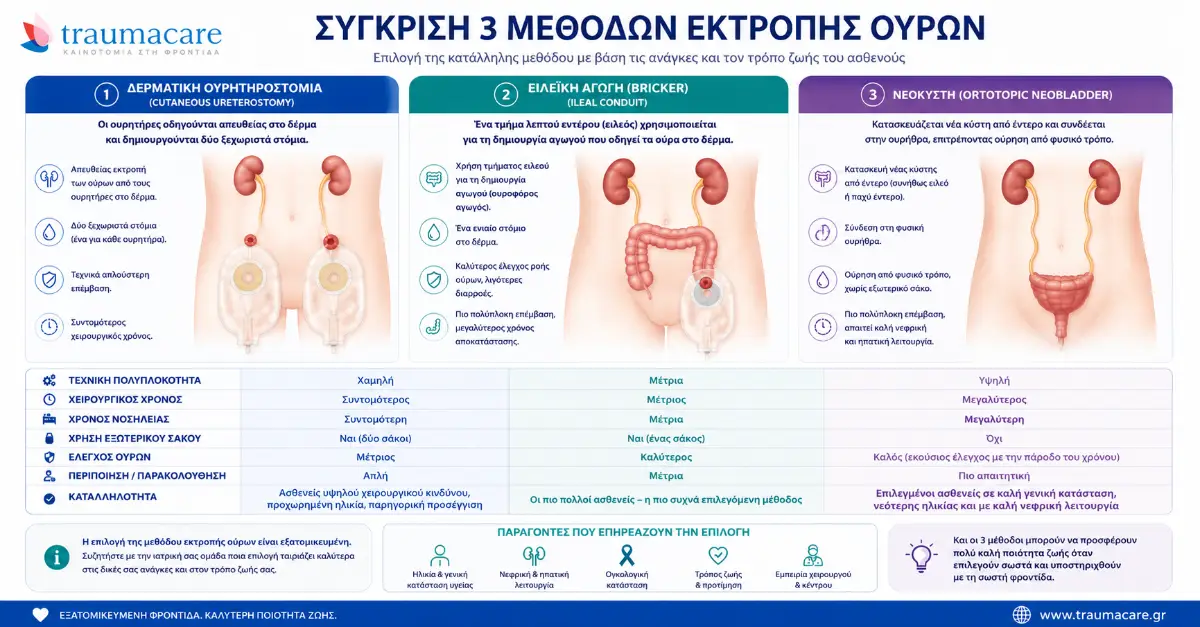
Three methods of urinary diversion — one decision
When the bladder needs to be removed or bypassed, there are three basic options for urinary diversion. Each has different indications, techniques, and impact on daily life. In this article, we compare them in detail to help you understand why your doctor has recommended a particular one.
According to the EAU Guidelines 2024 [1] , the choice of method is individualized and depends on the underlying disease, age, general condition, renal function, urethral anatomy, and personal preferences of the patient.
The 3 methods at a glance
| Characteristic | 🔵 Nephrostomy (PCN) | 🟢 Ureterostomy (Bricker) | 🟣 Neocyst |
|---|---|---|---|
| Type | External catheter in the kidney | Stomach stoma + pouch | Neocyst from intestine |
| Duration | Temporary (usually) | Permanent | Permanent |
| Invasiveness | Minimally invasive (15-30 minutes) | Major surgery (4-7 hours) | Major surgery (5-9 hours) |
| Hospitalization | 1-3 days | 7-9 days | 9-14 days |
| Urination | In a bag | In an ostomy bag | Normal (through the urethra) |
| Body image | Visible bag | Discreet bag under clothing | No visible change |
🔵 Nephrostomy (PCN — Percutaneous Nephrostomy)
Percutaneous nephrostomy is a minimally invasive procedure where a thin catheter is placed from the back directly into the kidney to drain urine when there is obstruction . According to current guidelines [2] , it is mainly used:
- In urolithiasis in the ureter with hydronephrosis and fever (urgent decompression for urosepsis)
- In malignant ureteral obstruction (prostate, cervical, lymph node cancer)
- Before definitive treatment (e.g. chemotherapy, radiotherapy, surgery)
- In rare cases, as a permanent solution when there is no other option
Advantages: Quick, minimally invasive, low postoperative risk, reversible.
Disadvantages: External bag, catheter change every 2-3 months, swimming restrictions, higher risk of urinary tract infections.
🟢 Ureterostomy (Bricker / Ileal Conduit)
Ureterostomy is the most common method of permanent urinary diversion after radical cystectomy — accounting for >60% worldwide [1] . A section of intestine (~15 cm) is used as a conduit that carries urine from the ureters to a stoma in the abdomen. The patient wears an ostomy bag.
Who is suitable for [3] :
- Almost all patients who need cystectomy — no strict criteria
- Elderly with comorbidities that do not tolerate a larger operation
- Patients with renal dysfunction (eGFR < 45 mL/min)
- Patients with urethral/sphincter damage or tumor infiltration there
- Patients who do not want or cannot self-catheterize
Advantages: Technical simpler, safer, shorter hospital stay, quick return to daily life , compatible with a wide range of patients. Quality of life comparable to neobladder after the first months of adaptation [4] .
Disadvantages: Permanent stoma and pouch, need for constant care, psychological adjustment.
🟣 Orthotopic Neobladder
The neobladder is a reservoir made from a section of the intestine that is placed in place of the old bladder and connected to the urethra. The patient urinates normally — although differently (without a feeling of fullness, with scheduling, and possible nocturnal incontinence in the first few months).
Strict eligibility criteria [1] [3] :
- Age < 75 years (relative criterion)
- Good renal function ( eGFR > 45 mL/min )
- Intact external urethral sphincter
- No urethral tumor infiltration
- Willing to undergo 6-12 months of voiding training and possible self-catheterization
- Psychological and motor competence
Advantages: No visible pouch, almost normal urination, better body image, better self-image.
Disadvantages: More complex procedure, longer hospital stay, training time 6-12 months, nocturnal incontinence in 30-50% in the first year, intermittent self-catheterization in 25-30% of patients for complete evacuation, metabolic disorders.
Quality of life: What the studies say
The Cochrane systematic review comparing continent vs incontinent diversion [5] concluded that there is no clear winner in overall quality of life. What matters is:
- Neocyst is superior in body image and early psychological parameters
- Ileal conduit is superior in rapid recovery and absence of early postoperative voiding problems
- At 12-24 months, overall HRQoL becomes comparable — patient adjustment is the most important factor
This is critical: ileal conduit is NOT a “second choice”. It is the right choice for a specific patient profile — and studies show that patients who choose it (either for medical reasons or as a preference) have similar satisfaction to those who have a neocyst.
Complications: Comparison table
| Complication | Nephrostomy | Ureterostomy | Neocyst |
|---|---|---|---|
| UTI/infection | High risk | Moderate | Moderate |
| Parastomal hernia | None applicable | 15-30% | Not applicable |
| Nocturnal incontinence | Not applicable | Not applicable | 30-50% (first year) |
| Need for self-catheterization | No | No | 25-30% |
| Stoma stenosis | No applicable | 5-10% | Not applicable |
| Kidney stones | Rare | 5-10% | 5-10% |
| Metabolic acidosis | No | Rare | More common |
EOPYY coverage — for all three methods
According to Government Gazette B' 5395/09-10-2025 [6] :
| Method | EOPYY Coverage | Participation |
|---|---|---|
| Nephrostomy | Catheter + bags + consumables | 0% |
| Urethrostomy | €270/month — bags, base plates, consumables | 0% |
| Neocyst | Self-catheterization catheters (if needed) | 0% |
How to choose — 5-question guide
- Is the condition temporary or permanent? If you have an obstruction that can be resolved (e.g., stone), nephrostomy is a good temporary solution.
- How good is your renal function? If eGFR > 45 mL/min & you are younger, neocyst is an option. Otherwise, ileal conduit.
- How important is body image? If the visible pouch is an important psychological factor & you meet the criteria, neocyst.
- Are you willing to undergo 6-12 months of training? If not, ileal conduit offers a faster return to daily life.
- Do you have other conditions? In the elderly or with comorbidities, ileal conduit is safer.
In any case, the final decision is made together with your urologist — this article is informative to start the discussion in an informed way.
Material selection — How Traumacare helps
At Traumacare, as exclusive representatives of B Braun Avitum in Greece , we support patients with all three methods:
- ✅ Nephrostomy: Catheters, drainage bags, antiseptics, dressing change materials
- ✅ Ureterostomy: Full range Flexima (Uro Silk flat & convex, Active O' convex, Key, 3S, Uribag) with anti-reflux valve and hydrocolloid skin protector
- ✅ Neocyst: Catheters self-catheterization, hygiene materials
In all cases: full management of the EOPYY procedure (e-EOPYY, electronic opinion), express delivery next-day, pre-operative consultation.
Contact for personalized information
| ✉️ Contact form | 💬 Viber channel Traumacare ✓ |
Related articles
- Pillar A: Complete guide to nephrostomy
- Pillar B: Complete guide to ureterostomy
- What is ureterostomy — cutaneous vs ileal conduit
- Bricker / Ileal Conduit: the surgical procedure step by step
- When is a ureterostomy done — indications
Author: Vangelis Micharikopoulos, Traumacare — exclusive representatives of B Braun Avitum Greece
Scientific documentation: EAU Guidelines on Muscle-invasive and Metastatic Bladder Cancer (2024), EAU Guidelines on Urolithiasis (2024), AUA/ASCO/SUO Guideline on MIBC (2024), NICE NG2 Bladder Cancer (2023), Cochrane Review on continent vs incontinent urinary diversion, Cookingham et al. World J Urol 2022, BAUS patient information
Last updated: May 2026
Note: The content is for informational purposes only and is not a substitute for medical advice. The final choice of urinary diversion method should be made in collaboration with your treating urologist.
📚 Βιβλιογραφία / Επιστημονικές πηγές
- EAU Guidelines on Muscle-invasive and Metastatic Bladder Cancer . European Association of Urology, 2024. uroweb.org/guidelines
- EAU Guidelines on Urolithiasis . European Association of Urology, 2024. uroweb.org/guidelines/urolithiasis
- AUA/ASCO/SUO Guideline on Muscle-Invasive Bladder Cancer . American Urological Association, 2017 (amended 2024). auanet.org
- Cookingham LM et al. Health-related quality of life in patients with ileal conduit urinary diversion: a systematic review . World Journal of Urology , 2022. pubmed.ncbi.nlm.nih.gov
- Yuh BE et al. Continent versus incontinent urinary diversion after radical cystectomy for bladder cancer . Cochrane Database of Systematic Reviews. cochranelibrary.com
- ΦΕΚ Β' 5395/09-10-2025 — Καθορισμός υλικών στομίας με κάλυψη ΕΟΠΥΥ . Εθνικό Τυπογραφείο. eopyy.gov.gr
- NICE NG2: Bladder cancer — diagnosis and management . National Institute for Health and Care Excellence, 2015 (updated 2023). nice.org.uk/guidance/ng2
- BAUS — Information about Urinary Diversion (Ileal Conduit) . British Association of Urological Surgeons. baus.org.uk