



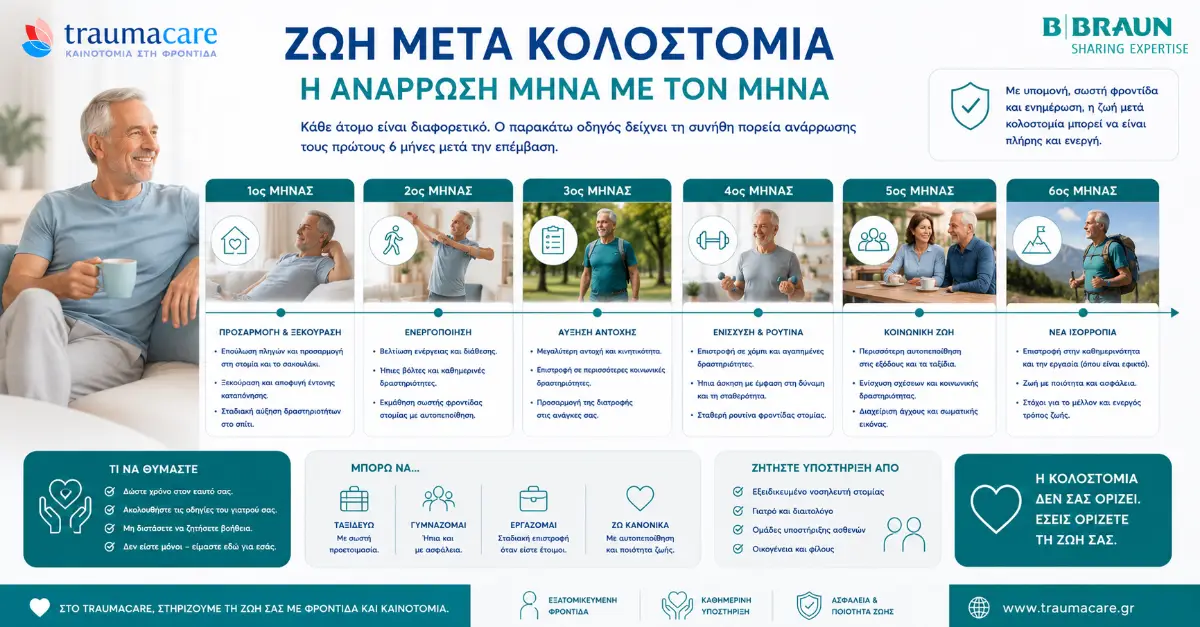
La vida después de la colostomía NO termina, se transforma
Es el pensamiento que tienen la mayoría de los pacientes antes de la cirugía: “¿Cómo será mi vida con una bolsa?” . La verdad es que la gran mayoría de los pacientes regresan a una vida completamente normal — trabajo, viajes, ejercicio, sexo — en 3 a 6 meses [1] .
En esta guía, te preparamos mes a mes sobre qué esperar, cómo acelerar tu recuperación y cuándo buscar apoyo.
Mes 1: Sanación y adaptación
Semanas 1-2: Primeros días en casa
Las dos primeras semanas son las más psicológicamente exigentes . El estoma todavía está hinchado, los movimientos son dolorosos y el miedo a cambiar la bolsa es normal. [2] .
- Manejo del dolor: Tome la medicación para el dolor según lo prescrito. Espere alivio del dolor diariamente.
- Ejercicio: Caminatas cortas alrededor de la casa, ejercicios de respiración lenta. NO objetos pesados.
- Dieta: Dieta baja en fibra (arroz, pan blanco, papas sin pelar). Abundantes líquidos (1.5-2 litros/día).
- Bolsa: Cambiar cada 2-3 días con Flexima Plana (estándar) o Activa (premium para piel sensible) — tamaño más grande para estoma agrandado.
- Control del estoma: Debe ser rosa/rojo y húmedo. Espere un ligero sangrado al limpiarlo — normal.
Semanas 3-4: Estabilización
El estoma comienza a encogerse. Su confianza para cambiar la bolsa aumenta.
- Regresar a caminar al aire libre (15-30 minutos)
- Regresar a ducharse (aún no bañarse)
- Introducir gradualmente nuevos alimentos, uno a la vez, con un diario de alimentos
- Apoyo psicológico: hable con su cónyuge, familia o consejero. La ansiedad es normal pero manejable .
- Reevaluar el tamaño de la abertura de la bolsa: el tamaño del estoma disminuye
Mes 2: Regreso a la rutina
Según la revisión sistemática de Vonk-Klaassen et al. (2016) [1] , a las 6-8 semanas los pacientes informan una clara mejora en su calidad de vida.
- Trabajo de oficina: Regreso en 6-8 semanas (después de aprobación médica)
- Conducir: Permitido de 4 a 6 semanas cuando ya no se toman analgésicos fuertes
- Actividades: Caminar ligero, ir de compras, socializar, cocinar
- Todavía no permitido: Levantar más de 5 kg, nadar, hacer ejercicio extenuante, tener relaciones sexuales con mucho esfuerzo físico
- Cabestrillo: Estabilización de elección: Active premium o Flat estándar, quizás pruebe Flexima 3S (2 piezas) para cambios más frecuentes sin irritación
Dieta en el segundo mes
Según las directrices de UOAA [3] :
- Adición gradual de alimentos uno por uno para prueba de tolerancia
- Líquidos 1,5-2 litros/día (más en colostomía ascendente)
- Probióticos (yogur, kéfir) para reducción del olor
- Evitar alimentos que causen gases/olor en situaciones sociales
➡️ Consulte la guía completa de la dieta de 30 alimentos .
Mes 3: Actividad fisiológica completa
A los 3 meses, el paciente suele tener plena capacidad para todas las actividades fisiológicas . Estadísticas [1] :
- Más del 85% regresan al trabajo, al ocio y a las actividades sociales
- Más del 75% recuperan la actividad sexual
- Más del 90% califican su calidad de vida como “buena” o “muy buena”
Vida sexual después de la colostomía
Este es quizás el tema más temido y uno del que su médico puede no haber hablado lo suficiente [4] :
- En hombres: la resección anorrectal (RAR) puede afectar la erección y la eyaculación. Los medicamentos disponibles (inhibidores de la PDE5) son de gran ayuda. Hable con un médico a partir del segundo mes.
- En mujeres: si se extirparon órganos adyacentes, puede ocurrir sequedad vaginal. Los medicamentos y técnicas disponibles son de gran ayuda.
- Instrucciones prácticas: Use un cinturón de retención de bolsa (Ally Belt), vacíe la bolsa con anticipación, posición apropiada. Se informa a la esposa/pareja al mismo tiempo.
- Psicológicamente: Es un miedo inicial esperado. No permita que se convierta en evitación; la familiaridad regresa.
Regreso al ejercicio
| Actividad | ¿Cuándo regresas? |
|---|---|
| Caminar | Desde la semana 1, aumenta gradualmente |
| Ciclismo | Semanas 8-12 |
| Natación | Después de la 4.ª semana (si el estoma cicatriza bien) — Impermeables Flexima |
| Gimnasio cardiovascular | Desde el 2.º mes (con Ally Belt) |
| Pesas / Ejercicio militar | Después de 3 meses, gradualmente (riesgo de hernia paraestomal — siempre con Ally Belt ) |
| Deportes de contacto | Con protección y siempre consultando con un médico |
Meses 4-6: Completa normalidad
A los seis meses, la vida ha vuelto realmente a la normalidad . La bolsa se convierte en parte de la rutina, como cepillarse los dientes: se hace sin pensar.
Viajes: Sí, puedes
Según las directrices de UOAA (Asociaciones Unidas de Ostomía de América) [3] , los pacientes con colostomía pueden viajar a cualquier lugar, con la preparación necesaria:
- Consigue el doble de Flexima de lo que crees que necesitas
- Certificado de viaje de un médico para sistemas (aeropuertos, escáneres de seguridad)
- Ten cuidado en destinos exóticos: nutrición e hidratación
- Cinturón retención de equipaje en vuelos y en climas cálidos
➡️ Guía completa para hacer ejercicio y viajar
Trabajo y vida social
Casi nadie notará que llevas un bolso. Con el moderno Flexima Active con funda beige midi, el perfil es mínimo y el bolso es invisible bajo la ropa normal.
Consejos para situaciones sociales:
- Antes de eventos: Vacía o cambia el bolso. Comprueba que esté bien sujeto.
- Ropa: Las blusas de cintura ancha o ajustadas son excelentes para disimular. Cinturones sobre el estoma.
- Qué decirles a los demás: Lo que quieras. No tienes que dar explicaciones. A los amigos/compañeros cercanos, un simple "Me operaron y estoy bien" es suficiente.
Cuándo contactar a un médico
Busque atención médica inmediata si experimenta [5] :
- 🚨 Fiebre > 38 °C con escalofríos: posible infección de la herida o intraabdominal
- 🚨 Dolor abdominal intenso nuevo o que empeora
- 🚨 Ausencia de deposiciones por estoma durante > 12 horas: posible obstrucción por alimentos
- 🚨 El estoma cambia de color (azul, negro, blanco: necesita revisión urgente)
- 🚨 Fugas continuas o irritación cutánea grave: consulte la guía de fugas
- 🚨 Sangrado abundante del estoma (no leve al limpiarlo)
- 🚨 Hernia paraestomal: abultamiento visible alrededor del estoma. Ver artículo especial
Para más problemas no urgentes (cambio de tipo de bolsa, irritación de la piel, preguntas generales), contacte con Traumacare: nuestro equipo responde en el canal de Viber de Traumacare o por teléfono.
Bienestar psicológico: igualmente importante
La vida después de una colostomía puede traer desafíos emocionales: preocupaciones sobre la imagen corporal, ansiedad sobre el futuro, depresión después de un diagnóstico de cáncer. Tasas 15-25% de pacientes experimentan depresión en los primeros seis meses [1] .
Fuentes de apoyo:
- Cónyuge/familia: Hable abiertamente. No hay vergüenza.
- Grupos de pacientes: En Grecia hay grupos en línea y comunidades de ostomía. Hable con personas que hayan pasado por lo mismo.
- Asesoramiento profesional: Psicólogo especializado en pacientes oncológicos. No hay vergüenza.
- Enfermera de estoma: Además del apoyo técnico, puede brindar apoyo emocional.
Cambio de materiales en los primeros 6 meses: qué esperar
El estoma cambia de forma en los primeros meses. Es probable que necesite diferentes tamaños de Flexima [6] :
| Etapa | Recomendación de Flexima |
|---|---|
| Semanas 1-6 (abultado) | Flexima plano o activo (tamaño de apertura más grande) |
| Meses 2-3 (reducido) | Reevaluar el tamaño o tipo (posible cambio a convexo si se produce retracción) |
| Meses 4-6+ (fijo) | Sistema permanente: Active premium o Flat estándar o 3S (2 piezas) según |
En Traumacare, como representantes exclusivos de B Braun Avitum en Grecia, ofrecemos reevaluación gratuita cada 3-6 meses para asegurar que el producto siga siendo adecuado para usted.
Contacto para consulta de seguimiento
| ✉️ Formulario de contacto | 💬 Viber Traumacare ✓ |
Artículos relacionados
- Pilar C: La guía completa de colostomía
- Dieta para colostomía: 30 alimentos
- Ejercicio, viajes y natación
- Bolsa de colostomía: ¿Cuál elegir?
Autor: Traumacare Medical Group — representantes exclusivos de B Braun Avitum Greece
Documentación científica: Vonk-Klaassen SM et al. QoL Research 2016, ASCRS Clinical Practice Guidelines, UOAA Patient Guide, WOCN Society Guidelines, Cancer Research UK Patient Information
Última actualización: Mayo de 2026
Nota: El artículo es informativo y se basa en estadísticas de grandes cohortes. Las experiencias individuales variarán. Consulte a su proveedor de atención médica para decisiones individuales y cronograma de recuperación.
📚 Βιβλιογραφία / Επιστημονικές πηγές
- Vonk-Klaassen SM et al. Problemas relacionados con la ostomía y su impacto en la calidad de vida de los ostomizados por cáncer colorrectal: una revisión sistemática. Investigación sobre la calidad de vida, 2016. pubmed.ncbi.nlm.nih.gov
- Guías de práctica clínica de la ASCRS para la atención quirúrgica de pacientes con colostomía. Sociedad Americana de Cirujanos de Colon y Recto. fascrs.org
- UOAA — Asociaciones Unidas de Ostomía de América: Guía de Colostomía . ostomy.org/colostomy
- Función sexual y calidad de vida después de la cirugía colorrectal . Revisión sistemática. pubmed.ncbi.nlm.nih.gov
- Guía de práctica clínica de la Sociedad WOCN para el manejo del paciente adulto con ostomía fecal . Sociedad de Enfermeras de Heridas, Ostomías y Continencia. wocn.org
- Cancer Research UK: Vivir con una colostomía . cancerresearchuk.org
- BAUS - Información para el paciente sobre el cuidado del estoma . Asociación Británica de Cirujanos Urológicos. baus.org.uk
- ΦΕΚ Β' 5395/09-10-2025 — Πίνακας 11, Α/Α 2 (Υλικά Κολοστομίας) . Εθνικό Τυπογραφείο. eopyy.gov.gr