



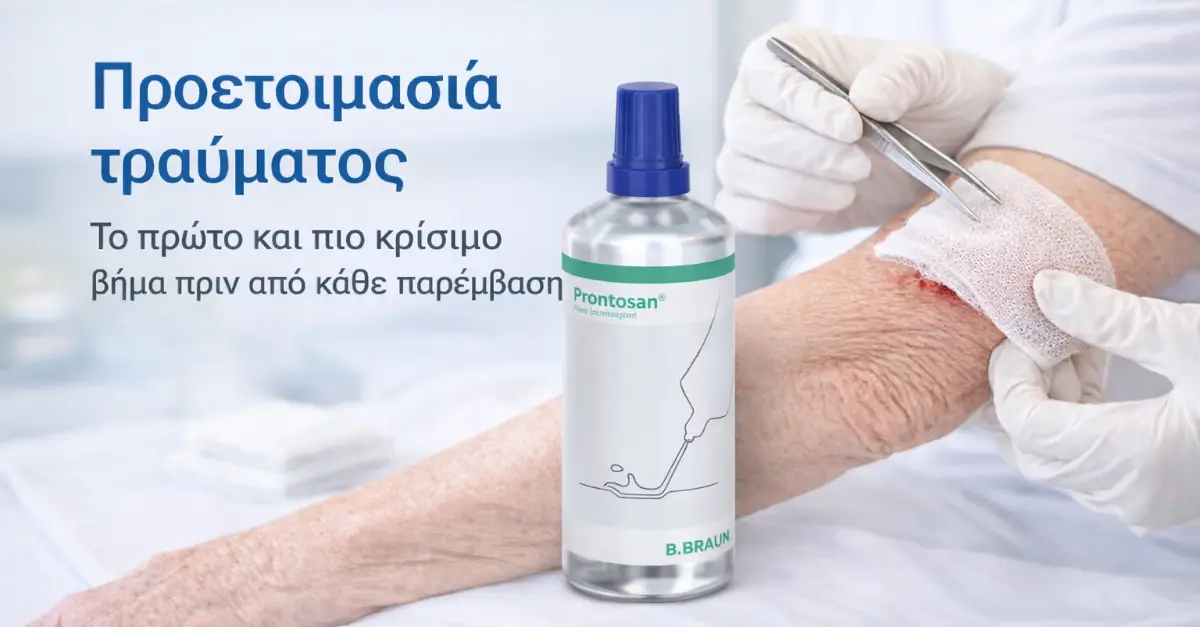
When a wound does not close as expected, the first thought is often that “something stronger” or “different material” is needed. In practice, however, most problems in healing do not start with the product , but with the fact that the wound has not been properly prepared.
In modern wound and ulcer care, preparation is considered the most critical step before any targeted intervention. Without it, even the most modern practices can fail.
Wound and ulcer: what they mean in practice
The term wound is used to describe any wound of the skin or underlying tissues. In cases where a wound is significantly delayed in healing or remains open for a long time, healthcare professionals may also refer to it as an ulcer.
For the patient and their caregiver, the important thing is not the term, but the fact that it is a wound that needs proper and systematic care.
What is meant by “wound bed preparation”
Wound bed preparation is a continuous and comprehensive process in which:
- the wound or ulcer is assessed as a whole,
- the patient’s general condition is taken into account,
- and the basic conditions are created so that healing can begin and progress smoothly.
According to internationally recognized wound care practices, preparation is not a single action , but a dynamic process that requires constant reassessment.
Why a wound or ulcer may not heal
A wound may be delayed in healing for reasons that are not always apparent, such as:
- underlying diseases (e.g. diabetes mellitus, vascular insufficiency),
- reduced blood perfusion or oxygenation,
- prolonged pressure or repetitive injury,
- fragmented or incorrect care,
- factors that are not visible to the naked eye.
When the wound looks “clean” but does not close
Many patients and caregivers wonder: “Since the wound looks clean, why does it not close?”
In modern wound care, the role of biofilm , an organized microbial structure that can cover the wound surface without always causing obvious signs of infection, has been recognized.
- is not easily removed by simple cleaning,
- can harbor microorganisms,
- and often constitutes an invisible barrier to healing.
When care is not applied correctly
Even when proper assessment has been made, healing can be delayed if care is not applied correctly.
- incorrect use of materials,
- inadequate patient or caregiver education,
- non-systematic application of instructions,
- selection of inappropriate materials for the stage of wound.
Care depends not only on what materials are used, but also on how , when and with what consistency they are applied.
The basics of proper preparation
1. Understanding the cause
Each wound or ulcer has a different mechanism and requires a different approach.
2. Assessing the general condition
Healing is influenced by nutrition, medication, mobility and compliance with care.
3. Debridement and initial stabilization
Proper debridement allows for better assessment and creates conditions for safe care.
4. Continuous reassessment
The appearance of a wound can change and requires regular monitoring.
Preparation as the basis of modern ulcer care
In international practice, preparation is the basis on which more specialized approaches are applied that evaluate:
- the wound tissue,
- the inflammation or microbial burden,
- the moisture balance,
- and the image of the lips.
Why proper information protects the patient
- reduces the risk of errors,
- helps in timely seeking help,
- strengthens cooperation with health professionals.
What's next
The next article in the series will analyze the role of wound tissue and how its condition can hinder healing.
Read the next article: Wound tissue – why its condition affects healing
This article is based on internationally recognized wound care practices and is for informational purposes only. It is not a substitute for medical or nursing evaluation.
Edited by: Traumacare Team