



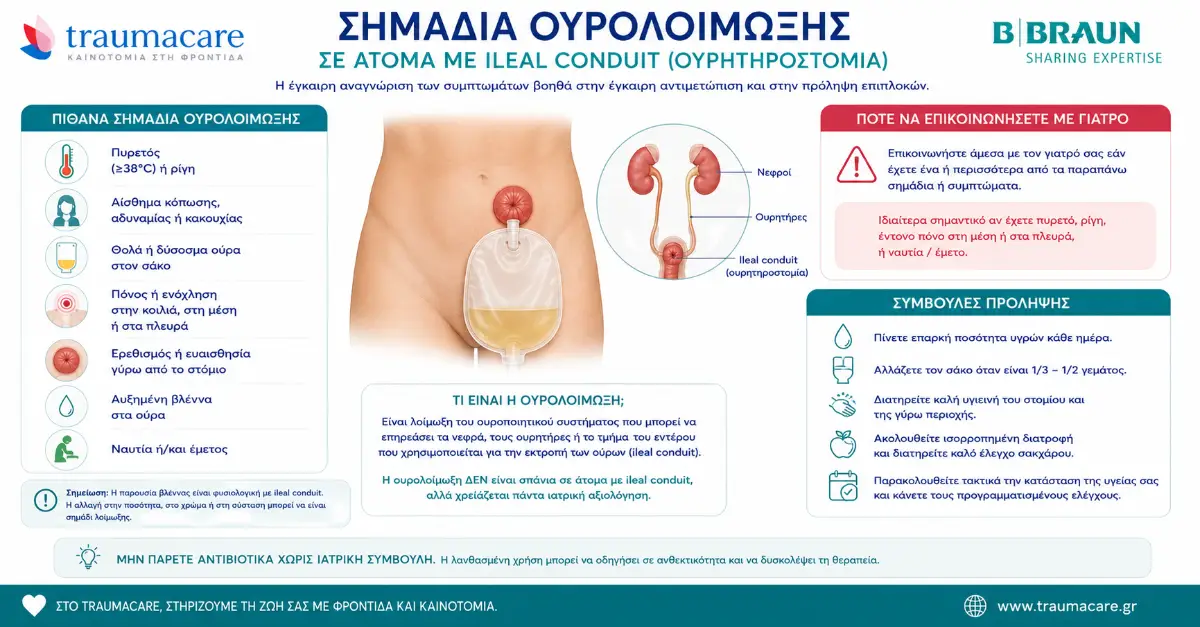
Why UTIs are Special with an Ileal Conduit
When you live with an ileal conduit ureterostomy , the anatomy of your urinary tract is different from that of a healthy person. There is no longer a bladder to hold and sterilize urine — urine flows continuously from the kidneys, through an intestinal loop, to the bag.
This means two things [1] :
- Bacteriuria (presence of bacteria in the urine) is almost constant — occurring in 100% of ileal conduit patients
- Symptomatic UTI (UTI with symptoms/fever) is what really counts — and it can be prevented
According to the EAU Guidelines on Urological Infections (2024) [1] , Bacteriuria in ileal conduit patients is NOT treated prophylactically with antibiotics — this causes resistance. It is only treated when symptoms appear. So recognition of symptoms is key.
The 7 signs of a urinary tract infection with an ileal conduit
Unlike a classic UTI, you will not feel burning or frequent urination (you no longer have a bladder). Symptoms are different [2] :
| # | Sign | Severity |
|---|---|---|
| 1 | Fever > 38°C — especially if accompanied by chills | EMERGENCY |
| 2 | Pain in the back or side (kidney) | EMERGENCY |
| 3 | Cloudy/milky urine with bloody appearance | HIGH |
| 4 | Strong odor of urine (more than usual) | HIGH |
| 5 | General malaise , exhaustion, myalgias, nausea | HIGH |
| 6 | Decreased urine output (<500 mL/24 hours) | HIGH |
| 7 | Confusion/altered level of consciousness (elderly) | EMERGENCY |
Note for the elderly: In elderly patients, urinary tract infection may present only with confusion or collapse without fever. If you notice a sudden change in the condition of an elderly patient, seek immediate evaluation. [3] .
Risk factors
According to the epidemiological study by Madersbacher (2003) [4] , the main factors that increase the risk of symptomatic UTI are:
- Urinary reflux (reflux from the conduit to the kidneys) — the most important mechanism
- Stoma or stricture — causes stasis urine
- Kidney stones — secondary complication in 5-10% of patients
- Infrequently emptied pouch — allows bacterial growth
- Inadequate hydration — below 1.5 L/day
- Diabetes, immunosuppression, age > 65
- Poor hygiene when changing pouch — not washing hands, not cleaning stoma
🛡️ Prevention: The 6 most effective measures
1. Anti-reflux valve in the bag — the No. 1 prevention
The anti-reflux valve is the first line of defense against UTIs. It acts as a one-way valve: urine flows from the stoma into the bag — but it does not return back.
Why this is critical [1] : when urine refluxes, bacteria from the bag ascend to the kidneys, causing pyelonephritis — the most serious form of UTI.
All bags in the B Braun Flexima Uro series have a built-in anti-reflux valve as standard — not an extra. This includes:
- Flexima Uro Silk Flat
- Flexima Uro Silk Convex
- Flexima Active O' Convex
- Flexima Key (gentle hydrocolloid)
- Flexima 3S (2-piece system)
- Flexima Uribag (night bag)
2. Adequate hydration 2-2.5 L/day
Increased urine production continuously flushes the conduit and reduces bacterial adhesion. Test method: your urine should be light yellow , not dark [5] .
3. Frequent bag emptying — do not let it fill up
Empty bag every 3-4 hours (or when it is 1/3 full). The more urine that remains static in the bag, the more bacterial growth.
4. Night bag (Uribag) for sleeping
During sleep, the bag fills up without you emptying it. Attach the Flexima Uribag (larger capacity nighttime collector) to the day bag. So:
- No need to wake up to empty
- Urine is continuously directed to the Uribag — without stopping
- The anti-reflux valve provides additional protection
5. Proper hygiene when changing the bag
- Wash hands before and after changing
- Clean the stoma with lukewarm water and mild soap (no antiseptics — they damage the skin)
- Dry the skin thoroughly before the new bag
- Change every 3-5 days (no more, to avoid irritation or leakage)
6. Cranberry & D-Mannose — aids
According to a Cochrane review [6] , cranberries and D-mannose have modest but visible preventive effects against recurrent UTIs in the general population. In ileal conduit patients, data are limited — but several patients report improvement. Talk to your doctor before starting.
When symptoms appear: What the doctor does
The correct diagnosis and treatment of symptomatic UTI in an ileal conduit patient follows a specific protocol [1] :
- Proper urine specimen collection: NOT from the bag! Conduit catheterization or collection directly from the stoma with sterile technique should be performed. Bag specimen = false positive culture.
- Urine culture + antibiogram: Due to frequent antibiotic resistance, do not start antibiotics before culture .
- Blood test: CRP, white blood cells, creatinine — assessment for systemic inflammation.
- Imaging: Renal ultrasound to exclude hydronephrosis or abscess. CT/PET if complicated pyelonephritis is suspected.
- Targeted antibiotic therapy: Based on antibiogram. Duration 7–14 days. Severe cases require IV hospitalization.
Misconceptions to avoid
| Misconceptions | Reality |
|---|---|
| “I have to take antibiotics all the time for prevention” | FALSE. Causes resistance. Only in selected cases of recurrent UTI. |
| “I know right away if I have a UTI because of the burning sensation” | FALSE. You don’t have a cyst — you won’t feel the burning sensation. You need to know the 7 special signs. |
| “Urine odor means UTI” | NOT NECESSARILY. The odor is normal. If it is strong foul smell + cloudy urine, then maybe. |
| “Culture from the bag is reliable” | WRONG. False positive. Must be done properly via catheterization. |
Contact for comprehensive care
| ✉️ Contact form | 💬 Viber channel Traumacare ✓ |
Related articles
- Urostomy bag — which one to choose?
- How to change a urostomy bag — steps
- Life after cystectomy — 6-month guide
- Pillar: The complete guide to ureterostomy
Author: Traumacare Medical Group — exclusive representatives of B Braun Avitum Greece
Scientific documentation: EAU Guidelines on Urological Infections (2024), Madersbacher S. et al. on bacteriuria in urinary diversion (2003), Cochrane Review on UTI prophylaxis, Colwell JC & Pittman J. (J Wound Ostomy Continence Nurs 2017), BAUS Patient Information
Last updated: May 2026
Note: In case of symptoms, contact your treating physician immediately. The article is for informational purposes only and is not a substitute for medical evaluation.
📚 Bibliography / Scientific sources
- EAU Guidelines on Urological Infections . European Association of Urology, 2024. uroweb.org/guidelines/urological-infections
- BAUS — Information about Urinary Diversion (Ileal Conduit) . British Association of Urological Surgeons. baus.org.uk
- Colwell JC, Pittman J. Urostomy care and management . Journal of Wound, Ostomy and Continence Nursing , 2017. pubmed.ncbi.nlm.nih.gov
- Madersbacher S et al. Long-term outcome of ileal conduit diversion . Journal of Urology , 2003;169(3):985-990. pubmed.ncbi.nlm.nih.gov
- UOAA — United Ostomy Associations of America: Urostomy Guide . ostomy.org/urostomy
- Cochrane review: Cranberries for preventing urinary tract infections . Cochrane Database of Systematic Reviews. cochranelibrary.com
- WOCN Society: Clinical Practice Guideline for Urostomy Care . Wound, Ostomy and Continence Nurses Society. wocn.org
- EAU Guidelines on Muscle-invasive and Metastatic Bladder Cancer . European Association of Urology, 2024. uroweb.org/guidelines