



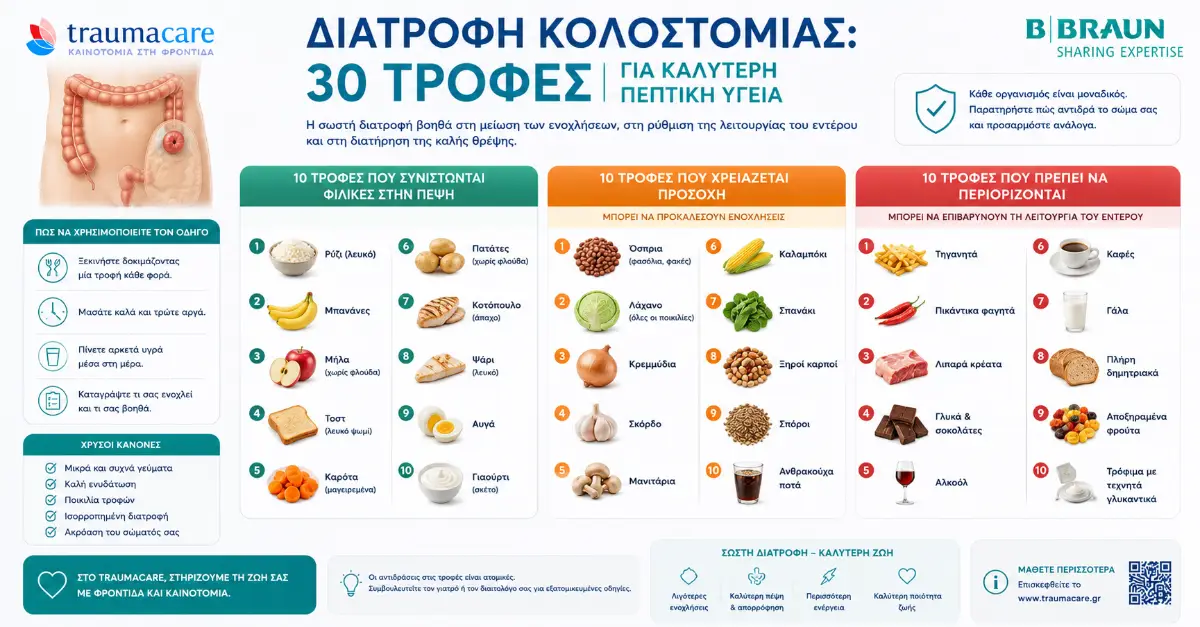
Colostomy Diet: Free with Strategy
The good news : after a colostomy, your diet is almost free . You don’t have to cut out foods permanently. According to the UOAA (United Ostomy Associations of America) guidelines [1] , the goal is to eat a balanced diet with minor adjustments.
In this comprehensive guide, we break down 30 foods — which ones are safe, which ones cause gas/odor/blockage, and how to plan your own diet for each type of colostomy.
Postoperative Nutrition Phases
According to the ASCRS Clinical Practice Guidelines [2] and ERAS Society protocols:
| Phase | Nutrition | Goal |
|---|---|---|
| Days 1-3 after | Fluids (water, broth, tea) | Gradual resumption digestive |
| Week 1 | Low-fiber (rice, white bread, pasta) | Less gas, smooth healing |
| Weeks 2-4 | Gradually adding foods one by one | Tolerance test |
| From week 5+ | Complete balanced diet | Normal life |
The 30 Foods & Their Effects
✅ 10 Safe Foods for Daily Consumption
These are low-residue foods that are easily digested, do not cause gas or odor, and are suitable for almost all patients:
| # | Food | Benefit |
|---|---|---|
| 1 | White rice, pasta | Easily digestible, does not increase gas |
| 2 | White bread, toast | Stabilizes bowel movements |
| 3 | Potatoes (no skin) | Carbohydrates + potassium |
| 4 | Lean meat (chicken, turkey) | Protein without indigestion |
| 5 | Cooked/steamed fish | Protein + omega-3 |
| 6 | Natural yogurt | Probiotics — reduces odor |
| 7 | Bananas (ripe) | Potassium, stabilizes |
| 8 | Apples without peel/Apple sauce | Pectin stabilizes bowel movements |
| 9 | Cooked eggs | High-quality protein |
| 10 | Soft cheese (feta, mozzarella) | Protein + calcium |
⚠️ 10 Foods That Cause Gas
You don’t have to cut out these foods — but moderate and avoid them before social events:
| # | Food | Why |
|---|---|---|
| 11 | Beans, chickpeas, lentils | Indigestible carbohydrates (oligosaccharides) |
| 12 | Cabbage, broccoli, cauliflower | Cruciferous vegetables — cause sulfurous gases |
| 13 | Onion, garlic (raw) | FODMAPs, intestinal fermentation |
| 14 | Carbonated drinks | CO2 → bag inflation |
| 15 | Beer | CO2 + fermentation |
| 16 | Chewing gum | Aerophagia (air swallowing) |
| 17 | Apples, pears (peel) | High fructose |
| 18 | Milk (if lactose intolerant) | Lactose indigestion |
| 19 | Raisins, dried fruits | High fructose/sorbitol |
| 20 | Sorbitol-containing candies/chocolates | Polyol — causes gas & diarrhea |
🔴 5 Foods That Cause Strong Smells
| # | Food | Why |
|---|---|---|
| 21 | Asparagus | Volatile sulfides derivatives |
| 22 | Fish (oily) | Trimethylamine derivatives |
| 23 | Eggs (in excess) | Sulphides |
| 24 | Hard cheese (parmesan, gouda) | Concentrated volatiles |
| 25 | Garlic (cooked) | Allicin metabolism |
🚫 5 Foods with Blockage Risk
In patients with ileostomy these are more critical — but also in colostomy there is a potential risk in ascending or transverse colostomy. Chewing well is the key:
| # | Food | Prevention |
|---|---|---|
| 26 | Corn (whole) | Do not swallow it whole — whole or ground |
| 27 | Nuts whole | Ground (e.g. tahini) or very finely chewed |
| 28 | Mushrooms | Well cooked + small pieces |
| 29 | Carrots raw | Cooked or grated |
| 30 | Celery, spinach raw | Cooked or chopped |
💚 Foods that Reduce Odor & Gas
In addition to those that we avoid , there are also foods that help [3] :
- Natural yogurt with live cultures — probiotics Lactobacillus, Bifidobacterium
- Kefir — alternative with a greater variety of bacteria
- Cranberry juice (sugar-free) — reduces urine odor (if you also have a urostomy)
- Parsley — natural deodorant
- Chamomile — calms the bowel, reduces gas
- Lemon — alkalizes, reduces odor
- Fresh butter (not spicy cheeses)
💧 Hydration: The Critical Element
Hydration is perhaps the most important part of the diet for colostomy patients [4] .
- Aim for: 1.5-2 litres of water/day (more in loose stools or hot climates)
- Signs of good hydration: light yellow urine (not dark)
- In ascending colostomy (loose stools): extra electrolytes (potassium, sodium)
- Avoid: excessive coffee (diuretic) and alcohol (dehydration)
Recommendations by Colostomy Type
| Type Colostomy | Dietary Adjustments |
|---|---|
| Loose stools | More hydration + electrolytes. Additional fibers (banana, apple sauce, white bread) for solidification. Avoid hard fibers. |
| Transverse (semi-formed) | Balanced diet with moderate fiber. Monitor response to various foods. |
| Sigmoid/Descending (shaped) | Almost normal diet. Beware of gassy/odorous foods in social situations. |
7 Practical Guidelines for Daily Nutrition
- Eat slowly and chew well — reduces aerophagia and risk of obstruction
- Small meals frequently (5-6/day) instead of 2-3 large ones
- 2-week food diary to identify personal triggers
- Introduce new foods one at a time — don’t try too many new foods on the same day
- Before social events — avoid high-risk foods (gas/odor)
- Cranberry/D-mannose supplement — helps if you also have a urostomy
- Nutritionist advice — especially in the first 3 months or in the elderly
Probiotics & Nutritional Supplements
As recommended by Hill et al. (International Scientific Association for Probiotics and Prebiotics) [5] , probiotics can help with:
- Reducing malodorous fermentation byproducts
- Improving intestinal flora
- Stabilizing bowel movements
Sources: live culture yogurt, kefir, sauerkraut, kimchi, miso, or probiotic supplements (Lactobacillus + Bifidobacterium).
When Should You See a Nutritionist?
- In the first 3 months after surgery (ideally)
- In ascending colostomy with continuous liquid stools
- In significant weight loss or malnutrition
- In IBD (Crohn's, UC) — personalized nutritional strategy
- In diabetes or other chronic diseases
- In repeated episodes of obstruction from specific foods
Free Consultation with Traumacare
| ✉️ Contact form | 💬 Viber Traumacare ✓ |
Related articles
- Pillar C: Complete colostomy guide
- Odor & Gas — 8 Practical Solutions
- Life After a Colostomy — 6 Month Guide
- Crohn’s Disease — Causes & Ostomy Bags
Author: Traumacare Medical Group — exclusive representatives of B Braun Avitum Greece
Scientific documentation: UOAA Diet & Nutrition Guide, ASCRS Clinical Practice Guidelines, WOCN Society Guidelines, Hill C et al. ISAPP Probiotics Consensus, BAUS Patient Information
Last updated: May 2026
Note: Dietary recommendations are general. In chronic diseases (diabetes, IBD, kidney disease) or elderly people, consult a dietitian for a personalized program.
📚 Βιβλιογραφία / Επιστημονικές πηγές
- UOAA — United Ostomy Associations of America: Diet & Nutrition Guide for People with Ostomies . ostomy.org/diet-nutrition
- ASCRS Clinical Practice Guidelines for the Surgical Care of Patients with Colostomy . American Society of Colon and Rectal Surgeons. fascrs.org
- WOCN Society Clinical Practice Guideline for Management of Adult Patient with Fecal Ostomy . Wound, Ostomy and Continence Nurses Society. wocn.org
- BAUS — Information about Hydration in Ostomy Patients . British Association of Urological Surgeons. baus.org.uk
- Hill C et al. The International Scientific Association for Probiotics and Prebiotics consensus statement . Nature Reviews Gastroenterology & Hepatology . pubmed.ncbi.nlm.nih.gov
- ECCO Guidelines on Nutrition in IBD . European Crohn's and Colitis Organisation. ecco-ibd.eu
- Vonk-Klaassen SM et al. Ostomy-related problems and quality of life . Quality of Life Research , 2016. pubmed.ncbi.nlm.nih.gov
- ERAS Society Guidelines for Perioperative Care in Elective Colorectal Surgery . pubmed.ncbi.nlm.nih.gov