



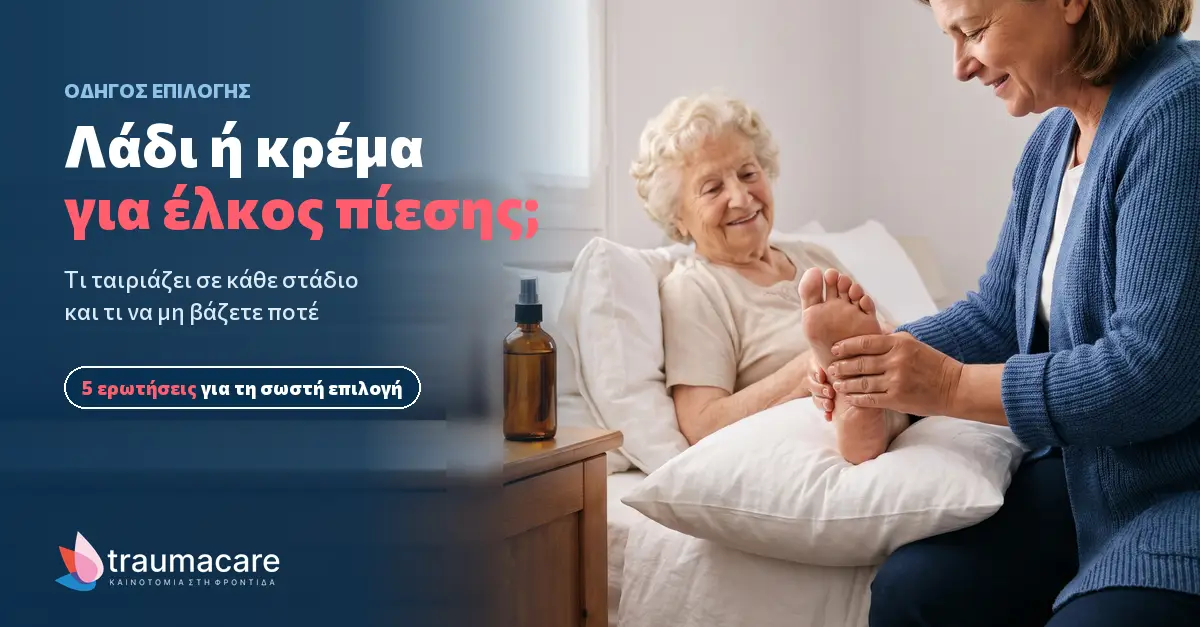
"What is the best cream?" is the first question every family asks when they see redness on the heel or tailbone of an older relative. The honest answer is that the right cream depends on the stage. The same product that helps intact skin can do harm on an open wound.
In this guide you will see what suits each situation: oil, barrier cream or dressing, and what you should never apply.
At a glance
- Skin at risk or stage 1: an oil with hyperoxygenated fatty acids (HOFA), such as Linovera® by B. Braun.
- Moisture from incontinence: a barrier cream or barrier film (zinc or silicone).
- Blister or open wound: no cream. A dressing, after assessment by a nurse.
- Never vigorous massage or rubbing on red areas, talcum powder, surgical spirit or steroid cream without medical advice.
- No cream replaces changes of position.
Not sure what is right for you? Ask us.
The Selection Guide: What Does Your Loved One Need?
| Question | If the answer is "yes" |
|---|---|
| Is there a blister, broken skin or fluid? | No cream. Assessment by a nurse, wound bed preparation and a dressing. |
| Is there a red area that does not turn white when pressed? | Stage 1 pressure ulcer: change of position and Linovera®. |
| Do they spend many hours in bed or in a wheelchair? | Prevention with Linovera® on the pressure points and a mattress or cushion. |
| Do they have incontinence or wear pads? | Zinc cream or barrier film in the pad area. |
| Is the skin dry, thin or prone to rubbing? | Barrier film and gentle moisturising, without rubbing. |
First the stage, then the cream
Before you choose a product, look at what is happening to the skin. Press the red area for 3 seconds: if it does not turn white, it is a stage 1 pressure ulcer. If there is a blister or the skin has broken, it is stage 2 or higher. You will find the steps in detail in our article on stage 1 pressure ulcers.

Oil or cream: what is the difference?
| Product | What it does | When | When not |
|---|---|---|---|
| Oil with fatty acids (HOFA) | Lubricates and protects the skin on pressure points. According to B. Braun it reduces friction and dehydration and may improve microcirculation. | Skin at risk, stage 1 pressure ulcer | Open wound, blister |
| Zinc barrier cream | Forms a protective layer against urine and faeces. | Incontinence, irritated skin in the genital area | Open wound, under an adhesive dressing |
| Barrier film (silicone) | An invisible, clear layer that protects against moisture and friction without feeling greasy. | Incontinence, around wounds, under dressings | When the skin needs nourishing |
| Moisturising cream | Softens dry skin. | Dry, thin skin in older people | On moist or irritated skin, on a wound |
| Dressing | Protects the wound and keeps the right environment for healing. | Stage 2 and above | Without an assessment, on an infected wound without medical advice |
Skin at risk and stage 1: the fatty acid oil
Where body weight presses the skin against bone, the tiny blood vessels close. Less blood and oxygen get through, and the skin cells, through their mitochondria, do not have the energy to renew themselves. This is exactly what hyperoxygenated fatty acids (HOFA) target.
In a randomised clinical trial in high-risk patients, pressure ulcers developed in 7.3% of the HOFA group compared with 17.4% of the placebo group (Torra i Bou et al., J Wound Care 2005).
Linovera® by B. Braun is a 30 ml spray oil with HOFA from sunflower oil, aloe vera and gotu kola (Centella asiatica); rosemary is the only essential oil and is there only for the scent. It is a class IIa medical device for the prevention of pressure ulcers and the treatment of stage 1 pressure ulcers. Because it is a spray, it spreads with a few gentle strokes, without the rubbing a thick cream needs.
- Spray onto clean, dry, intact skin: tailbone, heels, hips, shoulder blades.
- Spread gently, with your fingertips, until absorbed, without pressing.
- 2–3 times a day, as recommended by B. Braun and the nurse's care plan.
- Do not apply it to an open wound or blister.
Moisture from incontinence: barrier cream or barrier film
Urine and faeces soften and irritate the skin. Moist skin breaks down more easily under pressure and friction. What is needed here is not a "repair" cream but a barrier:
- Zinc oxide cream: a thin layer after each wash of the area. You do not need to remove all of it each time, only the soiled parts.
- Silicone barrier film: clear, not greasy, does not stop the pad from absorbing and lets you see the skin underneath.
Barrier cream and oil do not clash: the oil goes on the pressure points, the barrier on the area that gets wet.
${{products:56,50,1297}}
Blister or open wound: no cream
From stage 2 onwards the skin has broken. A cream on an open wound traps moisture and bacteria, makes it hard to monitor and can delay healing. What is needed here:
- assessment by a nurse or doctor,
- wound bed preparation and management of biofilm, e.g. with Prontosan® Gel X by B. Braun,
- a suitable dressing, e.g. a silicone foam dressing.
For detailed care at each stage, see our guide to pressure ulcer care by stage.
What not to apply
- Powder, talc, surgical spirit, cologne: they dry out and irritate the skin.
- Steroid (cortisone) cream without a doctor's advice: it thins the skin.
- Antibiotic ointment without medical advice: it is not prevention.
- Thick creams under adhesive dressings: the dressings will not stick properly.
- Home remedies on an open wound.
Cream alone is not enough
No product takes the pressure off the skin. The basics remain:
- changes of position, usually every 2 hours in bed, with the heels off the mattress,
- a suitable pressure-relief mattress or cushion,
- dry skin and changing wet pads straight away,
- protein and fluids in the diet.
For the basics of pressure ulcers, their stages and causes, see our main guide.
Frequently asked questions
What is the best cream for a pressure ulcer?
There is no single cream for everything. For skin at risk or a stage 1 pressure ulcer, an oil with hyperoxygenated fatty acids, such as Linovera® by B. Braun, is suitable. For moisture from incontinence you need a barrier cream or barrier film. A blister or open wound needs a dressing, not a cream.
Oil or cream for prevention?
For prevention on pressure points, the fatty acid oil (HOFA) has the study behind it and spreads without rubbing. A barrier cream does not prevent pressure damage; it protects against moisture. Often both are needed, in different places.
Can I put a repair cream on an open wound?
No, unless your doctor or nurse says so. An open wound needs wound bed preparation and a suitable dressing. A thick cream traps moisture and bacteria where they should not be.
Does zinc oxide cream help?
Yes, when the problem is moisture from urine or faeces. It creates a barrier on the skin. It does not replace changes of position and does not treat a pressure ulcer. Apply a thin layer, not on broken skin.
How often should I apply Linovera oil?
According to B. Braun, 2–3 times a day, following the nurse's care plan. Spray onto clean, dry skin and spread gently with your fingertips until absorbed, without pressing and without vigorous rubbing.
Is it OK to massage the cream into red areas?
No deep massage. Vigorous rubbing over bony areas can injure the tissue underneath. Products are spread gently, with the fingertips, until absorbed.
Do steroid creams or antibiotic ointments help?
Only on a doctor's advice. Steroid cream thins the skin when used for a long time, and antibiotic ointment used without good reason can cause irritation or resistance. They are not prevention products.
Is cream enough to prevent a pressure ulcer?
No. No oil or cream takes the pressure off the skin. Changes of position, the right mattress or cushion, dry skin and good nutrition are the basis. Skin care helps on top of these.
Not sure what is right for your loved one?
The Traumacare team can help you choose the right skin care: oil, barrier cream, dressings, pressure-relief mattress or cushion.
Send us a message using the form below or call +30 2311 286 262. Orders are shipped discreetly, in plain packaging.
Contact form
This article is for information only and does not replace an assessment by a doctor or nurse.