



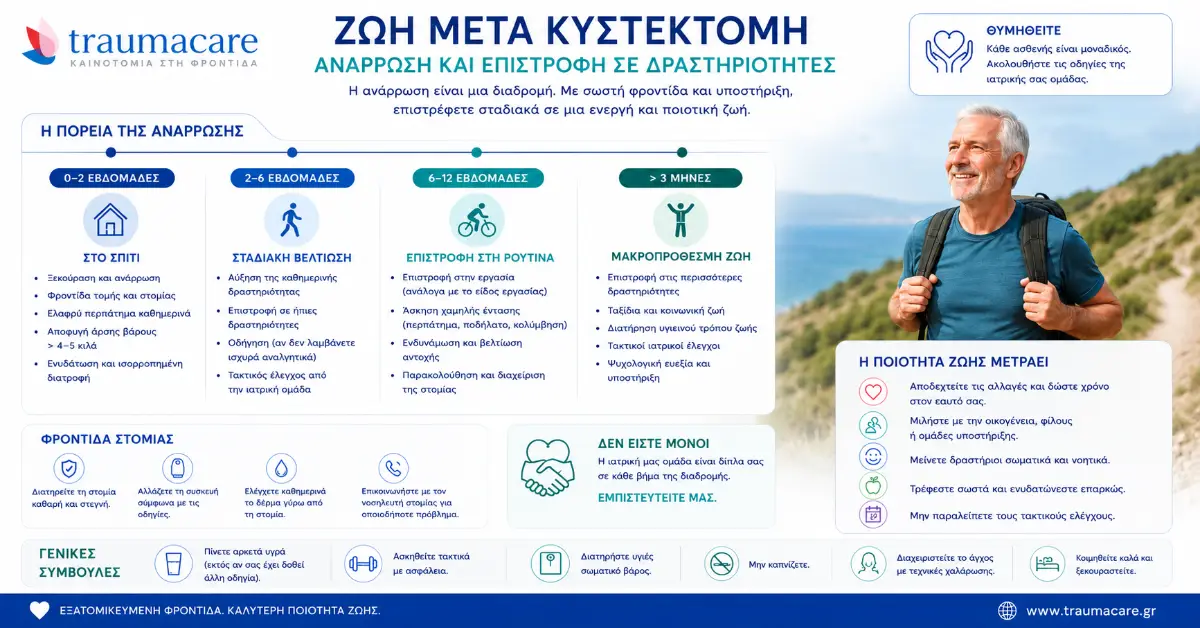
Life after cystectomy is NOT over — it is transformed
It is the thought most patients have before surgery: “What will my life be like with a bag?” . The truth is that the vast majority of patients return to a fully normal life — work, travel, exercise, sex — within 3-6 months [1] .
In this guide we prepare you month by month about what to expect, how to speed up your recovery, and when to seek support.
Month 1: Healing and adjustment
Weeks 1-2: First days at home
The first two weeks are the most psychologically demanding . The stoma is still swollen, movements are painful, and fear of changing the bag is normal.
- Pain management: Take pain medication as prescribed. Expect pain relief daily.
- Exercise: Short walks around the house, slow breathing exercises. NO heavy objects.
- Diet: Gradually return to normal diet. Plenty of fluids (1.5-2 liters/day).
- Pouch: Change every 3-5 days with B Braun Flexima Uro Silk Flat (larger size for enlarged stoma).
- Removal of ureteral stents: At 10-14 days in an outpatient setting.
Weeks 3-4: Stabilization
The stoma begins to shrink. Your confidence in changing the bag increases.
- Return to light walking outside (15-30 minutes)
- Return to showering (no bath yet)
- Psychological support: talk to your spouse, family, or counselor. Anxiety is normal but manageable.
Month 2: Return to routine
According to a systematic review in the World Journal of Urology [2] , at 6–8 weeks patients report a clear improvement in their quality of life.
- Office work: Return in 6-8 weeks (after medical approval)
- Driving: Allowed from the 4th-6th week when you are no longer taking strong painkillers
- Activities: Light walking, shopping, socializing, cooking
- Not yet allowed: Lifting more than 5 kg, swimming, intense exercise, sexual intercourse with high physical strain
Diet in the 2nd month
Your diet is free — there are no specific restrictions due to ileal conduit. Recommendations [3] :
- Fluids 2-2.5 liters/day — kidney protection, reduced risk of uroliths
- Vitamin C for acidic urine (reduces odor and microbial growth)
- Cranberry juice/pills — preventive for UTI (discuss with doctor)
- Avoid excessive asparagus/spicy foods (may change urine odor)
Month 3: Complete normal activity
At 3 months, the patient usually has full capacity for all normal activities. Statistically, according to the study by Stein et al. (1,054 patients) [4] :
- Over 85% return to work, leisure and social activities
- Over 75% regain sexual activity
- Over 90% rate their quality of life as “good” or “very good”
Sex life after cystectomy
This is perhaps the most feared topic — and one that your doctor may not have talked about enough. The truth [5] :
- In men: prostate removal affects erection. In most cases, medication (PDE5 inhibitors) or mechanical support is needed. Talk to a urologist from the 2nd month.
- In women: if the uterus/anterior vaginal wall was removed, dryness may occur. Available medications and techniques help significantly.
- Practical instructions: Use a bag retention belt, empty the bag beforehand, appropriate position. The wife/partner is informed together.
- Psychologically: It is an expected initial fear. Don't let it become avoidance — the familiarity returns.
Return to exercise
| Activity | When are you returning |
|---|---|
| Walking | From week 1, gradually increase |
| Cycling | Weeks 8-12 |
| Swimming | After the 4th week (if the stoma heals well) |
| Cardio gym | From the 2nd month |
| Weights / Military exercise | After 3 months, gradually (risk of parastomal hernia) |
| Sports contacts | With protection & always a discussion with a doctor |
Months 4-6: Complete normalcy
By six months, life has truly returned to normal. The bag becomes part of the routine, like brushing your teeth — you do it without thinking.
Travel — yes, you can
According to the guidelines of UOAA (United Ostomy Associations of America) [6] , urostomy patients can travel anywhere — with preparation:
- Get twice as much Flexima as you think you need
- Travel certificate from a doctor for systemics (airports, CT scanners)
- Water sterilization in exotic destinations (risk of UTI from bad water)
- Bag retention belt for flights and hot climates
Work and social life
Almost no one will notice that you have a bag. With the modern Flexima Uro Silk with midi beige cover, the profile is minimal and the bag is invisible under normal clothing.
Tips for social situations:
- Before events: Empty the bag. Check that it is securely fastened.
- Clothing: Wide-waisted or tight-fitting T-shirts hide it perfectly. Bandages over the stoma.
- What do you tell others: As much as you want. You don't have to explain. To close friends/colleagues, a simple "I had surgery and I'm fine" is enough.
When to contact a doctor
Seek immediate medical attention if you experience [7] :
- 🚨 Fever > 38°C with chills — possible pyelonephritis
- 🚨 Back/side pain new or severe
- 🚨 Blood in the urine (more than a small amount in the first few days)
- 🚨 Stoma changes color (blue, black, white — urgent control)
- 🚨 Continuous leaks or severe skin irritation
- 🚨 No urine output > 4 hours — possible obstruction
- 🚨 Parastomal hernia — visible swelling around the stoma
For more non-urgent issues (bag type change, skin irritation, general questions), contact Traumacare — our team answers on Traumacare Viber channel or by phone.
Psychological well-being — equally important
Post-cystectomy life can bring emotional challenges: body image concerns, anxiety about the future, depression after a cancer diagnosis. 15-25% of patients experience depression in the first six months [2] .
Support sources:
- Spouse/family: Talk openly. There is no shame in it.
- Patient groups: In Greece there are online groups and ostomy communities. Talk to people who have been through the same thing.
- Professional counseling: Psychologist specialized in oncology patients. No shame.
- Stoma nurse: Beyond the technical, she can support you emotionally.
Changing materials in the first 6 months — what to expect
The stoma changes shape in the first months. You will likely need different Flexima sizes:
| Stage | Flexima Recommendation |
|---|---|
| Weeks 1-6 (bulging) | Flexima Uro Silk Flat (larger size) |
| Months 2-3 (reduction) | Re-evaluate size or type (possible change to convex) |
| Months 4-6+ (stable) | Permanent system: Uro Silk Flat beige midi or Active O' Convex |
At Traumacare, as exclusive B Braun Avitum representatives in Greece , we offer free reassessment every 3-6 months to ensure that the product continues to suit you.
Contact for follow-up consultation
| ✉️ Contact form | 💬 Viber channel Traumacare ✓ |
Related articles
- Bricker / Ileal Conduit: the surgical procedure step by step
- Ureterostomy bag: which one to choose?
- How to change urostomy bag — steps
- Pillar: Complete guide to ureterostomy
Author: Traumacare Medical Group — exclusive representatives of B Braun Avitum in Greece
Scientific documentation: EAU Guidelines on Muscle-invasive Bladder Cancer (2024), Cookingham et al. World J Urol 2022, Stein JP et al. J Clin Oncol 2001, UOAA Urostomy Guide, Cancer Research UK Patient Information, BAUS Patient Information, WOCN Society Clinical Practice Guideline
Last updated: May 2026
Note: The article is informative and is based on statistics from large cohorts. Individual experiences vary. Always consult your healthcare provider for individual decisions and recovery timelines.
📚 Βιβλιογραφία / Επιστημονικές πηγές
- Cancer Research UK: Living with a urostomy . cancerresearchuk.org
- Cookingham LM et al. Health-related quality of life in patients with ileal conduit urinary diversion: a systematic review . World Journal of Urology , 2022. pubmed.ncbi.nlm.nih.gov
- BAUS — Information about Urinary Diversion (Ileal Conduit) . British Association of Urological Surgeons. baus.org.uk
- Stein JP et al. Radical cystectomy in the treatment of invasive bladder cancer: long-term results in 1,054 patients . Journal of Clinical Oncology , 2001;19(3):666-675. pubmed.ncbi.nlm.nih.gov
- EAU Guidelines on Muscle-invasive and Metastatic Bladder Cancer . European Association of Urology, 2024. uroweb.org/guidelines
- UOAA — United Ostomy Associations of America: Urostomy Guide . ostomy.org/urostomy
- WOCN Society: Clinical Practice Guideline for Urostomy Care . Wound, Ostomy and Continence Nurses Society. wocn.org
- Shabsigh A et al. Defining early morbidity of radical cystectomy for patients with bladder cancer . European Urology , 2009;55(1):164-176. pubmed.ncbi.nlm.nih.gov