



Carrying a nephrostomy doesn't mean you have to stop traveling. It just takes a little extra preparation and some simple precautions. This guide will help you travel safely — from a nearby town to a flight abroad.
If you don't know what a nephrostomy is or the overall care , start there.
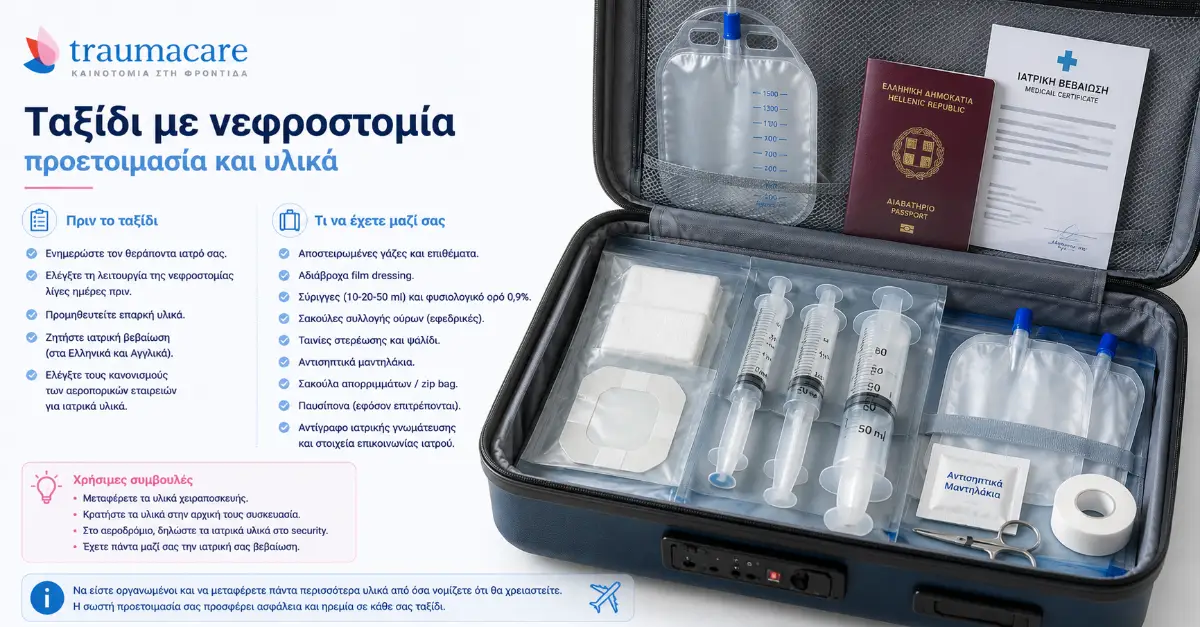
Before you go — preparation checklist
- Consult with your doctor 2-3 weeks in advance.
- Medical certificate in Greek and English (e.g., "Patient has a percutaneous nephrostomy. Carries medical supplies.").
- List of medications and supplies.
- Contact details of your urologist.
- Confirmation that your insurance covers emergencies abroad (European Health Insurance Card or private).
What materials to take
Always take twice as many as you estimate you will need:
- Urine collection bags (4-6 for a week of travel).
- Foot bags + overnight bag.
- Waterproof film dressings (3-5 pieces).
- Alcohol swabs, chlorhexidine antiseptics.
- Clean gloves.
- Plastic disposal bags.
- Stabilization stickers (StatLock or silk tape).
- Irrigation syringes (if trained).
- 0.9% saline solution in ampoules (allowed on airplanes with medical certificate).
Air travel
At security
Politely inform the employee before the scanner. Show the medical certificate. They will usually request a body search instead of a body scanner. Items (syringes, gauze, liquids) are allowed with medical documentation — place them in a clear bag in your carry-on.
In the cabin
Drink water regularly during the flight — the dryness in the cabin increases the risk of blockage. If possible, ask for a seat near a toilet. Empty the bag every 3 hours.
Cabin pressure
Changing cabin pressure does not affect the nephrostomy. If you notice the bag bulging, empty it.
At your destination
Accommodation
Check in advance if the accommodation has a shower (not just a bathtub), a fixed power outlet for charging your mobile phone (for emergency communication), and a refrigerator if needed for medication.
Local doctor
You have located the nearest urology center or hospital. In most European countries, the European Health Insurance Card covers emergencies.
Nutrition — Water
In countries with questionable water quality, drink only bottled water. Dehydration is the number 1 risk for clogging.
What to watch out for
- No swimming in the sea or pool — even on vacation.
- Be careful with sudden movements (e.g. taking out a suitcase).
- No intense sports activities (rafting, mountain biking on uneven terrain).
- Sun exposure — not directly at the exit point, use a shower to wash salt off the body.
What to do if something happens
If there is leakage, fever, pain, or accidental removal of the catheter — visit the nearest hospital. Show your medical certificate. In case of complete displacement, the new catheter can be placed by a local interventional radiologist until your return.
Before you return
Check your bag 24 hours before your return. If your urine is cloudy, there is leakage, or you feel feverish — contact your doctor in Greece and you probably won't need to change your flight.
| ✉️ Contact form | 💬 Viber channel Traumacare ✓ |
| See all nephrostomy products → |
Do you have any questions? Send a message
Our team will respond within 24 hours. As exclusive B Braun Avitum representatives, we can prepare a complete travel kit for you before you depart.
Contact form
Sources: TSA Medical Equipment Guidelines, European Health Insurance Card, Government Gazette B' 5395/2025. Informational article, not a substitute for medical advice.