



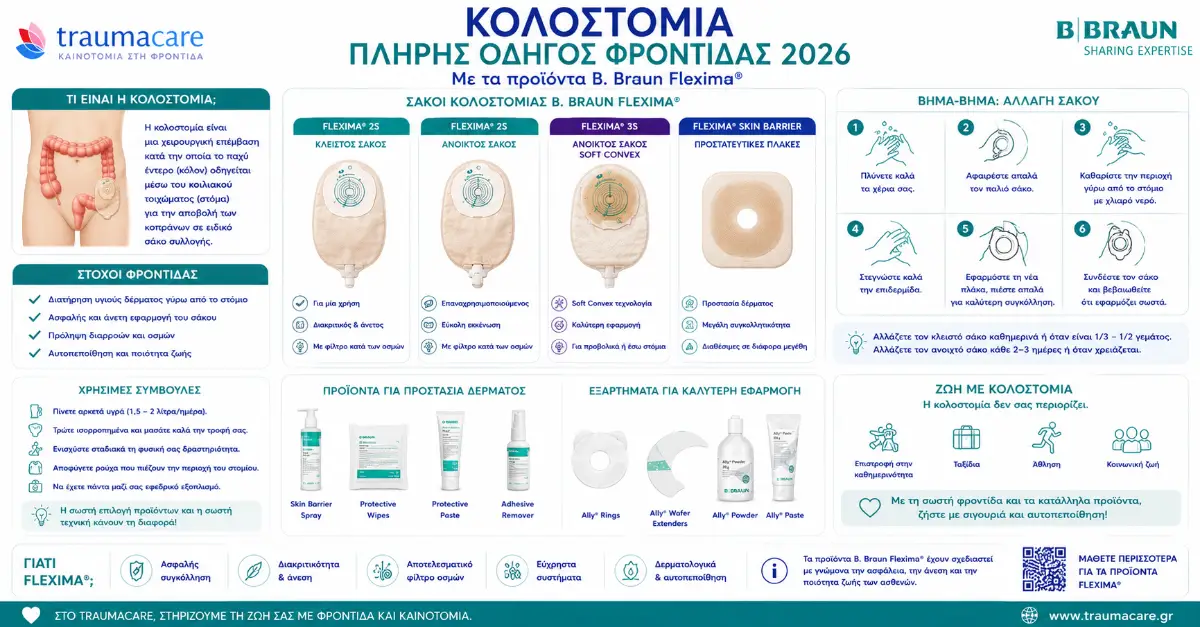
Colostomy: What you need to know before, during and after
You have been told that you will need a colostomy and you feel lost, scared, with thousands of questions in your mind? It is completely normal. In this complete guide 2026 you will find all the answers — from scientific documentation to practical everyday life — based on current international guidelines (ASCRS, ACPGBI, WCET) and our experience as exclusive B Braun Avitum representatives in Greece .
📑 Table of Contents
- What is a colostomy
- The 3 types of colostomy
- When is a colostomy done
- The surgical procedure
- Preparation before surgery
- The first days after discharge
- Choosing a bag — Decision Tree Flexima
- Common problems & solutions
- Diet with a colostomy
- Daily life — work, travel, relationships
- EOPYY coverage
- Why B Braun Flexima
1. What is a colostomy
A colostomy is a surgical procedure where a part of the large intestine is removed through the abdominal wall and creates a opening (stoma) — from which feces are collected in a special bag [1] .
It is one of the 3 major categories of digestive system stomas :
- Colostomy — from the large intestine (colon)
- Ileostomy — from the small intestine (ileum)
- Ureterostomy — from the urinary system (different category)
According to the According to data from the Hellenic Anti-Cancer Society, in Greece ~3,500-4,000 new colostomies are performed annually — the vast majority due to colon cancer, the 2nd most common cancer in the country.
Colostomy can be:
- Permanent — when the affected part of the bowel has been removed or the anus no longer functions
- Temporary — when the bowel needs to rest to heal (reversed in 3–12 months)
Good news: Modern colostomy care does not interfere with normal life . Over 85% of patients return to work, travel, exercise, and sex life [2] .
2. The 3 types of colostomy
Depending on the site of the colon used, we distinguish:
| Type | Characteristics | Stool consistency |
|---|---|---|
| Ascending | Right side of the abdomen. Rarer. | Liquid/watery |
| Transverse | Upper-mid abdomen. Often temporary. | Semi-formed |
| Descending/Sigmoid | Left lower abdomen. Most common type. | Shaped (regular) |
Why does the type matter? The type determines:
- How liquid the stool will be — so what kind of bag you need (closed for shaped, open/drainable for liquid)
- How often the bag will be filled
- The dietary adjustments
➡️ Read more about the 3 types of colostomy
3. When is a colostomy performed — Indications
According to the guidelines of the ASCRS (American Society of Colon and Rectal Surgeons) [3] , the main indications are:
- Colon or rectal cancer (~70% of cases)
- Inflammatory bowel disease (IBD) — Crohn's disease, ulcerative colitis
- Diverticulitis with complications (perforation, bleeding, stricture)
- Bowel injuries (traffic, puncture wounds)
- Congenital anomalies (Hirschsprung, pediatric)
- Severe fecal incontinence resistant to other treatments
- Radiation enteritis after pelvic radiotherapy
➡️ Complete analysis of all indications
4. The surgical procedure
Modern colostomy is mainly performed laparoscopically (through 4-5 small incisions) — with clear advantages over the open technique [4] :
- ✅ Less postoperative pain
- ✅ Faster recovery (hospitalization 4-7 days instead of 7-12)
- ✅ Lower risk of infection
- ✅ Better cosmetic result
- ✅ Fewer hernias (parastomal + abdominal) in the long term
The total duration of the surgery is 2-5 hours depending on the underlying Hospitalization 4-9 days with modern ERAS protocols.
➡️ Step-by-step procedure: from preparation to discharge
5. Preparation before surgery (2-4 weeks before)
According to ERAS protocols and the guidelines of ACPGBI (Association of Coloproctology of Great Britain and Ireland) [5] :
- Pre-operative staged check (CT scan, MRI, cardiological assessment)
- Smoking cessation — ideally 4 weeks before
- Stoma siting (stoma marking) by a specialized stoma nurse — before surgery
- Psychological preparation — discussion with spouse/family
- Selection of B Braun Flexima materials (free consultation from Traumacare) — we have all the consumables ready when you return home
- Bowel prep (bowel cleansing) 1-2 days before
6. The first days after discharge
The first 2 weeks are psychologically most demanding. What to expect:
- The stoma is swollen and will gradually shrink over the first 6-8 weeks
- Bag change every 2-4 days (more often initially)
- The first bowel movements may be watery — this will normalize
- Gradual resumption of normal diet (not all at once)
- Re-evaluate stoma size at 4-6 weeks (possible change of bag type)
➡️ Complete 6-month recovery guide
7. Bag Selection — Decision Tree B Braun Flexima
The right bag is the most important tool for your quality of life. The B Braun Flexima range offers a complete range for every patient profile [6] :
| Patient Profile | Flexima Recommendation |
|---|---|
| Active, young patient (discreet) | Flexima Active mini (1-piece, low profile) |
| Elderly, sensitive skin | Flexima Key (2-piece, gentle hydrocolloid) |
| Flat or retracted stoma (leakage) | Flexima Active O' Convex |
| Economical 5-day wear, fixed shape | Flexima 3S (2-piece guided) |
| Liquid stools / high output | Flexima Flat Drainable (empties without changing) |
| Skin folds / uneven surface | Flexima + Ally Paste (alcohol-free) |
| Parastomal hernia/sports | Flexima + Ally Belt (support) |
| Unusual stoma size | Flexima + Ally Rings (custom sizing) |
All Flexima Colo pouches come with standard :
- ✅ Activated carbon filter — controls odor and gases
- ✅ Premium hydrocolloid skin barrier — German made
- ✅ Discreet beige midi cover — invisible under clothes
- ✅ Soft fabric backing — breathable, anti-perspirant
| ✉️ Request a free sample | 💬 Viber Traumacare ✓ |
➡️ Complete bag selection guide with decision tree
8. Common problems & B Braun solutions
8.1 Bag leakage (Stoma Leakage)
The #1 problem of colostomy patients. According to studies by the Wound Ostomy and Continence Nurses (WOCN) Society [7] , rates > 30% report at least one leak/month.
Flexima Solution:
- Flexima Active O' Convex — convexity presses around stoma
- Ally Paste — fills folds, alcohol-free
- Ally Rings — custom sizing for irregular stomas
- Ally Belt — extra support
➡️ Read: 7 causes of leakage & solutions
8.2 Irritation & perioral dermatitis skin
~50% of patients experience skin problems at some point [8] : contact dermatitis, fungal infections, folliculitis.
Flexima Solution:
- Flexima Key — gentle hydrocolloid for sensitive skin
- Ally Paste — alcohol-free protection (no irritation)
- Correct technique: only lukewarm water + mild soap (no antiseptics)
➡️ Read: skin irritation — recognition & treatment
8.3 Parastomal hernia
Most common late complication — seen in ~38% of patients at 5 years and >50% long term [9] .
Flexima Solution:
- Ally Belt — daily support, reduces aggravation
- Flexima Convex — adapts to uneven surfaces
➡️ Read: parastomal hernia — prevention with Ally Belt
8.4 Odor & flatulence
The #1 psychosocial issue. The activated carbon filter incorporated into all Fleximas controls odor and gas.
➡️ Read: 8 practical solutions for odor
9. Colostomy diet
The diet is free — but some foods need attention [10] :
| Category | Examples |
|---|---|
| ✅ Safe | Lean meat, fish, eggs, yogurt, cheese, rice, potatoes, pasta, white bread, bananas |
| ⚠️ Caution — gas | Beans, cabbage, cauliflower, broccoli, onion, garlic, beer, carbonated drinks |
| ⚠️ Caution — odor | Asparagus, fish, eggs, garlic, spinach, coffee |
| ⚠️ Caution — blockage | Carrots, celery, corn, whole nuts, mushrooms, fruit with peel |
| 💧 Hydration | 1.5-2 liters of water/day — more at high output |
➡️ Complete nutritional guide with 30 foods
10. Daily life — work, travel, relationships
- Work: Return to office 6-8 weeks, heavy work 12+ weeks
- Exercise: Walking from week 1, cardio from month 2, weights after 3 months (always with Ally Belt)
- Swimming: From the 4th week — Flexima are waterproof
- Travel: Double Flexima stock, travel certificate from a doctor
- Sex life: Returns to 75%+ of patients after the first 3 months [2]
➡️ Read: exercise, travel & swimming with a colostomy
11. EOPYY Coverage
According to the Official Gazette B' 5395/09-10-2025 [11] , EOPYY covers:
- 270€/month colostomy materials
- 0% participation patient
- Bags, base plates, accessories (paste, rings, belts)
Procedure:
- Electronic opinion e-EOPYY from a surgeon/gastroenterologist
- Contact with Traumacare (name + AMKA)
- We take care of all the paperwork
- Express delivery next-day
12. Why B Braun Flexima & Traumacare
Traumacare is the exclusive representative of B Braun Avitum in Greece — and this means specific benefits for you:
| ✅ German manufacturing | B Braun Avitum — 180+ years of reliability in the medical sector |
| ✅ Full range | Active mini/midi/maxi, Key, 3S, Convex, Flat Drainable + Ally Paste/Rings/Belt |
| ✅ Activated carbon filter | Standard across the Flexima Colo range — no extra addition |
| ✅ Premium hydrocolloid | 3-5 days bonding, gentle on sensitive skin |
| ✅ Express delivery | Next-day delivery throughout Greece |
| ✅ Free consultation | Pre-op + follow-up + product changes |
| ✅ EOPYY Management | Full e-EOPYY processing — zero bureaucracy |
| ✅ Convatec Distribution | Complementary range when needed |
Start today — Free Flexima Sample
| ✉️ Contact form | 💬 Viber Traumacare ✓ |
Related articles — Cluster navigation
- #1C — What is a colostomy (3 types)
- #2C — When is a colostomy performed (indications)
- #3C — Colostomy procedure step-by-step
- #4C — Comparison: colostomy vs ileostomy vs ureterostomy
- #5C — Colostomy bag: which one to choose?
- #6C — Bag leakage: 7 causes & solutions
- #7C — Skin irritation: recognition & treatment
- #8C — Parastomal hernia with colostomy
- #9C — Odor & flatulence: 8 practical solutions
- #10C — Colostomy Diet: 30 Foods
- #11C — Life After Colostomy: 6 Month Guide
- #12C — Exercise, Travel & Swimming
Author: Traumacare Medical Group — exclusive representatives of B Braun Avitum in Greece
Scientific documentation: ASCRS Clinical Practice Guidelines (2024), ACPGBI Position Statement on Stoma Care, WCET International Standards, WOCN Society Clinical Practice Guidelines, Cochrane Database Systematic Reviews, Government Gazette B' 5395/09-10-2025
Last updated: May 2026
Note: The content is for informational purposes only and does not replace medical advice. Always consult your healthcare provider for individual decisions.
📚 Bibliography / Scientific sources
- ASCRS Clinical Practice Guidelines for the Surgical Care of Patients with Colostomy . American Society of Colon and Rectal Surgeons. fascrs.org
- Vonk-Klaassen SM et al. Ostomy-related problems and their impact on quality of life of colorectal cancer ostomates: a systematic review . Quality of Life Research , 2016. pubmed.ncbi.nlm.nih.gov
- ASCRS Practice Parameters for the Management of Colon Cancer . American Society of Colon and Rectal Surgeons, 2024. fascrs.org
- Buunen M et al. Survival after laparoscopic surgery versus open surgery for colon cancer: long-term outcome of a randomized clinical trial . Lancet Oncology , 2009. pubmed.ncbi.nlm.nih.gov
- ACPGBI Position Statement on Pre-operative Stoma Siting and Education . Association of Coloproctology of Great Britain and Ireland. acpgbi.org.uk
- B Braun Flexima Colostomy product specifications . B Braun Avitum. catalogs.bbraun.com
- WOCN Society Clinical Practice Guideline for Management of the Adult Patient with a Fecal or Urinary Ostomy . Wound, Ostomy and Continence Nurses Society. wocn.org
- Salvadalena G et al. Peristomal Skin Conditions: A Systematic Review . Journal of Wound Ostomy & Continence Nursing , 2020. pubmed.ncbi.nlm.nih.gov
- Antoniou SA et al. European Hernia Society guidelines on prevention and treatment of parastomal hernias . Hernia , 2018. pubmed.ncbi.nlm.nih.gov
- UOAA Diet & Nutrition Guide for People with Ostomies . United Ostomy Associations of America. ostomy.org
- ΦΕΚ Β' 5395/09-10-2025 — Specification of ostomy materials with EOPYY coverage . National Printing House. eopyy.gov.gr
- WCET International Ostomy Guidelines . World Council of Enterostomal Therapists. wcetn.org